
Reviewed · CADIZ & JEREZ TOURS
Jerez de la Frontera: Palacio Domecq Entrance Ticket
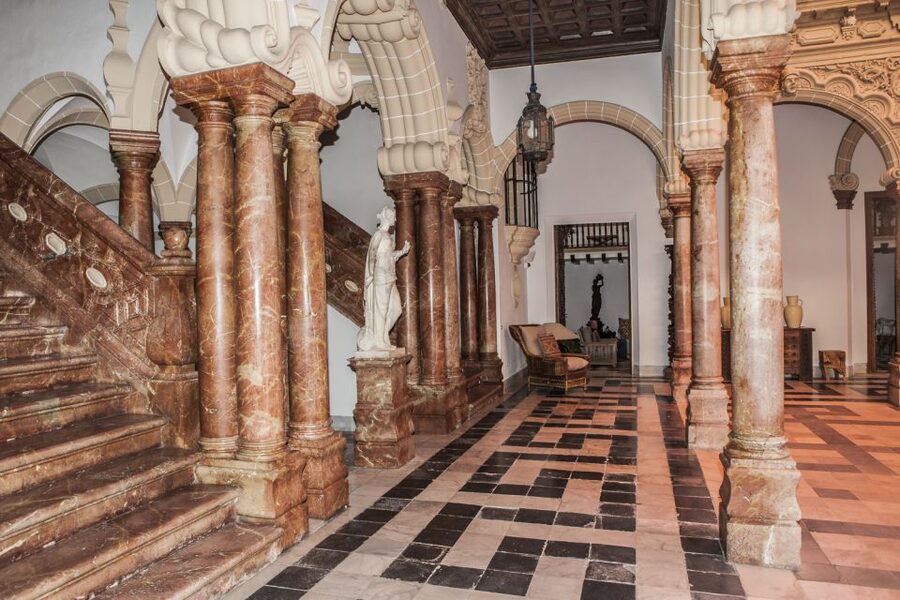
Jerez’s Palacio Domecq is less a grand royal residence than a finely preserved window into the city’s wine-making elite. Built in the latter half of the 18th century, this Andalusian-Baroque palace wraps its rooms around an Italian marble courtyard and opens toward broad views of Jerez.
I like the chance to see an authentic bourgeois home rather than another heavily staged monument, and I like the included audio guide, especially if you choose English. The paintings, tapestries, sculptures, and noble materials give the short visit plenty to look at.
The main drawback is the no-photography rule, which feels strict in a palace designed for visual details. At $17 per person, the ticket is reasonable if you care about architecture and Jerez’s wine families, but it may feel high for a 45-minute visit if you prefer a lively, human guide.
In This Review
- Key points
- Why Palacio Domecq matters in Jerez
- Entering the quadrangular palace
- Reading the palace as a bourgeois home
- Paintings, tapestries, and sculptures
- The audio guide: useful, but not for everyone
- The three-story facade and Jerez views
- What 45 minutes feels like
- Rules that affect your visit
- Wheelchair access and who should plan ahead
- Who will enjoy Palacio Domecq most
- Is the $17 ticket good value?
- Should you book Palacio Domecq?
- FAQ
- How long does the Palacio Domecq visit last?
- What is included with the ticket?
- Which languages are available for the audio guide?
- Where do I enter the palace?
- Can I take photographs inside?
- Can I bring food or drinks?
- Is Palacio Domecq wheelchair accessible?
- Do I need to bring identification?
- Can children enter the palace alone?
Key points
- An 18th-century wine family home: See how Jerez’s aristocracy and prosperous winemakers expressed status through architecture and decoration.
- A central Italian-marble courtyard: The quadrangular plan is organized around this elegant inner space.
- Audio commentary in three languages: Choose Spanish, English, or French for a self-guided visit.
- A short, focused experience: The visit lasts about 45 minutes, making it easy to fit into a day in Jerez.
- Strict museum rules: No indoor photography, food, drinks, large bags, pets, or touching the exhibits.
- Advance notice for wheelchair access: The palace is wheelchair accessible, but tickets must be bought at least 24 hours ahead for access arrangements.
Why Palacio Domecq matters in Jerez
Jerez is known around the world for its wine, but wine tourism can sometimes narrow a city’s story to cellars, barrels, and tastings. Palacio Domecq adds another layer. It shows the home life and public image of the families whose commercial success helped shape Jerez.
The palace is linked to one of Spain and Europe’s longest-established wine-making families. Inside, you see how business power became social power. The building was created for a well-off family in the second half of the 18th century, when Jerez’s aristocracy and prosperous wine merchants were putting their mark on the city.
That makes this visit useful even if you are not especially interested in wine. You are not simply looking at a pretty old house. You are seeing the setting in which an influential local family presented itself to the world.
More Cadiz & Jerez trips worth a second look
- Barcelona: Sagrada Familia Entry Ticket with Audio Guide
★ 4.6 · 105,312 reviews - Barcelona: Park Güell Admission Ticket
★ 4.4 · 76,534 reviews - Seville: Royal Alcázar Entry Ticket
★ 4.6 · 28,378 reviews
Entering the quadrangular palace
You begin at the main entrance of Palacio Domecq, where you show your ticket before entering. There is no complicated meeting arrangement, and the visit takes place inside the palace itself.
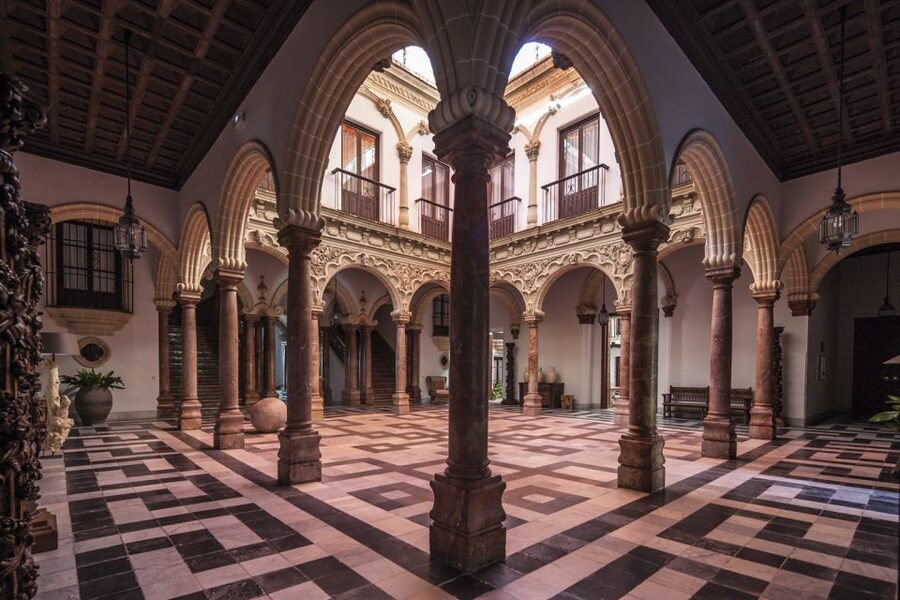
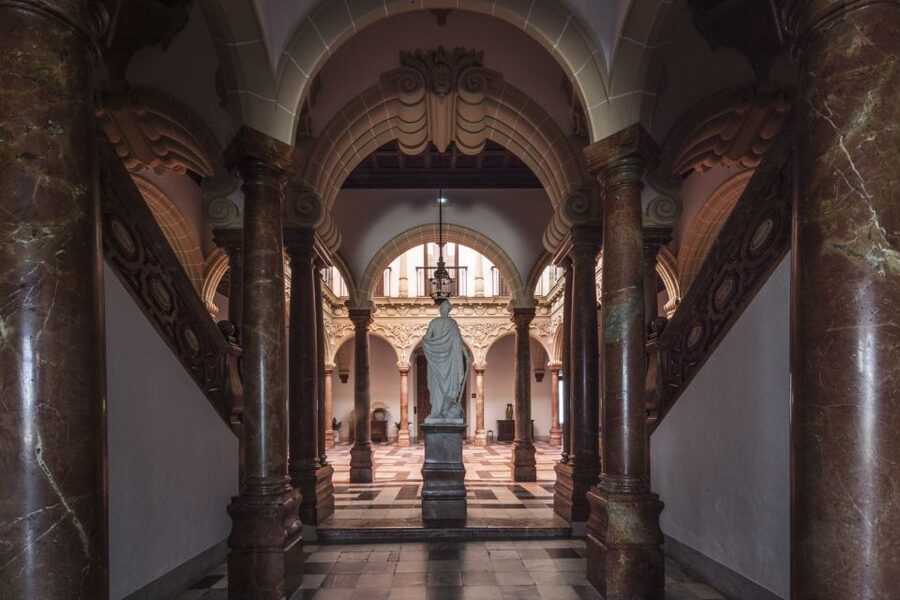
The building’s quadrangular plan gives the tour its structure. Rather than leading you through a random collection of rooms, the palace is organized around a large central courtyard. This arrangement is a classic feature of grand Andalusian houses, offering light, air, and a formal center for the home.
The Italian marble courtyard is likely to be your first strong visual impression. It gives the palace a cool, ordered feel and helps you understand the difference between a working home and a house built to display position. The courtyard is not just an attractive architectural feature. It is the organizing idea of the building.
Take a moment here before rushing to the next room. Look at how the interior spaces relate to the open center, and notice how the palace makes a private residence feel almost ceremonial.
Reading the palace as a bourgeois home
Palacio Domecq is described as a typical Jerez bourgeois house from the latter half of the 18th century. That phrase is important. You are not visiting a royal palace with a national political story. You are seeing the home of a powerful local family whose wealth came from trade and wine.
The architecture reflects that position. The house is ornate, but its meaning is grounded in Jerez. This is the sort of building that helps explain how a city’s leading commercial families lived, entertained, and displayed their success.
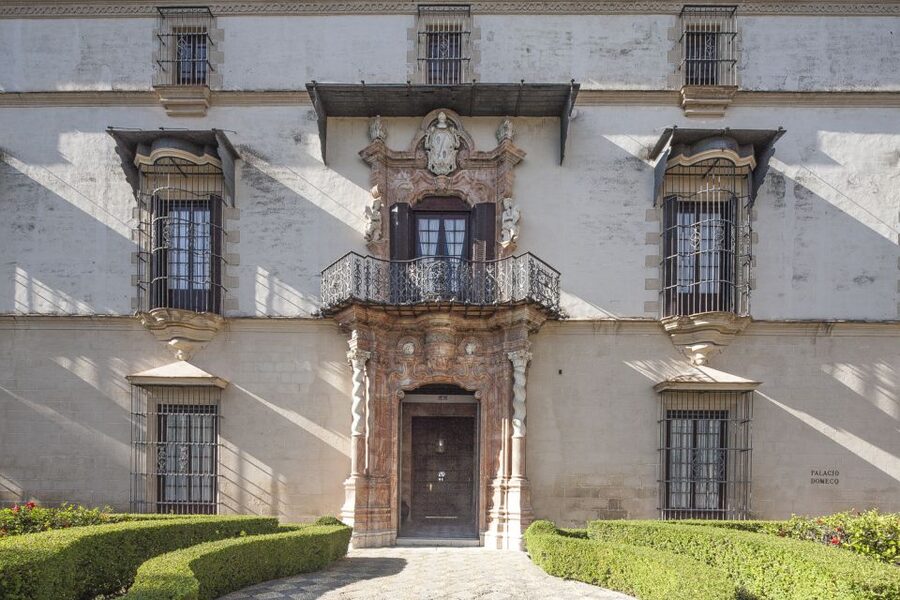
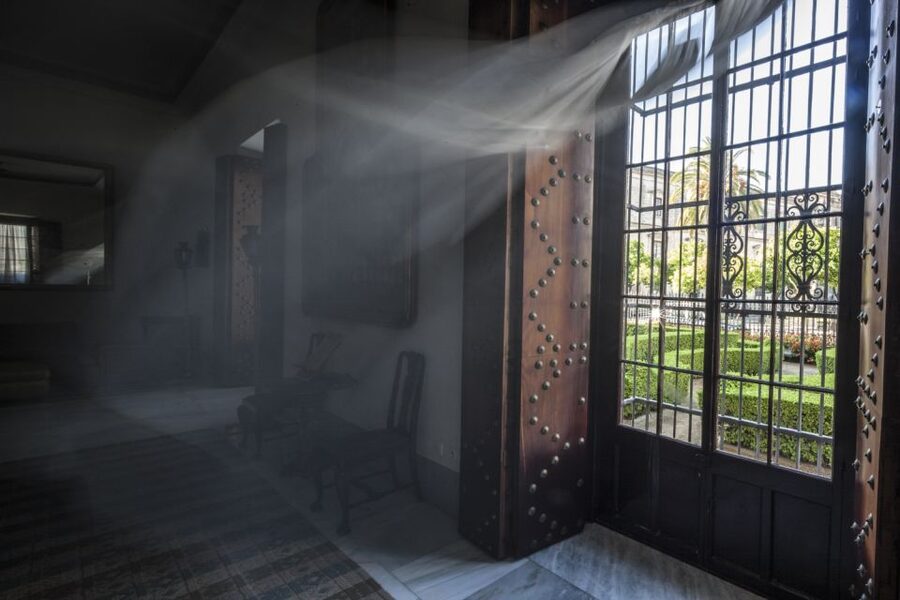
The facade rises three stories and includes majestic balconies. Those balconies are both decorative and practical, giving the building a strong public face while offering views across Jerez. From this high position, you get one of the palace’s best rewards: a different sense of the city beyond the monument itself.
I would pay attention to the contrast between the formal exterior and the central courtyard. From the street, the palace presents an imposing image. Inside, the courtyard brings the plan together and gives the residence a calmer rhythm.
Paintings, tapestries, and sculptures
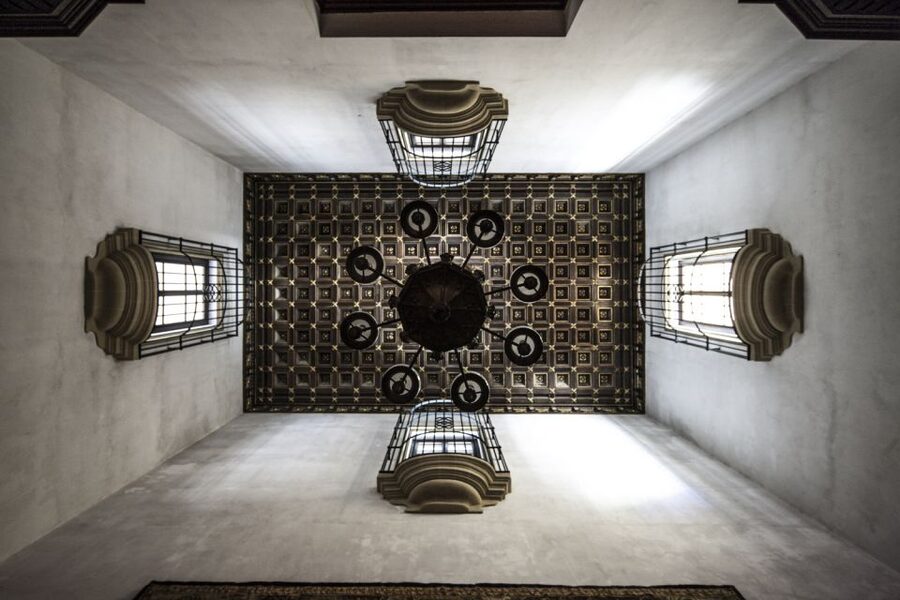
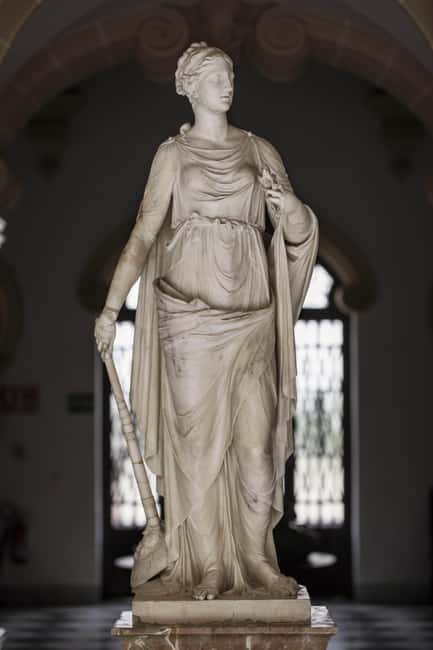
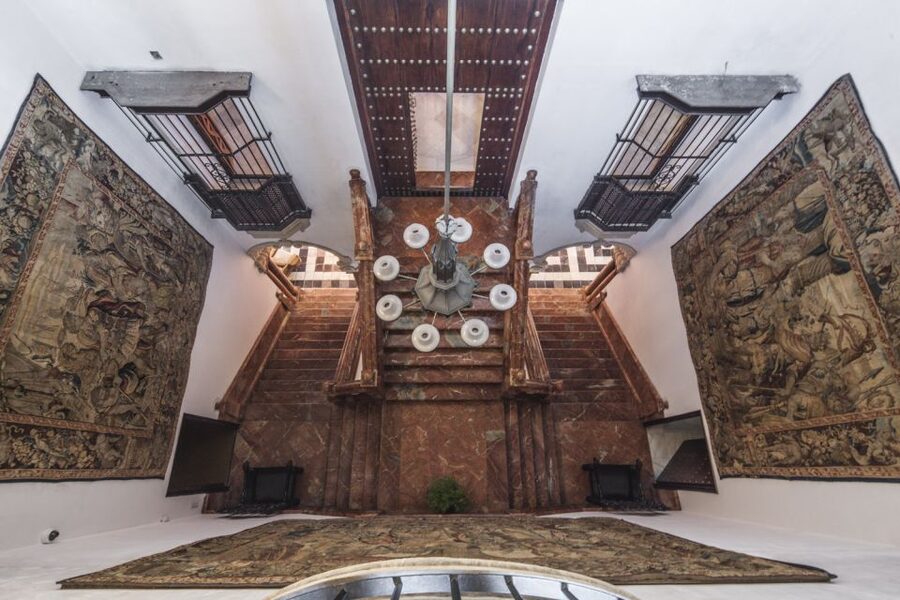
The palace interior includes paintings, tapestries, sculptures, and fine building materials. The collection is not presented as a separate art museum. Instead, these objects are part of the house and help show how its residents furnished an important home.
That setting matters. A painting in a palace room tells you something different from a painting on a gallery wall. Here, the works contribute to the atmosphere of status and refinement that the family wanted to create.
The tapestries are especially useful for understanding the decorative style of the residence. Along with the sculptures and architectural details, they make the rooms feel layered rather than bare. You can spend your time looking at individual objects, or step back and consider how everything works together as a statement about wealth.
Since photography is forbidden inside, you will need to look carefully while you are there. I find that rule frustrating in a building with so many details, especially when a quick photograph would help you remember the layout. Still, it does push you to slow down and pay attention rather than viewing the palace through a phone screen.
You must also avoid touching the exhibits. Food and drinks are not allowed, and noise is restricted. These rules make the visit quieter and more controlled, which suits the character of the house, but families with young children should know that this is not a loose, hands-on attraction.
A different way to spend the day, same corner of Spain:
- Jerez de la Frontera: Andalusian Horse Dance and Museums
★ 4.7 · 1,289 reviews - Jerez: Yeguada de la Cartuja Carthusian Horses Tour
★ 4.8 · 970 reviews - Jerez: Royal Andalusian School of Equestrian Art Admission
★ 4.6 · 882 reviews - Tarifa: Whale & Dolphin Watching in the Strait of Gibraltar
★ 4.7 · 835 reviews
The audio guide: useful, but not for everyone
An audio guide is included with the ticket, in Spanish, English, and French. For many people, this is the main source of context during the 45-minute visit.
The English commentary can make the architecture easier to understand, particularly if you do not already know how Jerez’s wine trade shaped the city. One English-language visitor specifically found the commentary through the earphones good, so I would choose the audio option if you want more than a silent walk through the rooms.
The format is not universally appealing. One Spanish-speaking visitor found the audio-guide system dull and felt it took away some of the palace’s possible charm. That criticism is worth taking seriously. Audio guides give you information at a steady pace, but they cannot respond to questions or adjust their tone to your interests.
If you enjoy moving independently, the guide lets you take in the palace without being tied to a group. If you prefer a guide who tells stories, points out small details, and adds personality, the experience may feel formal and quiet.
The available languages are Spanish, English, and French. No guide names are provided, and the experience is not described as a live guided tour.
The three-story facade and Jerez views
Do not treat the balconies and facade as background decoration. They are one of the clearest signs of the family’s social position.
A three-story facade with imposing balconies gives Palacio Domecq a strong presence in the city. It announces that this was a serious household, connected to commerce and local influence. The balconies also provide some of the best views of Jerez, giving you a chance to connect the palace with the city it helped define.
The view is not presented as a separate lookout attraction, so I would keep expectations sensible. The palace’s main purpose is architectural and historical, not panoramic sightseeing. Still, the upper facade and balconies help you understand the building’s relationship with the streets around it.
This is one reason I would place the palace visit alongside a broader walk through Jerez rather than treating it as a full afternoon activity. After seeing the family’s home, you can better appreciate the city’s wine-making identity and the scale of the local houses built by successful merchants.
What 45 minutes feels like
The listed duration is 45 minutes. That is long enough to examine the key rooms, courtyard, decorative features, and audio commentary without turning the palace into an all-day commitment.
I see the short length as an advantage for most itineraries. Jerez has enough sights to keep you busy, and a compact palace visit can fit neatly between other plans. It is also a good choice when you want an indoor stop during the hottest part of the day.
The same timing can make the price feel less comfortable. At $17 per person, you are paying for a focused heritage visit rather than a large complex with hours of exhibits. One supplied booking comment referred to a price of €25 for an audio-guided visit, which shows how important it is to check the exact price and currency at the time you book.
My advice is simple: book if you value the house itself. The price makes more sense when you are paying for access to a distinctive Jerez palace, its architecture, and its connection to the Domecq wine family. If you mainly want a long guided story or a place where you can take photographs, the value is weaker.
Rules that affect your visit
The palace has several restrictions that are easy to overlook. You cannot bring baby strollers, luggage, or large bags inside. Pets are not allowed, although assistance dogs are permitted.
Smoking, alcohol, drugs, food, and drinks are also prohibited. You cannot touch the exhibits, make excessive noise, or take photographs indoors. Unaccompanied minors are not permitted.
The photography rule deserves special attention. If you collect images of every historic interior, this visit may frustrate you. You will need to rely on memory and the palace’s visual impact rather than documenting every room.
Bring your passport or ID card. You show your ticket at the main entrance, and this identification requirement is worth remembering even for a short local attraction.
Wheelchair access and who should plan ahead
The palace is wheelchair accessible, but there is an important condition. For wheelchair access, tickets must be purchased at least 24 hours in advance because of logistical arrangements.
That means you should not assume a same-day ticket will work for an accessible visit. Contact or book ahead with this need clearly in mind. The available information does not provide further detail about the route, lifts, or accessible facilities, so you should confirm any specific requirements before paying.
The experience is listed as not suitable for people with visual impairments or hearing impairments. That matters because the visit depends heavily on seeing the interiors and using audio commentary. If you have a particular access need, ask the provider for clarification before booking.
Who will enjoy Palacio Domecq most
I would recommend this palace to you if you like historic houses, decorative arts, architecture, or the social story behind Jerez’s wine industry. It is also a good fit if you want a short, calm indoor visit with a clear beginning and end.
The palace works particularly well for:
- Architecture fans interested in Andalusian Baroque design
- People curious about Jerez’s wine-making families
- Independent visitors who prefer an audio guide
- Anyone with a spare 45 minutes in the city
- English, Spanish, or French speakers who want commentary in one of those languages
I would be more cautious if you want a live guide, lots of photographs, or a hands-on family attraction. The no-photo policy and quiet museum rules limit the experience for some children, and the audio format can feel dry if you prefer storytelling.
The palace is also not the best choice if you expect a huge royal complex. Its appeal comes from its character as a grand urban home, not from sheer size.
Is the $17 ticket good value?
At $17, the ticket sits in the range where expectations matter. You are paying for 45 minutes of access, an audio guide, and a look inside one of Jerez’s distinctive historic residences.
I consider that fair when you care about the palace’s specific story. There is no other palace in the city with the same stated combination of Andalusian-Baroque design, central Italian-marble courtyard, three-story facade, and connection to a major wine family. Those details give the visit a clear identity.
The value is less convincing if you judge attractions by time alone. A 45-minute audio-guided visit can feel expensive, particularly if you find the commentary boring or are unable to take photographs. One booking experience rated the building highly but still felt the price was too high for the length and format.
I would not buy this ticket as a random add-on. I would choose it because Palacio Domecq fills a particular gap in a Jerez visit: it lets you see the polished home behind the city’s commercial and wine-making power.
Should you book Palacio Domecq?
Book Palacio Domecq if you want a close look at an 18th-century Jerez residence and appreciate the connection between architecture, social status, and wine commerce. The Italian marble courtyard, decorative interiors, balconies, and included English audio guide give the visit real substance.
Skip it if indoor photography is essential, you dislike audio guides, or you want a longer, more personal guided experience. Also plan ahead if you need wheelchair access, and remember that the ticket is non-refundable.
For the right visitor, this is a neat and focused stop that adds context to Jerez beyond the tasting room. For everyone else, the short duration and strict rules may make $17 feel like a lot for a palace you cannot photograph.
FAQ
How long does the Palacio Domecq visit last?
The visit lasts 45 minutes. You should allow enough time to enter, use the audio guide, and examine the courtyard, rooms, decorations, and views.
What is included with the ticket?
The ticket includes entrance to Palacio Domecq and an audio guide.
Which languages are available for the audio guide?
The audio guide is available in Spanish, English, and French.
Where do I enter the palace?
Go to the main entrance of Palacio Domecq and show your ticket to access the palace.
Can I take photographs inside?
No. Photography inside the palace is not allowed.
Can I bring food or drinks?
No. Food and drinks are not permitted inside, and alcohol and drugs are also prohibited.
Is Palacio Domecq wheelchair accessible?
Yes, the palace is wheelchair accessible. For wheelchair access, you must purchase your ticket at least 24 hours in advance because of logistical arrangements.
Do I need to bring identification?
Yes. You should bring your passport or ID card.
Can children enter the palace alone?
No. Unaccompanied minors are not allowed.
Recently reviewed around Cadiz & Jerez
- Cadiz Food Tour: Tapas, Drinks and Delights with a Local★ 5.0 · 174 reviews
- Walking Tour through Cádiz: Stories from the hand of a local guide★ 5.0 · 532 reviews
- City Sightseeing Cadiz Hop-On Hop-Off Bus Tour★ 3.5 · 163 reviews
- Cadiz Small Group Bike Tour★ 4.5 · 215 reviews
- Cadiz Shore Excursion: City Sightseeing Cadiz Hop-On Hop-Off Bus Tour★ 4.0 · 124 reviews
- Andalusian Horses Dance Show★ 4.5 · 483 reviews
- Jerez: Traditional Tapas Tour★ 4.6 · 138 reviews
- Sancti Petri: Sunset Catamaran Cruise★ 4.5 · 277 reviews
Cadiz & Jerez Tours, compared.

Jerez de la Frontera: Andalusian Horse Dance and Museums
Read our review →

Royal Andalusian School of Equestrian Art Admission
Read our review →
Tarifa: Whale & Dolphin Watching in the Strait of Gibraltar
Read our review →
Bodegas Fundador Guided Tour with Tasting Session
Read our review →
Walking Tour through Cádiz: Stories from the hand of a local guide
Read our review →Browse the lists this tour appears in