
Reviewed · HORSES
Andalusian Horses Dance Show
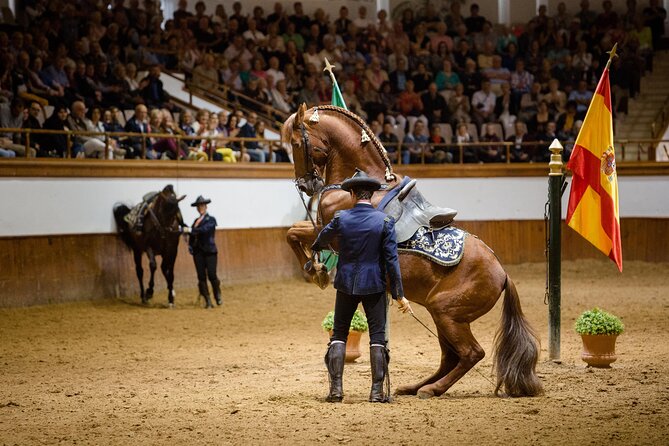
The most striking part of the Andalusian Horses Dance Show is the control. Horses and riders move through dressage exercises, carriage work, and traditional cattle-herding techniques with a calm precision that feels closer to ballet than a rodeo. The setting is Jerez, the city most closely linked with Andalusian horse culture.
I like the variety, since you are not watching the same movement for 90 minutes. I also like that the show gives you a direct look at traditional Spanish riding, from one-handed doma vaquera to formal Haute École exercises performed on the ground. The main drawback is seating: tickets are sold by price category, not by chosen row or seat, and some positions may have a restricted view.
In This Review
- Key points to know before you go
- What the Andalusian Horses Dance Show is really like
- Doma vaquera: riding shaped by cattle work
- Classical dressage with music and precision
- Carriage driving adds a different kind of spectacle
- Work in hand and Haute École exercises
- The carrousel brings the show together
- The Royal Andalusian School and what to see nearby
- Getting there from Cádiz, Seville, or a cruise port
- Seats, ticket collection, and summer comfort
- Is $33.43 a fair price?
- Who should book this show?
- Should you book the Andalusian Horses Dance Show?
- FAQ
- Where does the Andalusian Horses Dance Show take place?
- What time does the show start?
- How long does the performance last?
- What riding styles are included?
- Can I choose my exact seat?
- Do I need to bring a printed ticket or receipt?
- Can I take photographs or record the show?
Key points to know before you go
- Six to eight choreographies: The program may include classical dressage, carriage driving, work in hand, doma vaquera, and the final carrousel.
- A genuine Jerez tradition: The performance takes place at the Royal Andalusian School of Equestrian Art, not at a temporary tourist arena.
- Seats are assigned by booking order: You cannot select a particular row or seat number when purchasing.
- Plan for Spanish-only explanations: The riding is easy to follow visually, but spoken introductions may not be available in English.
- Arrive early in warm weather: The grounds and arena can feel hot in summer, and the warm-up area is worth seeing if open.
- Carry the right ticket paperwork: You must present a printed receipt at the ticket office, especially if you bought a discounted ticket.
What the Andalusian Horses Dance Show is really like
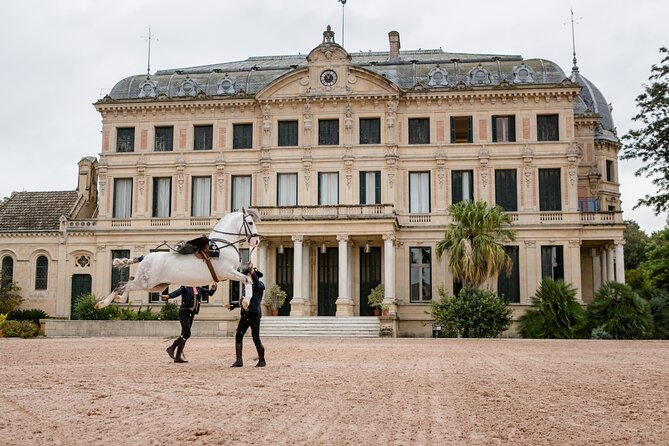
This is not a quick photo stop with a few trained horses. It is a formal 90-minute performance built around the riding traditions of Andalusia. Depending on the day, the school selects six to eight choreographies from its established program.
That changing schedule matters. You know the general style of the performance, but you may not see every listed exercise in one show. The school keeps the difficulty and entertainment value consistent while varying the exact combination of acts.
The horses perform to classical music, and the riders work with strikingly small movements. Much of the pleasure comes from watching the communication between horse and rider. You may find yourself focusing less on the dramatic jumps and more on the nearly invisible cues that guide a turn, change of pace, or carefully timed step.
The show is suitable for families, horse lovers, and anyone curious about Spanish culture. You do not need a technical understanding of dressage to enjoy it. Still, a little background helps you appreciate why the exercises are difficult and why the separate sections feel so different.
More Cadiz & Jerez trips worth a second look
- Jerez de la Frontera: Andalusian Horse Dance and Museums
★ 4.7 · 1,289 reviews - Jerez: Yeguada de la Cartuja Carthusian Horses Tour
★ 4.8 · 970 reviews - Cadiz: Andalusian Horses and Bulls Country Show
★ 4.6 · 189 reviews
Doma vaquera: riding shaped by cattle work
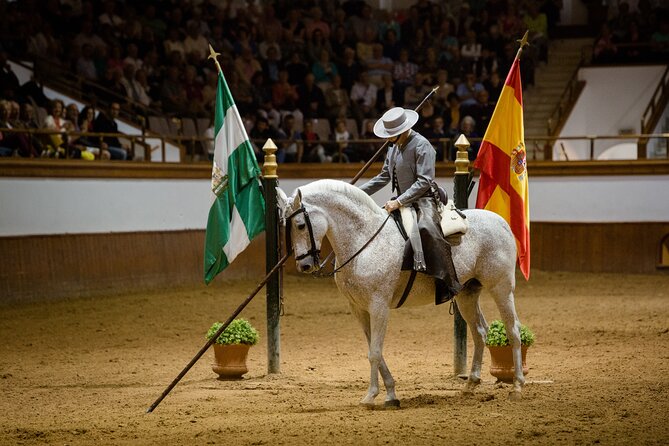
Doma vaquera is one of the most distinctly Andalusian parts of the program. This style grew from the practical skills used by traditional cattle herders. The rider guides the horse around the arena, often using one hand, while changing rhythm from a trot to a gallop.
The performance can include pirouettes and arreones, in which the horse breaks sharply into a gallop. It is a useful contrast to the polished calm of classical dressage. Here, the movement looks more functional and closely tied to work in the countryside.
I find this section especially valuable because it connects the show to everyday riding traditions rather than treating the horse as a purely decorative performer. You see how speed, balance, and quick changes of direction would matter when handling cattle.
The action can be less easy to read from a poor seat, so this is one reason to care about your position in the arena. A restricted view may hide part of a turn or make it harder to see the rider’s hand position.
Classical dressage with music and precision
Classical dressage is the heart of the performance. The school’s repertoire includes pieces known as The Colts, Airs on Horseback, Pas de Deux, Passage and Piaffe, Domino on Horseback, Airs above the Ground, and Fantasy.
You do not need to memorize these names, but they describe a range of demanding exercises. Passage and piaffe involve controlled, elevated steps in place or at a very collected pace. A pas de deux pairs horses and riders so their movements work together. Airs above the ground introduce more dramatic leaps and jumps.
The music gives the section its theatrical quality. Horses move through advanced exercises while the orchestra recordings provide rhythm and mood. At its best, the effect is graceful without becoming sugary. You see athletic ability, but also restraint.
The horses are trained to respond with impressive accuracy. Their movements may look effortless, though the difficulty is in maintaining balance, timing, and posture while following the rider’s quiet signals. If you enjoy ballet or classical music, you will probably find this portion especially appealing, even if you have never attended a dressage event.
One practical limitation is the language. Announcements and explanations may be made in Spanish only. You can still understand the broad action from the arena, but you may miss the background behind each exercise.
Carriage driving adds a different kind of spectacle
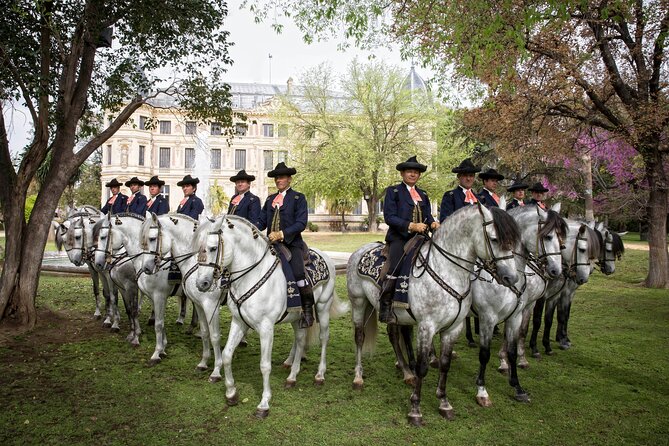
The carriage-driving section breaks up the close, precise work of the mounted horses. Here, horses draw carriages using classical harnesses, while coachmen guide them through the arena.
The old carriages were once used for transport. In this setting, they are part of an equestrian display, and the skill lies in managing several moving elements at once: horses, harness, carriage, pace, and direction.
This act has a slower, more formal rhythm than the galloping portions. It also gives you a chance to study the harness and the coachmen’s handling. The combination of polished vehicles and disciplined horses makes the section feel tied to an older style of public ceremony.
If you are bringing children, this variety helps hold attention. The show does not ask you to watch one type of dressage for the full 90 minutes. The carriage work provides a clear change in scale and movement.
A different way to spend the day, same corner of Spain:
- Jerez: Royal Andalusian School of Equestrian Art Admission
★ 4.6 · 882 reviews - Tarifa: Whale & Dolphin Watching in the Strait of Gibraltar
★ 4.7 · 835 reviews - Cadiz: City Sightseeing Hop-On Hop-Off Bus Tour
★ 4.1 · 753 reviews - Jerez: Bodegas Fundador Guided Tour with Tasting Session
★ 4.8 · 714 reviews
Work in hand and Haute École exercises
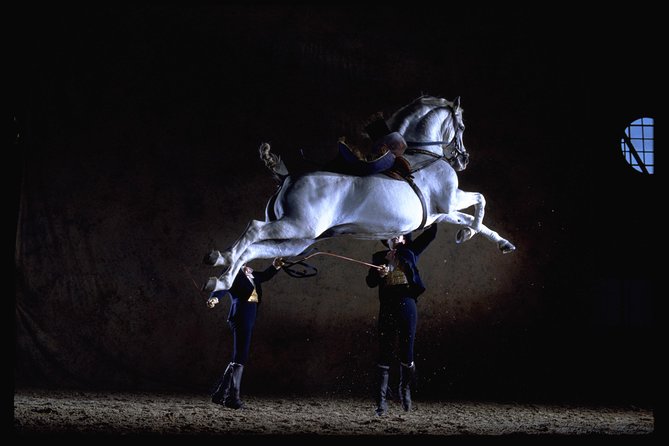
Work in hand shows that the horse can respond even when the rider is not seated. The horseman gives commands from the ground, guiding the horse through classical Haute École exercises.
The listed repertoire includes levades, caprioles, courbettes, piaffe between pillars, the Spanish walk, and work with long reins. Some of these movements are highly controlled steps. Others involve jumps or raised forequarters, creating the most acrobatic moments of the performance.
This section can be surprising if you have never seen formal dressage before. The horse appears to act independently, but the rider is still directing each movement. Watch the position of the handler and the horse’s response rather than waiting only for the biggest jump.
A good seat matters here too. Ground-level work may be partly hidden if someone or something blocks your sightline. Since you cannot choose a specific seat number, it is worth arriving with realistic expectations about your ticket category.
The carrousel brings the show together
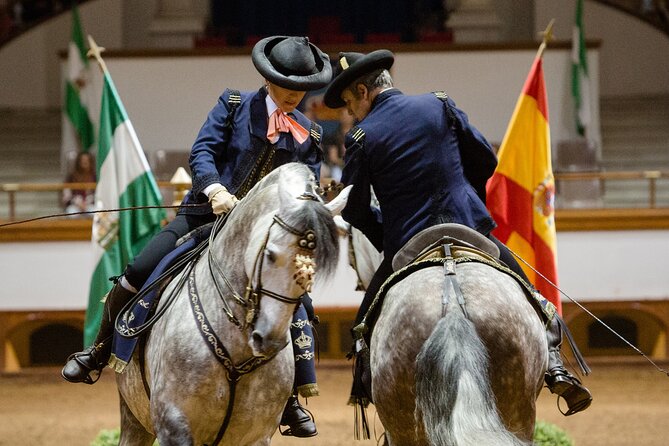
The carrousel is designed as the finale. A group of horses and riders works in unison, performing advanced exercises in the center of the arena.
This closing sequence is less about one horse’s individual trick and more about coordination. Several riders must maintain spacing, timing, and direction while the horses respond to their cues. The visual effect grows as the separate performances become one organized pattern.
I like this ending because it gives the show a clear shape. You begin with individual riding traditions and finish with a collective display. It is a fitting final section for a school that places such weight on control and formal presentation.
The full performance lasts about one hour and 30 minutes. That is long enough to feel like a proper outing, but short enough for most families to stay engaged. The program can change, so do not treat the published list as a promise that every named choreography will appear.
The Royal Andalusian School and what to see nearby
Your ticket is for the show at the Fundacion Real Escuela Andaluza del Arte Ecuestre in Jerez de la Frontera. The performance begins at 12:00 pm, and you should allow extra time to find the correct entrance and collect your ticket.
The grounds themselves are part of the appeal. One useful tip is to arrive 30 to 45 minutes early if your schedule allows. You may be able to watch horses and riders in a warm-up area before the show, and the site has a cafe and shop.
The show ends close to Jerez’s historic center, cafes, and other city sights. This makes it easy to combine the performance with a meal or an afternoon of exploring. It is also a sensible stop if you are already visiting Jerez as part of a wider Cádiz-area trip.
Do not confuse Jerez de la Frontera with another town when planning your train journey. One booking problem came from getting off at the wrong station because two towns appeared in the travel information. Check the exact destination before you leave.
Getting there from Cádiz, Seville, or a cruise port
The school is located at Av. Duque de Abrantes, s/n, 11407 Jerez de la Frontera. It is near public transportation, and you can reach Jerez independently from Cádiz or Seville by train, but you are responsible for arranging that transportation.
From a cruise port, a taxi can become expensive. A ride may take roughly 30 to 40 minutes, depending on the port and traffic, and agreeing on the full price before departure is wise. Do not assume that having a taxi wait for you will cost the same as the initial ride.
If you drive, parking is available nearby, but finding the right place can take patience. People may signal you toward parking and then ask for payment. Confirm whether a space is genuinely paid before handing over money, since free parking may be available close to the venue.
The start time is fixed, so build in a buffer. A late arrival is more stressful when you still need to redeem a voucher and find your seat.
Seats, ticket collection, and summer comfort
This is the most important practical issue. Tickets are sold by category, with row and seat numbers assigned according to the order of purchase or booking. You do not get to select your precise seat.
That system can work well if you book early, but it does not guarantee the best view. Some positions may have a restricted sightline, and a blocked section of the arena can spoil an otherwise excellent show. Booking around 31 days ahead is common for this experience, so planning early may improve your odds, though it still does not let you choose a particular chair.
When you arrive, present your printed receipt at the ticket office. If you purchased a discounted ticket, bring proof that you qualify. Without the required document, you may have to pay the difference to the full standard price, if full-price tickets are still available.
The arena can get warm during summer performances. I would bring a fan, water for before or after the performance, and light clothing, while remembering that bottles and cans are not allowed inside the grounds. Management can refuse other objects it considers unsuitable.
Photography, filming, and recording are prohibited unless you are an authorized professional. This is easy to forget in a visually striking show, so put the camera away and watch the riders directly.
Is $33.43 a fair price?
At about $33.43 per person, this is not the cheapest activity in Andalusia, but the price covers a full 90-minute performance at a major equestrian school. You are paying for a formal production with trained horses, riders, music, costumes, several riding disciplines, and a purpose-built venue.
The value is strongest if you already plan to visit Jerez. You can pair the show with lunch, city sights, or a wider visit to the Cádiz region without building an entire day around one short activity.
The value is less clear if you have little interest in horses, dressage, or staged cultural performances. The show is accessible, but it is still centered on equestrian technique. If you want a more casual animal encounter, this is not that kind of outing.
I would also factor in transport. A low ticket price can lose its appeal if you need an expensive taxi from a cruise port or make a costly mistake at the wrong train stop. Independent train travel from Seville or Cádiz can make the overall day easier to control, but you need to plan the route yourself.
Who should book this show?
I would recommend it most strongly to:
- Horse lovers and anyone curious about dressage
- Families looking for a polished cultural activity
- Visitors staying in Cádiz who want a worthwhile trip to Jerez
- People who enjoy classical music, ballet, or careful athletic performance
- First-time visitors seeking a clear taste of Andalusian riding traditions
You should think twice if you dislike formal performances, cannot tolerate warm indoor conditions, or need guaranteed seat selection. The Spanish-only narration may also matter if you want detailed spoken explanations rather than a mostly visual show.
The performance is generally suitable for most people, and public transportation is nearby. The provider offers free cancellation when you cancel at least 24 hours before the local start time. Changes or cancellations made inside that window are not accepted for a refund.
Should you book the Andalusian Horses Dance Show?
Yes, if you want to see a refined and distinctly Andalusian performance rather than a generic tourist attraction. The strongest parts are the variety of riding styles, the precision of the horses and riders, and the chance to see doma vaquera, carriage driving, work in hand, and classical dressage in one place.
Book early, arrive well before noon, confirm your Jerez train stop, and do not count on choosing a particular seat. If you handle those details, the show offers a memorable way to connect a visit to Jerez with the region’s living riding traditions.
FAQ
Where does the Andalusian Horses Dance Show take place?
The show takes place at the Royal Andalusian School of Equestrian Art, Av. Duque de Abrantes, s/n, 11407 Jerez de la Frontera, Cádiz, Spain.
What time does the show start?
The stated start time is 12:00 pm.
How long does the performance last?
The performance lasts approximately one hour and 30 minutes.
What riding styles are included?
The program can include doma vaquera, classical dressage, carriage driving, work in hand, and a carrousel finale. Each show uses six to eight choreographies selected from the school’s repertoire.
Can I choose my exact seat?
No. Tickets are sold by price category, and the row and seat number are assigned according to the order of purchase or booking.
Do I need to bring a printed ticket or receipt?
Yes. You must present your printed receipt at the ticket office to collect admission. Discounted tickets also require proof of eligibility.
Can I take photographs or record the show?
No. Photography, filming, and recording are not allowed unless you are an authorized professional. Bottles, cans, animals, and other unsuitable objects are also prohibited on the grounds.
Recently reviewed around Cadiz & Jerez
- Cadiz Food Tour: Tapas, Drinks and Delights with a Local★ 5.0 · 174 reviews
- Walking Tour through Cádiz: Stories from the hand of a local guide★ 5.0 · 532 reviews
- City Sightseeing Cadiz Hop-On Hop-Off Bus Tour★ 3.5 · 163 reviews
- Cadiz Small Group Bike Tour★ 4.5 · 215 reviews
- Cadiz Shore Excursion: City Sightseeing Cadiz Hop-On Hop-Off Bus Tour★ 4.0 · 124 reviews
- Jerez: Traditional Tapas Tour★ 4.6 · 138 reviews
- Sancti Petri: Sunset Catamaran Cruise★ 4.5 · 277 reviews
- Jerez: Guided Winery Tour with Wine Tasting★ 4.4 · 636 reviews
Horses, compared.
Jerez de la Frontera: How the Andalusian Horses Dance
Read our review →
El Salobre: Horse Riding Adventure with Transfer Options
Read our review →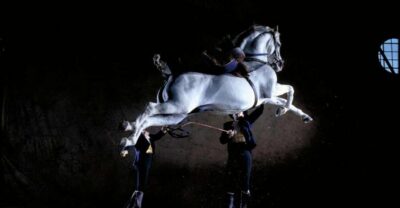
Jerez de la Frontera: Andalusian Horse Dance and Museums
Read our review →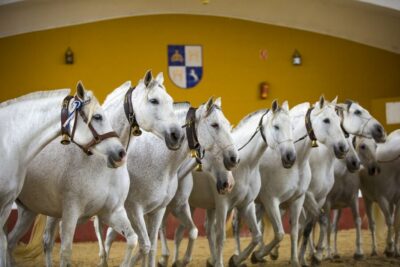
Montserrat Monastery & Horse Riding Experience from Barcelona
Read our review →
Browse the lists this tour appears in