
Reviewed · HORSES
Jerez de la Frontera: How the Andalusian Horses Dance
The remarkable thing here is the control. At Jerez’s Royal Andalusian School of Equestrian Art, horses and riders perform a carefully staged ballet that includes pirouettes, piaffes, and airs above the ground. The horses do not simply trot in circles. They change rhythm, move sideways, rear, leap, and work in close formation.
I like the mix of classical dressage and Doma Vaquera, the Spanish cattle-riding tradition. I also like the setting and presentation: Spanish music, traditional 18th-century costumes, carriages, and a polished arena performance. The main consideration is that the program changes, so you cannot count on seeing every named number at every show.
In This Review
- Key things to know before you book
- Why the horses are the real stars of Jerez
- Arriving at the Royal Andalusian School
- The opening choreographies and Spanish riding style
- From Pas de Deux to airs above the ground
- Carriage driving brings a different kind of skill
- Work in Hand shows obedience without a saddle
- The Carrousel provides a disciplined finish
- Music, costumes, and the feel of the show
- Is $31 good value for this performance?
- Getting there from Cádiz and planning your day
- Special gala dates and changing programs
- Who should book the Andalusian horse show?
- FAQ
- Where does the Andalusian horse show take place?
- How long does the performance last?
- How much does admission cost?
- What is included in the ticket?
- How many choreographies are performed?
- Which types of riding can I see?
- Are the exact numbers guaranteed?
- What should I bring to the ticket office?
- Can I choose my seat?
- Is the venue wheelchair accessible?
Key things to know before you book
- Six to eight equestrian choreographies: Each performance draws from a larger repertoire, so the exact running order varies.
- Several riding traditions in one show: Expect classical dressage, Doma Vaquera, work in hand, carriage driving, and a final Carrousel.
- A formal Spanish presentation: Music, costumes, trained horses, and precise choreography make this feel like a stage production with hooves.
- A good value at $31: The ticket covers admission to a 90-minute to two-hour performance, making it one of Jerez’s more distinctive cultural outings.
- Plan for the ticket office: Bring your printed voucher and passport or ID card, then collect your ticket at the Reservation Box Office.
- Useful for a Cádiz side trip: Jerez is reachable by train from Cádiz, followed by a short taxi ride to the school.
Why the horses are the real stars of Jerez
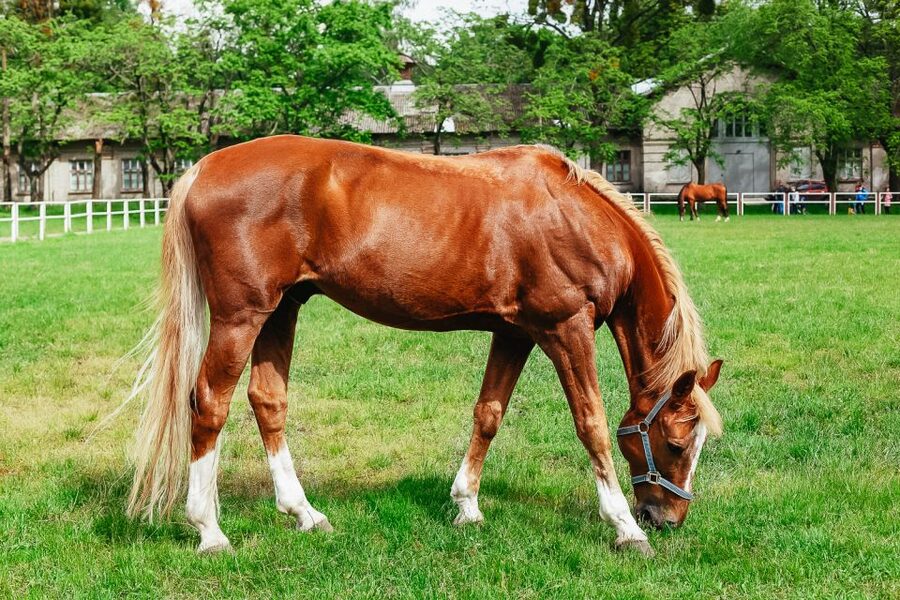
The Andalusian horse has long been associated with grace, strength, and disciplined movement. You see all three qualities here, but the show is not simply a beauty parade. The horses are asked to respond to tiny signals from their riders, often while maintaining a calm, almost effortless appearance.
That calm is part of the spectacle. A horse may move from a collected trot to a sharp turn, or from a slow, elevated step to a sudden gallop. The rider’s posture remains controlled, and the horse appears to understand the next instruction before you can see it happen.
I find this kind of performance more interesting when you watch the communication rather than waiting only for the biggest tricks. Look at the reins, the rider’s seat, and the horse’s changing balance. The most impressive moments are often quiet ones, when a horse responds with perfect timing.
The show also gives you a useful introduction to Spanish riding traditions. Classical dressage provides the technical base, while Doma Vaquera brings the working style once used by riders managing cattle. That combination gives the performance more character than a standard arena show.
More Seville trips worth a second look
- Horse-Drawn Carriage Ride Through Seville
★ 4.3 · 404 reviews - Seville: Authentic and Romantic Horse-Drawn Carriage Ride
★ 4.5 · 341 reviews - From Seville: Jerez, Cádiz and Andalusian Horses
★ 4.4 · 143 reviews
Arriving at the Royal Andalusian School
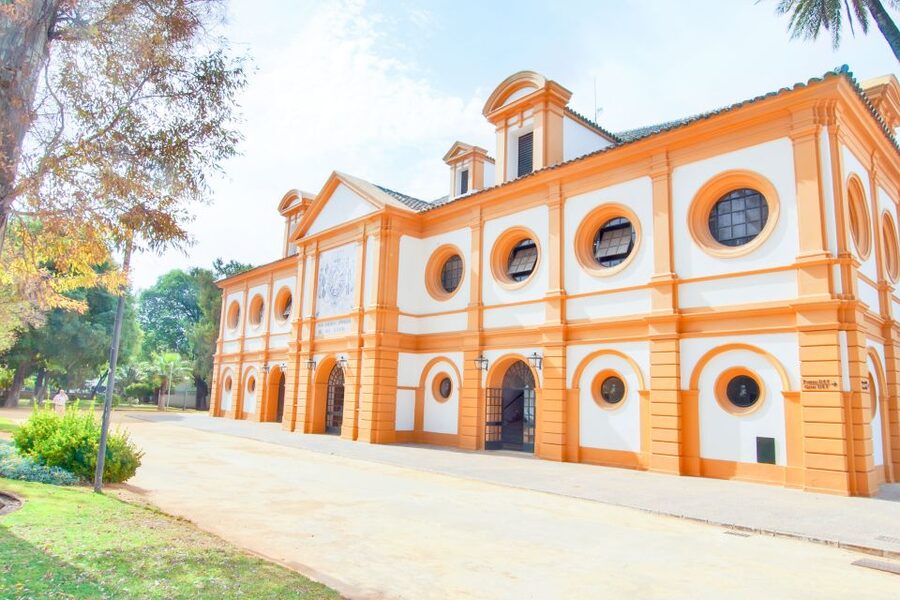
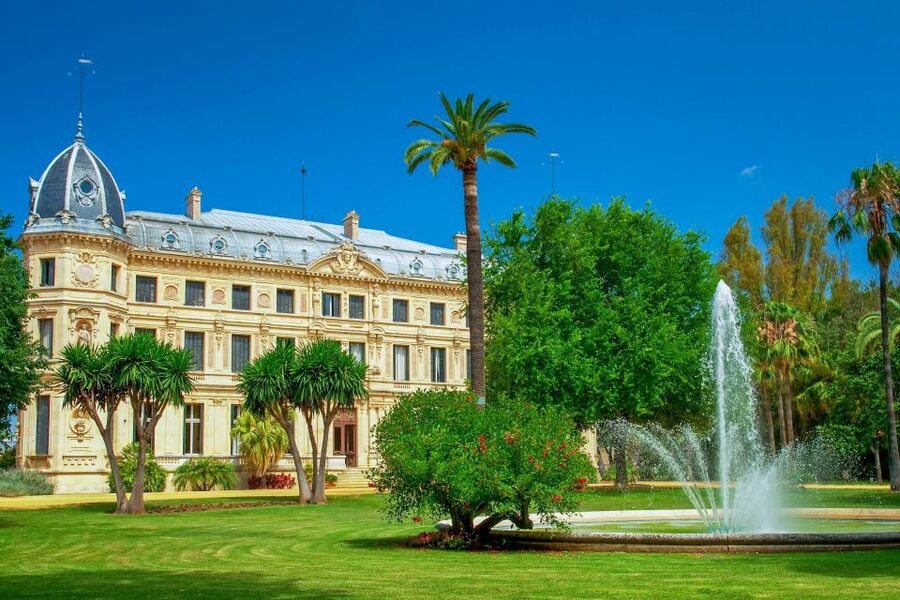
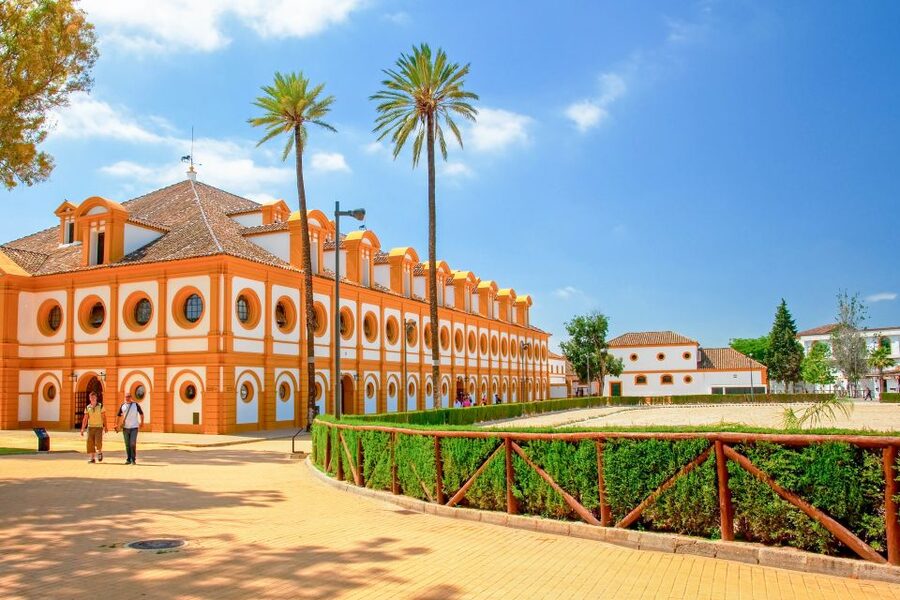
You go to the Reservation Box Office at the Fundación Real Escuela Andaluza del Arte Ecuestre. The venue is in Jerez de la Frontera, a city already known for sherry, flamenco, and horses, so the setting fits the subject rather well.
Your admission is for the show itself. The performance usually lasts between 90 minutes and two hours, depending on the program. Check the available start time when booking, since show times are scheduled rather than offered continuously throughout the day.
Allow time to reach the ticket office before the performance. You must present a printed voucher, and you should bring a passport or ID card. If you purchased a discounted ticket, bring proof of eligibility as well. Without the required proof, you may have to pay the difference to the full standard price, if tickets are still available.
The ticket category determines your seat. You do not choose a particular row or seat number, since seats are assigned according to the order of purchase or booking. That arrangement is worth knowing if you are particular about where you sit, though the arena is set up for a broad view of the action.
The opening choreographies and Spanish riding style
The exact program can change, but the school selects six to eight numbers from its established repertoire. That keeps the show from feeling like a single long routine and lets you see several distinct forms of riding.
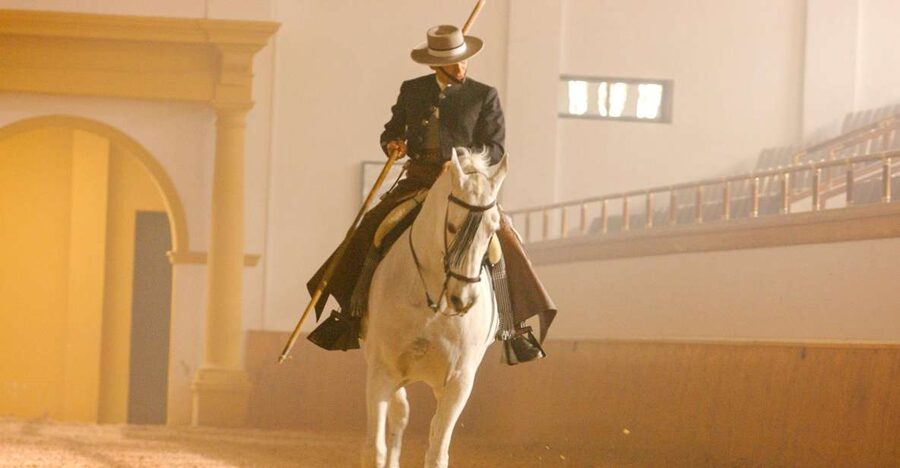
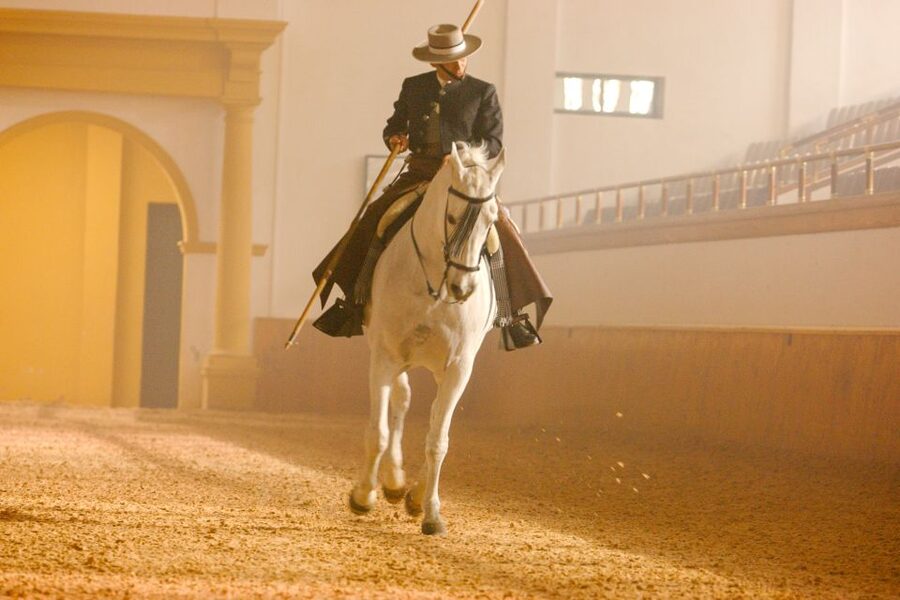
One section may feature Doma Vaquera. The rider works with one hand while the horse moves around the arena, first at a trot and then at a gallop. The changes of rhythm are central to the display. You may see pirouettes, in which the horse turns tightly around its hindquarters, and arreones, sudden breaks into a gallop.
Doma Vaquera comes from practical work with cattle, and that background matters. The movement is not decorative for its own sake. It reflects speed, balance, and the ability to change direction quickly in an open working environment. Even in a formal show, the style retains a direct, functional feel.
The classical dressage sections are more measured. The horses perform advanced exercises to classical music, with each movement built around balance and obedience. If you have seen dressage at a competition, you will recognize some of the principles, but the theatrical format makes the exercises easier to follow.
The 18th-century costumes add a strong visual link to Spain’s equestrian past. Riders are dressed for presentation, yet the clothes also help frame the movements as part of a long-established tradition. The effect is formal without being stiff.
From Pas de Deux to airs above the ground
The classical repertoire includes several numbers, each with a different focus. In The Colts, you see younger horses being introduced through controlled exercises. The number can be especially useful if you want to understand that this level of performance begins with training and patience, not just natural elegance.
The Pas de Deux places two horses and riders together. Their movements need to match in rhythm, direction, and speed, so the appeal comes from coordination as much as from individual skill. I like this section because a small difference between the horses becomes easy to spot.
Passage and Piaffer focuses on highly collected movement. The passage is an elevated, rhythmic trot, while the piaffe is performed almost in place. To a casual viewer, the horses may seem to be taking tiny steps, but the difficulty lies in maintaining power, balance, and rhythm without rushing.
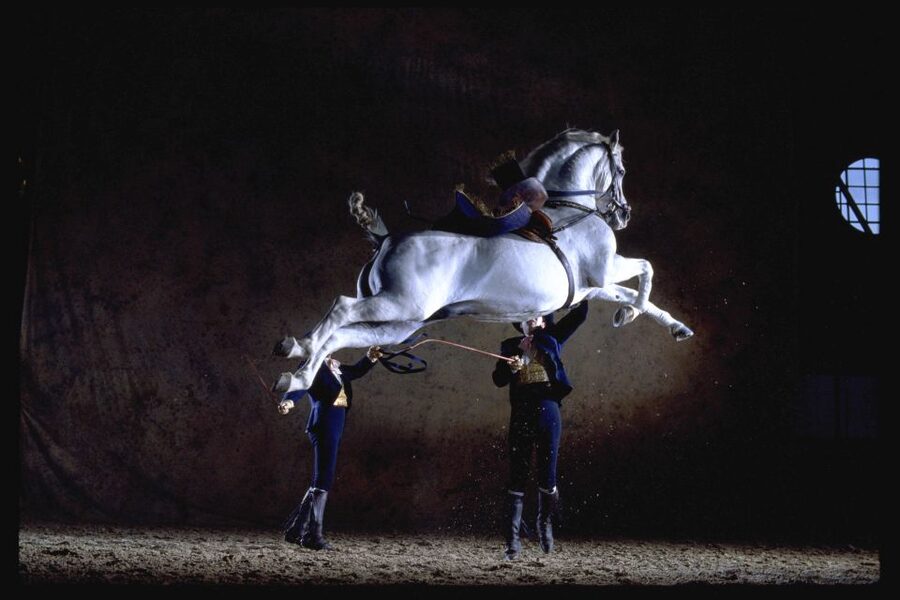
The Airs on Horseback and Airs Above the Ground move into more demanding territory. These exercises can include levades, caprioles, and courbettes. A levade asks the horse to raise the front of its body while staying balanced. A courbette involves a series of controlled leaps, and a capriole includes a powerful leap with a kick behind.
The Spanish walk is another crowd-friendly movement. The horse lifts its front legs in a deliberate, high step. It is easy to recognize, but the quality depends on regularity and control rather than height alone.
The school may also present Domino on Horseback or Fantasy, names that signal a more theatrical approach. Because the management can alter the program, I would treat the published repertoire as a menu of possibilities rather than a guaranteed checklist.
A different way to spend the day, same corner of Spain:
- Seville: Royal Alcázar Entry Ticket
★ 4.6 · 28,378 reviews - Seville: Cathedral and La Giralda Entry Ticket
★ 4.5 · 24,592 reviews - Seville: Live Flamenco Dancing Show Ticket at the Theater
★ 4.7 · 16,396 reviews - Seville: Casa de la Memoria Flamenco Show
★ 4.8 · 12,964 reviews
Carriage driving brings a different kind of skill
Carriage driving changes the pace and shape of the show. Instead of watching a single rider guide a horse from the saddle, you see horses drawing carriages under the direction of a coachman.
These carriages were once used for transport and are now maintained for sport and exhibition. The coachman must control the horses through the harness and reins while guiding the carriage around the arena. The result is not quite the same as riding, since the driver has to manage the movement of the team and the vehicle at the same time.
I like this part because it broadens your idea of horsemanship. The performance is not only about a horse carrying a rider elegantly. It is also about teamwork, equipment, timing, and the physical presence of a moving carriage.
The classical harnesses and formal presentation give the segment an old-world feel, but the skills are very practical. Watch how the coachman handles turns and changes of pace. The carriage numbers can be among the most visually striking parts of the program because several elements move together at once.
Work in Hand shows obedience without a saddle
In the work-in-hand section, the horse performs without the rider sitting in the saddle. The horseman gives instructions from the ground, and the horse responds with movements associated with Haute École, or high-level classical dressage.
You may see levades, caprioles, courbettes, piaffe between pillars, and the Spanish walk. The pillars help define the horse’s position and provide a reference point for the exercises. Without a rider’s weight on its back, the horse’s obedience becomes the main focus.
This is a good section for anyone who wants to see the training behind the spectacle. A horse performing under saddle can make the rider’s influence seem almost invisible. From the ground, the connection is easier to notice. You see how much depends on signals, concentration, and repeated practice.
The work-in-hand exercises also slow the show down in a useful way. After the speed of Doma Vaquera or the movement of carriage driving, this quieter section lets you appreciate precision. It is not a pause in the action. It is a different kind of action.
The Carrousel provides a disciplined finish
The Carrousel normally brings several horses and riders together for a closing display. They perform advanced exercises in unison, creating patterns across the arena.
Group riding leaves little room for error. Each rider must maintain position while matching the pace and direction of the others. The visual effect is orderly, but the discipline required is considerable. A small timing mistake would be obvious when several horses are moving side by side.
This finale gives the show a proper sense of conclusion. You have seen individual skill, traditional working methods, carriage driving, and ground training. The Carrousel gathers those ideas into one coordinated performance.
Music, costumes, and the feel of the show
The music is an important part of the experience. Classical pieces accompany the dressage numbers, while the broader program uses quintessential Spanish music to set the mood. You do not need to understand every technical term to follow the changing tone: some segments feel stately, others quick and energetic.
The traditional costumes help make the show feel rooted in Spain rather than like a generic horse exhibition. The 18th-century style is formal and decorative, and it gives the riders a shared visual identity as they move through the choreographies.
The presentation is polished and professional. That is good news if you want a dependable cultural performance, though it also means the show is carefully controlled. You are seeing trained equestrian art in a formal setting, not an informal look at everyday ranch work.
If you are lucky enough to have time around the performance, the grounds and training activity can add to the visit. Several people have found it rewarding to watch riders and trainers working before or after the main show. That extra viewing is not the same as a guaranteed behind-the-scenes tour, so think of it as a possible bonus rather than part of the scheduled ticket.
One practical warning: the gift shop may close earlier than you expect. If you want to browse, do it before the show or as soon as you arrive rather than leaving it until the end.
Is $31 good value for this performance?
At $31 per person, I consider this a fair price for a specialized two-hour cultural performance. You are paying for more than a seat in an arena. The ticket brings together trained Andalusian horses, several riding disciplines, live presentation elements, music, costumes, and a purpose-built equestrian venue.
The value is strongest if you have a real interest in horses, dressage, or Spanish traditions. Even if you know little about riding, the range of movements gives you plenty to watch. The price is also reasonable for a focused activity that can fit into a day in Jerez.
The main limit is that admission covers the show, not a broad guided visit through every part of the school. If your main goal is to learn about the institution’s background or see training areas, you should check exactly what is included for your selected date. The performance itself remains the central product.
Discounts may be available for eligible visitors, but you must show documentary proof at the ticket office. If you cannot prove eligibility, you may need to pay the standard price, subject to availability.
Getting there from Cádiz and planning your day
Jerez works well as a side trip from Cádiz. The train journey from Cádiz is easy, and a quick taxi ride takes you onward to the Royal Andalusian School. Build in enough time for the transfer and the ticket office, especially if you have booked a fixed performance time.
You can also make the horse show part of a wider Jerez day, though the exact timing depends on the performance schedule. The city is known for sherry, flamenco, and equestrian culture, so the show fits naturally with other local experiences.
The duration ranges from 90 minutes to two hours. That is long enough to feel substantial but short enough to avoid taking over an entire day. I would choose a performance time that leaves room for the journey back to Cádiz or for another Jerez activity afterward.
The venue is wheelchair accessible. Pets are not allowed, and you cannot bring glass objects, bottles, cans, weapons, or sharp objects into the grounds. Flash photography and audio recording are also prohibited. Non-flash photography may still be subject to venue rules, so follow staff instructions.
Special gala dates and changing programs
On June 30 and July 1 at 9 p.m., a special 50th Anniversary Gala is scheduled with the Four Equestrian European Schools from Austria, France, Spain, and Portugal. The Abu Dhabi International Riding School is also due to take part in the event developed under the supervision and training of the Royal Andalusian School.
These gala performances are different from the regular program. They are planned for a much larger outdoor setting with 4,000 seats, along with leisure and catering areas. If your visit matches those dates, select the gala option rather than assuming the standard performance ticket applies.
For ordinary performances, the management can alter or change the program. That is common with live equestrian shows, where horse welfare, training schedules, or event planning can affect the running order. Go for the style of performance as a whole, not one single promised trick.
Who should book the Andalusian horse show?
I would choose this for anyone spending time in Jerez or Cádiz who wants a distinctly Andalusian activity. It is especially well suited to horse lovers, dressage fans, families interested in animals, and anyone who appreciates live performance with a strong local identity.
It also works for people who want something beyond museums and historic buildings. You are watching a living tradition presented through movement, music, costumes, and trained animals.
I would think twice if you dislike formal shows, have no interest in horses, or need to see a specific routine. The schedule changes, and the experience is designed around polished equestrian display rather than audience participation.
For most visitors, the combination of price, length, and cultural setting makes it an easy recommendation. The strongest parts are the variety of riding styles, the precision of the horses, and the chance to see Spanish equestrian traditions presented at a high level. Book it if those details appeal to you, and bring your printed voucher so the ticket collection is straightforward.
FAQ
Where does the Andalusian horse show take place?
The show takes place at the Fundación Real Escuela Andaluza del Arte Ecuestre, also called the Foundation Royal Andalusian School of Equestrian Art, in Jerez de la Frontera.
How long does the performance last?
The performance lasts between 90 minutes and two hours. Starting times depend on the date and availability.
How much does admission cost?
The listed price is $31 per person. Discounted prices may be available for eligible visitors who can show proof of eligibility.
What is included in the ticket?
The ticket includes entrance to the equestrian show.
How many choreographies are performed?
Each show includes six to eight different choreographies selected from the school’s repertoire.
Which types of riding can I see?
The program may include Doma Vaquera, classical dressage, carriage driving, work in hand, and a Carrousel.
Are the exact numbers guaranteed?
No. The management schedules the repertoire and reserves the right to alter or change the program.
What should I bring to the ticket office?
Bring your printed voucher and passport or ID card. If you bought a discounted ticket, also bring documentary proof of eligibility.
Can I choose my seat?
Tickets are sold by seating category, not by specific row or seat number. Seats are assigned according to the order of purchase or booking.
Is the venue wheelchair accessible?
Yes, the activity is wheelchair accessible. Pets, flash photography, audio recording, glass objects, bottles, cans, weapons, and sharp objects are not allowed.
Recently reviewed around Seville
- Seville: Alcázar Fast-Track Access with Guided Tour★ 4.2 · 432 reviews
- Seville: Small Group Jewish Quarter Tour with Tapas & Drinks★ 5.0 · 119 reviews
- Seville: Sunset Roof Top Walking Tour★ 4.5 · 122 reviews
- Seville: VIP Exclusive Early Access Tour of The Alcazar★ 4.8 · 276 reviews
- Seville: Small-Group Jewish Quarter Discovery Walking Tour★ 4.9 · 499 reviews
- Seville: Flamenco Show at Tablao Almoraima in Triana★ 4.6 · 483 reviews
- Seville: Authentic and Romantic Horse-Drawn Carriage Ride★ 4.5 · 341 reviews
- Seville: Sunset and Evening Paddle Boarding Tour★ 4.8 · 355 reviews
Horses, compared.
El Salobre: Horse Riding Adventure with Transfer Options
Read our review →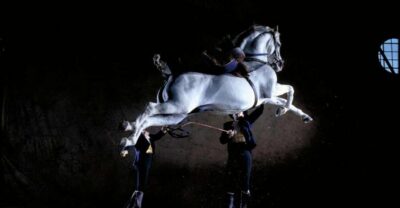
Jerez de la Frontera: Andalusian Horse Dance and Museums
Read our review →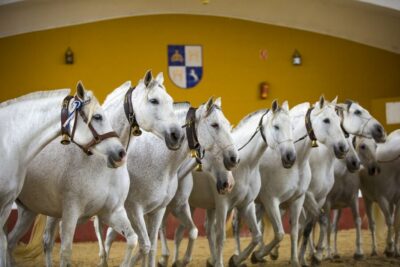
Montserrat Monastery & Horse Riding Experience from Barcelona
Read our review →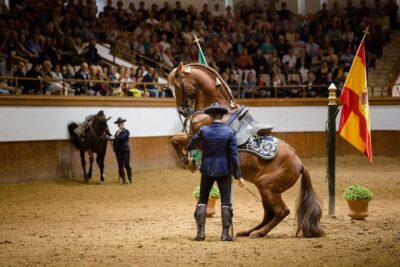
Browse the lists this tour appears in