
Reviewed · TUK TUK TOURS
Madrid Historical Tour with Local Guide in Eco Tuk Tuk Private
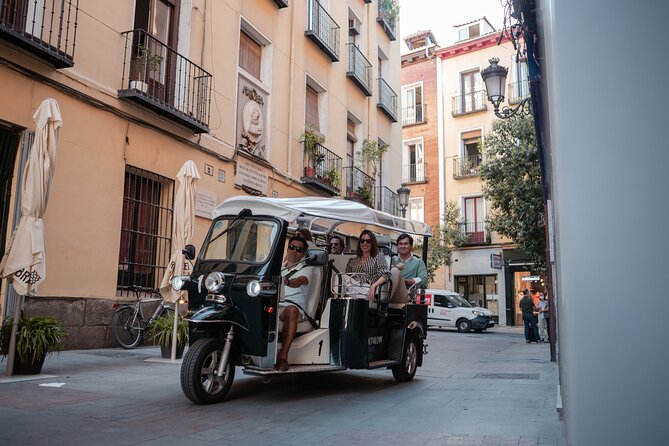
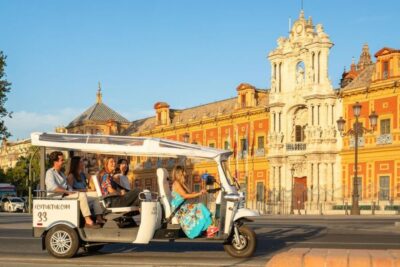
Madrid Historical Tour with Local Guide in Eco Tuk Tuk Private is a smart way to get your bearings fast. You ride in a quiet electric tuk-tuk, with your own party and an English-speaking driver-guide, past grand squares, royal buildings, museums, churches, and neighborhoods that can be tiring to cover on foot.
I especially like the private format, which lets you stay with your own group, and the chance to see a broad slice of Madrid in a short time. Guides such as Carlos, Laura, Clara, Alejandro, and Fernando are praised for mixing history with jokes, food tips, local stories, and personal knowledge of the city.
The main drawback is that this is a sightseeing ride, not a walking tour with long visits inside attractions. The route and photo stops are fixed, the sound system may not always be perfect, and the meeting point below Plaza de Oriente can be tricky to find.
In This Review
- Key points before you book
- Why a tuk-tuk works well in Madrid
- The covered market and Madrid’s everyday appetite
- San Francisco el Grande and the old center
- Atocha Station, a transport landmark
- Congress, fountains, and two football gods
- The Prado, Jerónimos, and Madrid’s art quarter
- Puerta de Alcalá and the grand city center
- Plaza de Santa Ana and the city between the monuments
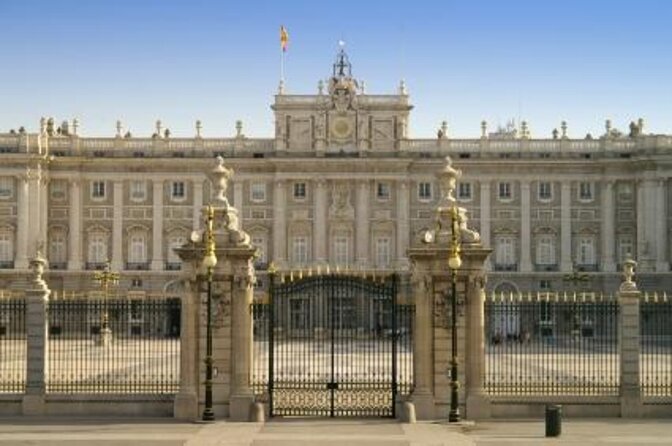
- The Almudena Cathedral and Royal Palace
- Temple of Debod at the end of the ride
- What the guides add
- Weather, comfort, and meeting-point facts
- Who should book it
- Should you book this Madrid tuk-tuk tour?
- FAQ
- How long does the Madrid Historical Tour by electric tuk-tuk last?
- How many people can ride in one tuk-tuk?
- Is the tour private?
- Is the tour offered in English?
- Where does the tour start?
- Where does the tour finish?
- Is hotel pickup included?
- Are entrance tickets included?
- Can children join the tour?
- What happens if I am late?
- Can I cancel for a refund?
Key points before you book
- Private tuk-tuk for up to four people: Your group rides alone, but larger parties need more than one vehicle.
- A fast first look at Madrid: The route links the Royal Palace, Prado area, Atocha, Cibeles, Puerta de Alcalá, and Temple of Debod.
- Electric and weather-ready: The vehicles are fully electric, with blankets and protective layers for cold, rain, and wind.
- Strong local guide element: Guides including Carlos, Laura, Clara, Gloria, Juan, Nerea, and Alejandro add stories, recommendations, and neighborhood context.
- Best booked early in your stay: Use the ride to decide which museums, plazas, and neighborhoods deserve a longer visit.
- Meet carefully: The pickup is in an underground bus station near the Royal Palace, not beside the other tuk-tuks outside.
Why a tuk-tuk works well in Madrid
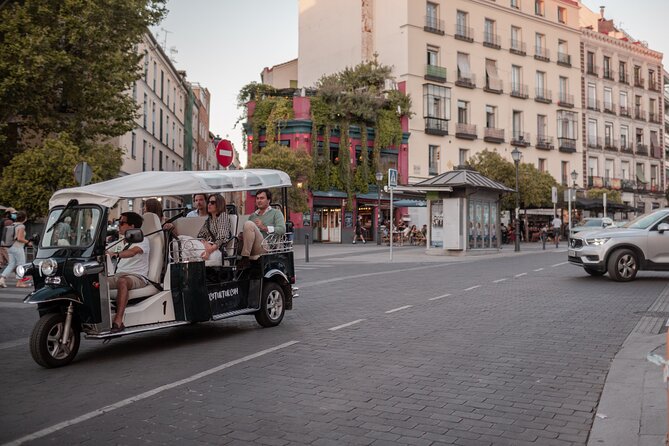
Madrid is a city of wide boulevards, large ceremonial squares, grand fountains, and districts that spread well beyond the old center. You can walk between many sights, but doing the whole circuit on foot takes time and energy. A tuk-tuk gives you a moving introduction without turning the day into a march.
The open-sided design also gives you a better street-level view than a large sightseeing bus. You can look up at façades, watch city life pass by, and hear your guide explain what you are seeing. The electric motor keeps the ride quieter and avoids the fumes of a standard vehicle.
This is a private experience, with a legal limit of four passengers per tuk-tuk. That matters for couples, families, and small groups who want to ask questions without sharing the ride with strangers. It also means the price of $28.66 per person can be good value if four people split one vehicle. For a solo passenger or pair, the cost is still reasonable for a private one to four hour orientation, but it is not the cheapest way to move around Madrid.
The route length depends on the time you book. A one-hour ride gives you a quick survey. Two hours offers a useful city introduction. Three hours gives the guide more room for context, neighborhoods, and stops. The longer option is the better choice if Madrid is new to you or you have only one day in town.
More Historical Tours in Madrid
- Madrid Essential: Historic Center, Plaza Mayor & Royal Palace
★ 5.0 · 6,416 reviews - Madrid Historic Centre Food Tour with Authentic Tapas & Wines
★ 5.0 · 814 reviews - Madrid Historical Walking Tour
★ 5.0 · 721 reviews
The covered market and Madrid’s everyday appetite
One early stop takes you past a covered market dating from around 1916. It combines local food, delicatessen counters, and events in an elegant setting.
This is a useful contrast to the monumental Madrid of palaces and ministries. The city is also about food shopping, quick conversations, and small plates. Your guide can help place the market in the rhythm of local life, though you should not assume the tuk-tuk tour includes a food tasting or a long market visit. The itinerary describes it as a sightseeing stop, not a meal.
If you want to return later, note the location and ask your guide for advice. Several guides are especially appreciated for restaurant suggestions and practical ideas about where to go after the ride.
San Francisco el Grande and the old center
The Royal Basilica of San Francisco el Grande sits in Madrid’s historic center, in the Palacio neighborhood. Its official name is the Basilica of Our Lady of the Angels, but the shorter name is the one you will hear most often.
The church adds a religious and architectural layer to the ride. From the tuk-tuk, you get the setting and exterior context rather than a full indoor visit. That is important to understand: the tour helps you decide what deserves a return visit, but it does not replace a museum or church admission.
This part of Madrid is also useful for seeing how royal, religious, and civic buildings sit close together. A guide can connect the basilica with the nearby palace district and explain why this area has long carried political and ceremonial weight.
Atocha Station, a transport landmark
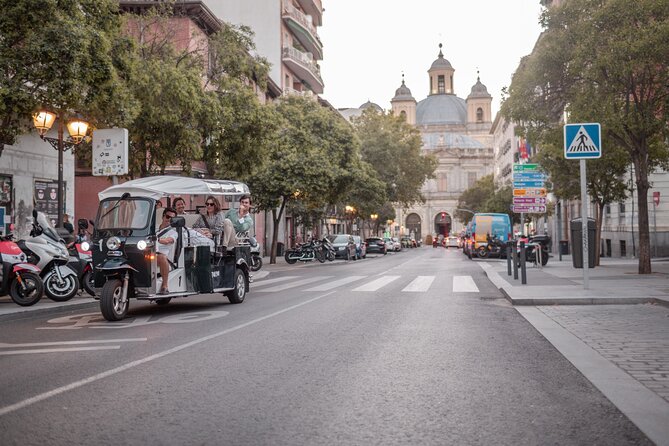
Atocha is Madrid’s main railway complex, near Plaza del Emperador Carlos V. It is the busiest station in Spain and one of Europe’s major rail hubs.
A railway station may sound like an odd sightseeing stop, but Atocha helps explain Madrid’s role as a national crossroads. It is also a practical reference point if you are arriving by train or planning a day trip. Seeing it on the route can make the city map easier to understand.
Do not expect the tuk-tuk to function as a transfer service. Hotel pickup and drop-off are not included, and transfers outside the planned route are not permitted. Treat Atocha as a landmark and orientation point, not a place where the tour will leave you.
More Tuk Tuk Tours in Madrid
- Madrid Welcome Tour with Local Guide in Eco Tuk Tuk Private
★ 5.0 · 2,936 reviews - Madrid: Private City Tour by Eco Tuk Tuk
★ 4.9 · 2,876 reviews - Madrid Express Tour with Local Guide in Eco Tuk Tuk Private
★ 5.0 · 413 reviews - Madrid: City Highlights Tuk Tuk Tour
★ 4.4 · 334 reviews
Congress, fountains, and two football gods
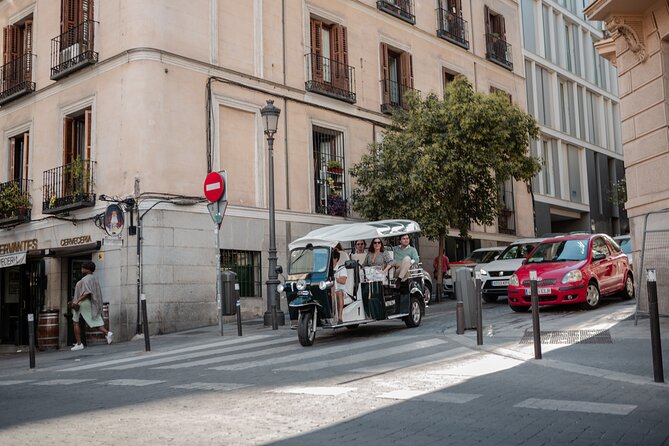
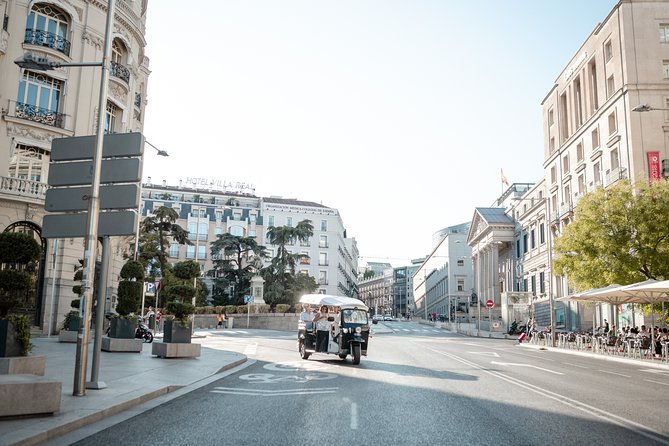
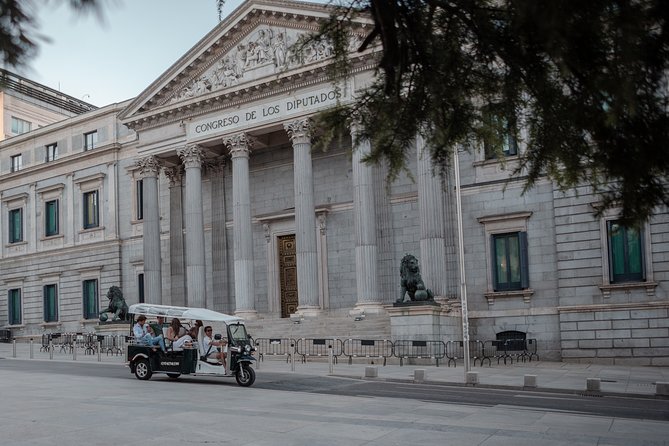
The Palace of the Spanish Courts, home to Spain’s Congress, occupies the site of a former convent. Its neoclassical façade has a broad staircase, six Corinthian columns, a sculpted pediment, and the famous bronze lions at the entrance. The lions were cast from iron taken from cannons captured during the war in Africa.
The building is usually viewed from outside. The Session Room, library, and Conference Room are not part of the tuk-tuk visit, but the exterior gives your guide a chance to discuss Spain’s political story and Madrid’s civic architecture.
You then reach the competing figures of Cibeles and Neptune. Both fountains hold an important place in Madrid’s public life and football culture. Atlético de Madrid celebrates at Neptune, while Real Madrid celebrates at Cibeles. This is one of those details that turns a grand fountain into a living part of the city.
If you follow football, this stop has extra appeal. If you do not, it is still a good example of how Madrid attaches modern loyalties to older monuments.
The Prado, Jerónimos, and Madrid’s art quarter
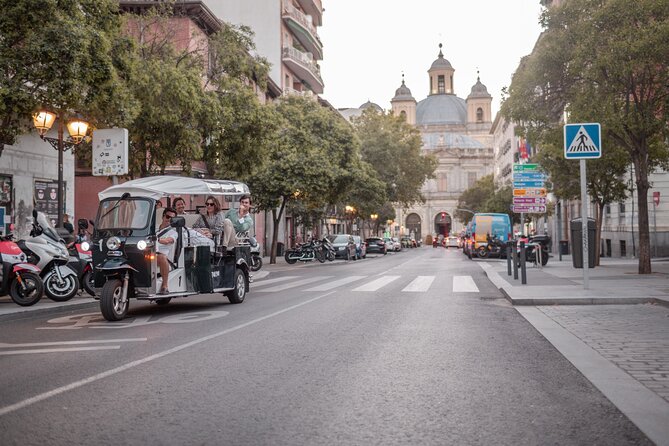
The Prado Museum is one of the major stops on the route. Its collection is especially strong in European painting from the 16th through 19th centuries, with works by many of the continent’s leading masters.
The tuk-tuk gives you an exterior introduction and helps you place the museum within Madrid’s central art district. It does not include admission or a museum tour, so plan a separate visit if you want to see the paintings. A short ride-by cannot do justice to the collection, but it can help you understand where the Prado sits and how to approach it later.
Next door is the Church of San Jerónimo el Real, commonly called Los Jerónimos. It is a late Gothic building with Renaissance touches and a long record of rebuilding and restoration. The church is a fine reminder that Madrid’s appearance has developed in layers. What you see today is not simply an untouched medieval building, but a structure changed over centuries.
The Prado and Jerónimos area reward a return on foot. During the tuk-tuk ride, make a note of anything you want to inspect more closely.
Puerta de Alcalá and the grand city center
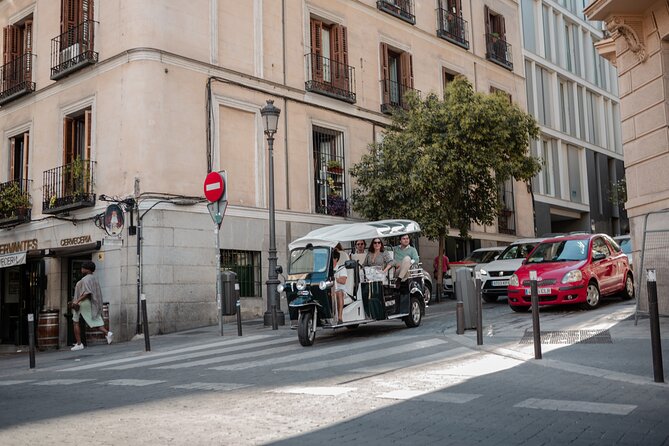
Puerta de Alcalá was ordered by Carlos III to replace an earlier gate and opened in 1778. It once marked an entrance to the city. Today it sits within Madrid’s traffic and public spaces, but its role as a ceremonial gateway remains clear.
The gate is one of the better photo stops because its scale and neoclassical design read well from the street. The vehicle stops at prearranged locations, so you cannot ask to stop anywhere that catches your eye. That fixed approach keeps the route moving, but it also limits spontaneity.
The ride continues around the area of Cibeles, where the fountain is framed by the Buenavista Palace, Linares Palace, Communications Palace, and Bank of Spain. This is one of Madrid’s most impressive architectural settings, and your guide can help distinguish the former post office building, now used by Madrid’s city government, from the other grand façades.
The Bank of Spain building is particularly ornate. It was created to give the national bank a headquarters suited to its role, including its former responsibility for issuing coins and banknotes throughout Spain. From the tuk-tuk, you get the exterior and the story, not access to the interior.
Plaza de Santa Ana and the city between the monuments
Plaza de Santa Ana lies in the Cortes district and dates from 1810. It has been redesigned several times, so its current appearance reflects modern urban changes as much as its original plan.
This is the sort of place where a good local guide adds value. Instead of rushing only between famous sights, you get a sense of the spaces where Madrid’s central districts meet. The plaza is also a useful spot to mark for a later walk, especially if you want to explore the surrounding streets at a slower pace.
The strongest part of this tour is often the connective tissue between major sights. Guides such as Laura and Sandra are praised for adding neighborhood stories, Spanish history, and local humor rather than reciting only dates and building names.
The Almudena Cathedral and Royal Palace
The Almudena Cathedral is Madrid’s most important religious building. Pope John Paul II consecrated it in 1993, making it the first cathedral outside Rome to be consecrated by a pope.
Its relatively recent completion can surprise you. Madrid’s chief cathedral does not have the same medieval age as many European cathedrals, and that difference is part of its story. A museum inside the cathedral contains objects connected with the history of the Madrid diocese, including mosaics, episcopal shields, and religious ornament. The tuk-tuk tour does not include museum admission, so plan another visit if you want to go inside.
The Royal Palace, also called the Palacio de Oriente, is the grand centerpiece of this section. Construction began in 1738 and lasted 17 years, after fire destroyed the earlier Palace of the Austrias on Christmas Eve in 1734. Carlos III moved in as his usual residence in 1764.
Today the palace is used for official receptions, ceremonies, and state events. Spain’s king and queen live at the Palacio de la Zarzuela instead. The surrounding Campo del Moro and Sabatini Gardens add green space to the royal setting. Campo del Moro can be visited during the day, while the Sabatini Gardens lie along the palace’s north side.
You will see the palace and gardens from the route, but this is not a palace interior tour. If you want rooms, collections, or a longer look at the gardens, schedule them separately.
Temple of Debod at the end of the ride
The Temple of Debod is an ancient Egyptian building on a hill near Plaza de España and Paseo del Pintor Rosales. It was moved to Madrid and now occupies the site of the former Cuartel de la Montaña.
The stop is listed as about 10 minutes, with free admission. That makes it one of the clearest chances to get out, take photographs, and see something unlike the Spanish architecture elsewhere on the route.
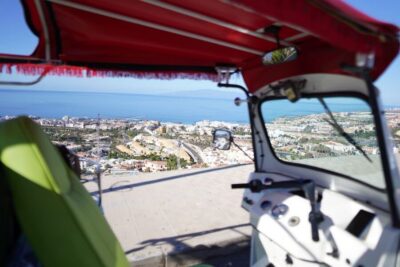
The temple is also a strong final stop because its elevated setting gives you a different view of Madrid. Keep your expectations practical: ten minutes is enough for a brief look, not an extended museum visit. Ask your guide what part of the site can be visited during your stop and use the time wisely.
What the guides add
The driver-guide is central to the experience. The best guides do more than identify monuments. Carlos is praised for answering questions and pointing out places worth adding to your plans. Laura is described as funny and especially connected to Madrid. Clara is noted for friendly conversation, a safe driving style, and clear English.
Other guides named by passengers include Fernando, Gloria, Sandra, Alejandro, Juan, and Nerea. Their reported strengths include local recommendations, stories about neighborhood names, Spanish history, legends, and a relaxed manner with families. You cannot choose a particular guide from the information provided, but the range of praise suggests that the guide’s personality will shape the ride.
The tour works best when you ask questions. Ask where to eat, which neighborhoods to revisit, and which attractions deserve a full afternoon. A two-hour ride early in your stay can save you from spending your limited time on places that do not fit your interests.
Weather, comfort, and meeting-point facts
The vehicles operate in rain and heat and are cancelled only in extreme conditions. Blankets and protective layers are provided for cold, wind, and rain, but you should still dress for the weather. A tuk-tuk is more exposed than a bus or car.
The vehicle is suitable for older people, and drivers can help passengers board. Children must be at least two years old, babies are not allowed, and each passenger must weigh at least 9 kilograms. Pets are not allowed for security reasons.
The meeting point is at C. de Bailén, 4, near the Royal Palace. The practical catch is that the pickup is in the underground bus station of Plaza de Oriente, beside the palace, not among the tuk-tuks outside. Search for Calle Bailén 4 or Puerta del Príncipe on Google Maps. Opposite the Prince’s Gate, look for the stairs down and the Eco Tuk Tuk signs.
If stairs are a problem, contact the operator by phone, WhatsApp, or email for elevator access. Arrive early. A delay reduces your tour time, and a delay of more than 15 minutes can lead to cancellation without a refund.
Who should book it
I would choose this tour for a first morning or first afternoon in Madrid. It suits families, couples, small groups, older people who want less walking, and anyone with only one day in the city. It is also a good match for solo visitors who want a private introduction rather than a large group ride.
I would not choose it as your only cultural sightseeing activity. The Prado, Royal Palace, Almudena Cathedral, and Temple of Debod all deserve more time than a drive-by can provide. Use the tuk-tuk to build your map, then return on foot or by public transport.
The price is strongest when shared by three or four people. Free cancellation is available up to 24 hours before the start time, which gives you some planning flexibility. Book earlier rather than later if your schedule is tight, since the experience is commonly reserved several weeks ahead.
Should you book this Madrid tuk-tuk tour?
Book it if you want a private, low-effort overview with a local guide, especially at the start of your visit. You will see a surprising number of major districts and have plenty of ideas for the rest of your stay.
Skip it if you prefer long indoor visits, spontaneous stops, or a slow walking tour focused on one neighborhood. For most first-time visitors, though, the electric tuk-tuk is a fun and practical orientation ride, and the $28.66 per-person price is fair when your group shares the vehicle.
FAQ
How long does the Madrid Historical Tour by electric tuk-tuk last?
The tour lasts approximately one to four hours, depending on the option you book.
How many people can ride in one tuk-tuk?
The legal maximum is four passengers per tuk-tuk. Larger groups may require more than one vehicle.
Is the tour private?
Yes. Only your group participates in the private activity.
Is the tour offered in English?
Yes. English is the listed language for the experience.
Where does the tour start?
It starts near the Royal Palace at C. de Bailén, 4, Centro, Madrid. The actual pickup is in the underground bus station of Plaza de Oriente.
Where does the tour finish?
The activity ends back at the meeting point.
Is hotel pickup included?
No. Hotel pickup and drop-off are not included.
Are entrance tickets included?
The tour includes sightseeing from the tuk-tuk and a free-admission stop at the Temple of Debod. Admission to attractions such as the Prado Museum, Almudena Cathedral Museum, and Royal Palace is not listed as included.
Can children join the tour?
Children must be at least two years old. Babies are not allowed, and the minimum passenger weight is 9 kilograms.
What happens if I am late?
A delay reduces the activity time and may change the planned route. If you are more than 15 minutes late, the tour can be cancelled without a refund.
Can I cancel for a refund?
You can cancel at least 24 hours before the start time for a full refund. Cancellations or changes made less than 24 hours before the start time are not accepted for a refund.
More Tuk-Tuks in Madrid
- Tour Guiado En Tuk Tuk Recorre Avila De La Forma Mas Comoda
★ 4.4 · 235 reviews - Tour Madrid: Secrets in a Electric Tuk Tuk
★ 4.6 · 155 reviews - Madrid: Eco-Friendly, Private, and Unique Tuk Tuk Experience
★ 4.9 · 105 reviews - Tour Welcome Barcelona with Local Guide in Eco Tuk Tuk Private
★ 5.0 · 1,882 reviews
Recently reviewed around Madrid
- Tour Madrid: Secrets in a Electric Tuk Tuk★ 4.6 · 155 reviews
- Madrid: Don Quixote de la Mancha Windmills & Toledo Tour★ 4.9 · 254 reviews
- Tour Guiado En Tuk Tuk Recorre Avila De La Forma Mas Comoda★ 4.4 · 235 reviews
- Madrid: Guided Tour of Toledo with Cathedral Visit★ 4.3 · 399 reviews
- Madrid: Toledo Day Trip with Winery Visit and Wine Tasting★ 4.4 · 177 reviews
- Madrid: 6-Hour Day Trip to Toledo with Guided Walking Tour★ 4.0 · 865 reviews
- Madrid: Tasty Tapas Tour & Visit to a Terrace with Views★ 4.5 · 118 reviews
- Madrid: Flamenco Show&Drink at Tablao 1911 (World’s Oldest)★ 4.7 · 253 reviews
Tuk Tuk Tours, compared.
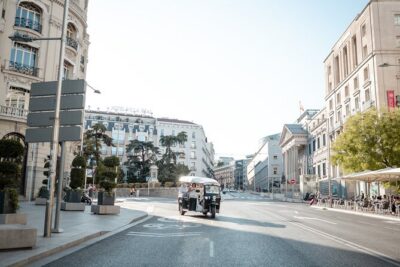
Madrid Welcome Tour with Local Guide in Eco Tuk Tuk Private
Read our review →
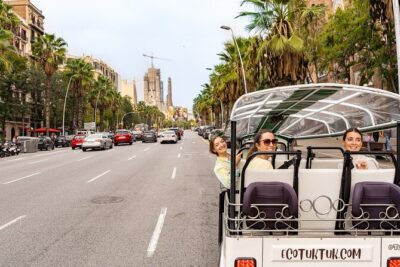
Tour Welcome Barcelona with Local Guide in Eco Tuk Tuk Private
Read our review →


Madrid Express Tour with Local Guide in Eco Tuk Tuk Private
Read our review →Browse the lists this tour appears in