
Reviewed · 3-HOUR EXPERIENCES
Granada: 3-Hour Cathedral and Royal Chapel Tour
Granada’s cathedral and Royal Chapel tell the story of a city changing hands, faiths, and rulers. This three-hour walk links those major sights with the old Alcaicería market streets and La Madraza, once Granada’s first university. The result is more than a church visit: it is a compact lesson in how Christian Granada took shape after 1492.
I like the story-led guiding, especially when guides such as Cynthia, Estella, Rocío, Abel, and Laura connect paintings, altars, royal tombs, and architecture to larger events. I also like the route’s variety: grand religious buildings give way to narrow shopping lanes and an Islamic-era school.
The main consideration is pace. Three hours is a long stretch for a walking tour, and the cathedral contains a great deal to absorb. A large group can also make it harder to hear or linger, although some departures are small enough to feel almost private.
In This Review
- Key points at a glance
- Why this three-hour route works in Granada
- Meeting at Plaza Bib Rambla
- Entering the Encarnación Cathedral
- The Royal Chapel and Granada’s royal story
- Walking the Alcaicería streets
- La Madraza, Yusuf I, and the final historical layer
- What the guides add to the visit
- Is $45 good value?
- Who should book this tour?
- Practical verdict
- FAQ
- How long is the Granada Cathedral and Royal Chapel tour?
- What language is the tour offered in?
- Where does the tour meet?
- Which tickets are included?
- Does the tour include skip-the-line entry?
- What places are visited?
- What is La Madraza?
- How much does the tour cost?
- Can I cancel or pay later?
Key points at a glance
- Three major settings in one walk: See the Encarnación Cathedral, Royal Chapel, Alcaicería, and La Madraza without arranging separate visits.
- Strong historical focus: The tour explains Granada’s Christian past and the shift from Nasrid Muslim rule to Catholic monarchy.
- Guides make the difference: Cynthia, Estella, Rocío, Abel, and Laura have been singled out for clear explanations, humor, and vivid storytelling.
- Tickets are included: Cathedral and Royal Chapel admission, along with skip-the-line entry, are covered in the $45 price.
- A useful central meeting point: Find the guide at Plaza Bib Rambla by the orange umbrella.
- English or Spanish: You can book the tour with a live guide in either language.
Why this three-hour route works in Granada
I like this tour because it puts Granada’s major historical layers in the same frame. The cathedral and Royal Chapel represent the city’s Christian monarchy. The Alcaicería preserves the feel of an older commercial quarter, while La Madraza points back to Granada’s Islamic intellectual life.
That sequence matters. If you visit each place on your own, you may see beautiful interiors without understanding how they fit together. A good guide gives you the links: royal power, religious change, education, trade, and the reshaping of the city center.
The route is also practical for a first visit. It stays in central Granada, so you do not lose time on transport between stops. At $45 per person, the price is reasonable if you want admission handled and prefer a guide who can explain what you are seeing. The value depends heavily on your guide, but the repeated praise for guides including Estella, Cynthia, Rocío, and Abel suggests that the experience is built around personal interpretation rather than a recorded script.
More Granada trips worth a second look
- Granada: 3-Hour Alhambra and Generalife Gardens Guided Tour
★ 4.7 · 1,304 reviews - Alhambra, Nasrid Palaces, and Generalife 3-Hour Guided Tour
★ 4.4 · 889 reviews - Ibiza Ocean Club Boat Party with 3 Hours Premium Drinks and DJ
★ 4.5 · 1,473 reviews
Meeting at Plaza Bib Rambla
The tour begins at Plaza Bib Rambla, one of the easiest central locations to find in Granada. Look for the guide holding an orange umbrella. That detail is useful in a busy square, especially if several walking groups are gathering at the same time.
Arrive with enough time to locate the meeting point. The tour is on foot, and the three-hour length means you will want comfortable shoes. The supplied information does not specify the exact route between each building, so allow for steady walking through the central streets rather than treating this as a series of seated visits.
The guides speak English or Spanish. English-speaking guides named in the feedback include Cynthia, Estella, Rocío, Abel, Laura, and others. Their styles vary, but the strongest pattern is clear explanation paired with storytelling. That is particularly helpful in Granada, where a name or date can mean little until someone explains the political and religious shift behind it.
Entering the Encarnación Cathedral
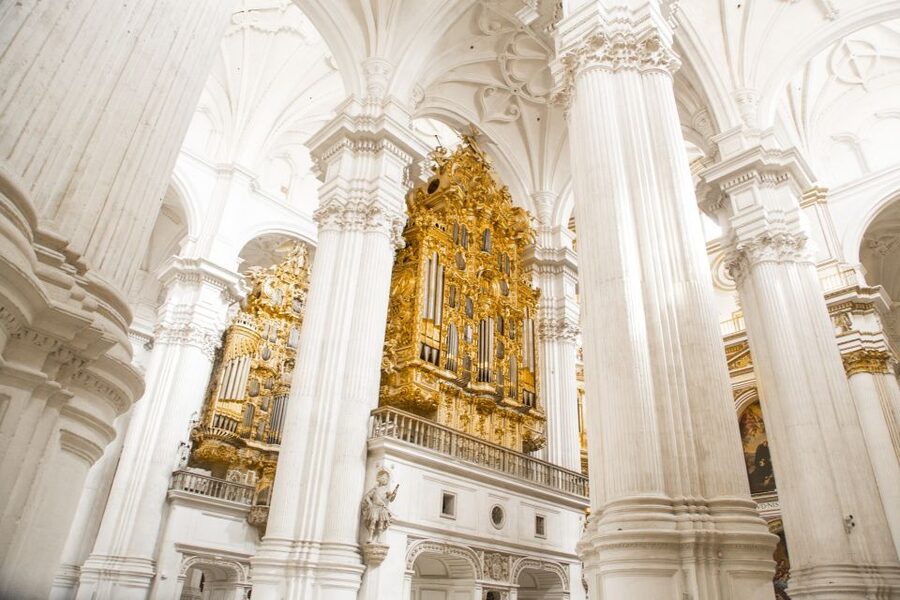
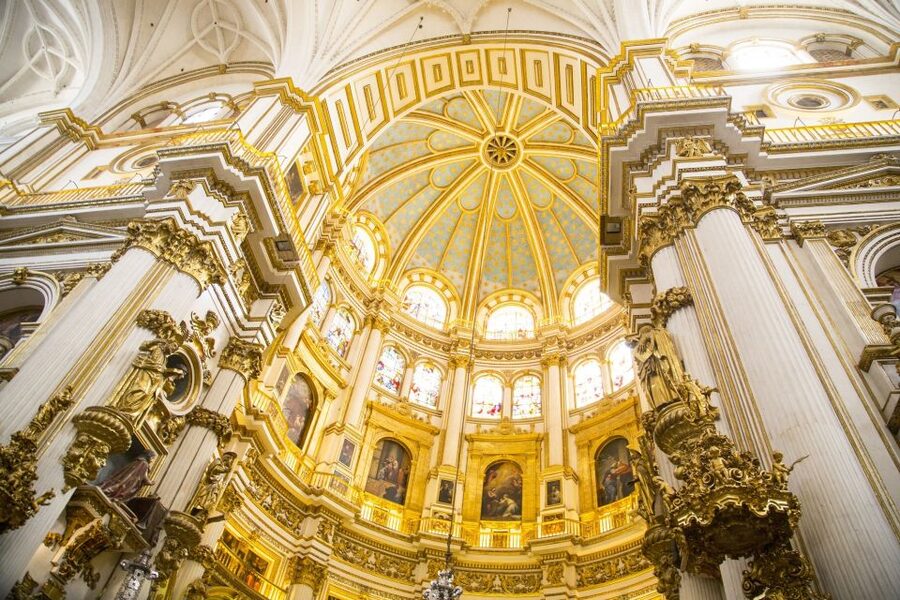
The Encarnación Cathedral is the tour’s largest visual stop. You will enter with a guide rather than simply walk through the nave alone, and that changes how you read the building. The tour covers the cathedral’s design, altars, paintings, and other religious works, with attention to both what you are looking at and why it was made.
Spanish cathedrals can feel overwhelming. There are side chapels, layers of decoration, large paintings, and altars competing for your eye. I appreciate having someone select the details worth your attention. Several guides have been praised for explaining the designer, the artwork, and the meaning behind the objects rather than rushing from one room to the next.
Expect a substantial amount of information here. One guide has been described as a historian who gave useful background before entering, while another took time to explain all the altars and art. That approach suits you if you want context and enjoy asking questions. It may feel slow if you prefer to look around silently or take photographs without interruption.
The cathedral is also where the tour’s Christian history comes into focus. You will hear how the building fits into Granada after the Catholic Monarchs’ conquest and how religious architecture helped express the new order. The point is not simply that the cathedral is grand. It is that its scale, decoration, and contents reflect a major change in the city’s identity.
The Royal Chapel and Granada’s royal story
The Royal Chapel is likely to be the emotional center of the tour. It is closely tied to Isabella I of Castile and Ferdinand of Aragon, the monarchs whose rule shaped the final Christian conquest of Granada. The visit gives you a direct way to connect royal history with the city you are walking through.
Guides explain the chapel’s buildings, artifacts, and religious meaning. The emphasis is not limited to architecture. You can expect discussion of the people associated with the chapel and the role it played in presenting monarchy and faith together.
I would save your questions for this section if you are curious about the Catholic Monarchs, Granada’s change of power, or the difference between the cathedral and chapel. The two buildings are close in location and easy to combine, but they serve different purposes. The cathedral is a major place of worship and art. The Royal Chapel has a more focused royal and memorial character.
Several guides have been praised for making this material clear and entertaining. Patricia, for example, is described as explaining the meaning of artifacts in a simple, engaging way. Estella is repeatedly noted for clear English and detailed explanations. Those qualities matter here because the chapel’s significance can be missed if you only admire the interior.
The chapel is not a quick photo stop. Give yourself time to listen, then look again at the objects and spaces the guide has explained. Photography rules and visiting conditions can change, so follow the instructions given on the day.
A different way to spend the day, same corner of Spain:
- Granada: Alhambra & Nasrid Palaces Tour with Tickets
★ 4.7 · 19,801 reviews - Granada: Alhambra and Nasrid Palaces Entry Ticket
★ 4.6 · 15,130 reviews - Granada: Alhambra & Generalife Fast-Track Guided Tour
★ 4.7 · 8,313 reviews - Granada: Alhambra & Gardens Tour w/Nasrid Palaces Option
★ 4.5 · 6,437 reviews
Walking the Alcaicería streets
After the major religious interiors, the route passes through the Alcaicería, Granada’s historic market quarter. The change is welcome. You move from formal stone buildings into narrower streets associated with trade and the older urban fabric of the center.
This part of the tour helps you picture Granada as more than a collection of monuments. The streets bring the discussion down to street level: shops, lanes, movement, and the way commercial areas connect important buildings. The walk is also a chance to reset after the cathedral and chapel, which can involve a lot of standing and listening.
Do not expect a long shopping session. The Alcaicería is included as a historical passage through the center, not as a dedicated market tour. I would treat it as a useful connector and a visual reminder of Granada’s Islamic and commercial past.
Some guides add nearby points or small detours when time allows. One guide was praised for taking the group off the usual path to see additional points. That sounds appealing, but it also means the exact experience can vary by guide and group pace. If you have a particular interest, ask your guide what can fit before the tour ends.
La Madraza, Yusuf I, and the final historical layer
The tour concludes by passing through La Madraza, the first university created by Yusuf I. This is one of the route’s most useful stops because it adds Granada’s educational and Islamic past to the Christian and royal story told earlier.
The word madraza refers to a place of learning. Here, the focus is on the building’s role in Granada under Muslim rule and on Yusuf I, the Nasrid ruler connected with its creation. That gives you a fuller picture of the city before the Christian conquest, rather than presenting Granada’s story as beginning in 1492.
La Madraza is especially valuable after the Alcaicería walk. You have already seen how the central streets preserve older patterns of trade and movement. At La Madraza, you encounter another side of that society: learning, scholarship, and public life.
The stop also gives the tour a sensible ending. You begin with Christian monuments, pass through an older market area, and finish with a reminder of the Islamic Granada that came before them. I like that structure because it leaves you with a more balanced understanding of the city.
What the guides add to the visit
This tour depends on the guide more than a simple ticketed entry does. The most praised qualities are clear English, strong historical background, patience, warmth, humor, and the ability to tell a story.
Cynthia has been praised for answering many questions, adding context, and sometimes going beyond the scheduled time. Estella is noted for clear speech, careful explanations, and a warm manner. Rocío is described as passionate about Granada and good at bringing the city’s past to life. Abel has been praised for knowing subjects beyond the cathedral and chapel, which can turn a narrow monument tour into a broader introduction to Granada.
Other guides, including Patricia, Carmen, Laura, Hamdi, Isabella, and Roberto, have also received praise for making the material approachable. You should not book expecting one specific guide unless the operator confirms that in advance. Still, the range of positive guide feedback suggests that the tour’s strongest asset is the human explanation.
A few practical points follow from that. Ask questions. Let the guide know if you need a little more time with a painting or architectural detail. If you are in a large group, stay close and position yourself where you can hear. One departure was described as large, while others were small enough to feel nearly private, so group size is not fixed.
Is $45 good value?
The $45 fee includes the cathedral ticket, Royal Chapel ticket, guide, and skip-the-line entry. That makes the price easier to justify than a basic walking tour that only explains buildings from the outside.
I see the best value for first-time visitors who want the major religious sights explained in one sitting. Admission costs alone are not the only issue. Without a guide, you may spend time trying to work out which altars, paintings, and royal references matter. The tour gives you a framework, then leaves you in a better position to return independently if you want a quieter look.
The value is lower for visitors who have already studied Granada’s Christian and Islamic history or who prefer to read at their own pace. Three hours is a serious commitment, and the tour may provide more explanation than you want.
The flexible booking terms help. You can reserve now and pay later, and cancellation is allowed up to 24 hours before the start for a full refund. Check the available start times when booking, since the schedule is not stated as fixed.
Who should book this tour?
I would choose it for a first or second day in Granada, especially if the cathedral and Royal Chapel are high on your list. It gives you useful background before you explore more of the city, including the Alhambra and older neighborhoods.
It also suits anyone who likes history explained in plain language. The guides do not simply identify a doorway or painting. The strongest tours connect the monument to royal power, religious change, art, and the city’s earlier Muslim culture.
Families and mixed-age groups may appreciate the storytelling and the chance to ask questions, though three hours can be long for anyone who dislikes walking or extended explanations. Art lovers will get the most from the attention to altars, paintings, and design. History fans will value the movement from Yusuf I’s La Madraza to the Catholic Monarchs’ Royal Chapel.
I would skip it if your only goal is a quick look inside the cathedral. In that case, a self-guided visit may give you more freedom. I would also think twice if your schedule is tight enough that a long stop at one monument would cause stress.
Practical verdict
I recommend this tour if you want Granada’s central monuments to make sense as part of one story. The route has a strong balance: cathedral art, royal memory, market streets, and Islamic scholarship. The $45 price includes the key admissions and a live guide, so you are paying for both access and interpretation.
Book it when you value explanation over speed, and try to keep some energy for the final walk through La Madraza. The cathedral and Royal Chapel may be the headline stops, but the route is at its best when all four parts are considered together.
FAQ
How long is the Granada Cathedral and Royal Chapel tour?
The tour lasts three hours.
What language is the tour offered in?
A live guide is available in English or Spanish.
Where does the tour meet?
Meet at Plaza Bib Rambla. The guide will be waiting with an orange umbrella.
Which tickets are included?
Tickets for the Encarnación Cathedral and the Royal Chapel are included.
Does the tour include skip-the-line entry?
Yes, skip-the-line ticket access is included.
What places are visited?
The route includes the Encarnación Cathedral, the Royal Chapel, the Alcaicería streets, and La Madraza.
What is La Madraza?
La Madraza was the first university created by Yusuf I, and it is visited near the end of the tour.
How much does the tour cost?
The listed price is $45 per person.
Can I cancel or pay later?
You can reserve now and pay later. Cancellation up to 24 hours in advance qualifies for a full refund.
Recently reviewed around Granada
- Segway Your Way Through Granada’s History: The Ultimate Ride★ 5.0 · 334 reviews
- Granada: Alhambra and Nasrid Palaces Private Tour★ 4.9 · 242 reviews
- Granada: Sacromonte Caves Flamenco Show with Dinner★ 4.4 · 156 reviews
- Sacromonte Caves Museum Admission Ticket★ 4.6 · 502 reviews
- From Granada: Alpujarra Villages Guided Day Tour★ 4.8 · 217 reviews
- From Granada: Alpujarra Mountain Villages Tour★ 4.7 · 298 reviews
- Granada: Traditional Flamenco Show at Tablao Casa Ana★ 4.8 · 390 reviews
- Granada: Historic Center and Lower Albaicin Walking Tour★ 4.7 · 136 reviews
3-Hour Experiences, compared.

Ibiza Ocean Club Boat Party with 3 Hours Premium Drinks and DJ
Read our review →
Barcelona 3-hour Bike or E-Bike Tour: Highlights and Hidden Gems
Read our review →
Best of Madrid: 3-Hour Guided Bike Tour in Small Groups
Read our review →
3-Hour Alhambra and Generalife Gardens Guided Tour
Read our review →

Browse the lists this tour appears in