
Reviewed · HISTORICAL TOURS
Barcelona in 2 Hours: Guided Walk Through History and Sights
Barcelona’s story comes alive in the narrow lanes between Els 4 Gats and Santa Maria del Mar. In two hours, this walking tour links Picasso’s old café, Roman waterworks, medieval Jewish streets, Catalan politics, saints, kings, and a Gothic basilica into one brisk route through the old city.
I like the way the tour mixes famous sights with easy-to-miss details, such as the first gate of Barcelona, Picasso’s early exhibition site, and the scars on Plaça Sant Felip Neri. I also like the practical local advice provided by guides including Darren, Petra, Jorge, Sonia, and Vanessa, who are praised for clear explanations and good food recommendations.
The main drawback is the pace. Eleven stops in about two hours leaves little time for long visits inside buildings, and the Cathedral and Santa Maria del Mar require separate admission. Street noise can also make it hard to hear if your guide does not use a speaker.
In This Review
- Key points to know before you book
- Why this two-hour route works
- Starting at Els 4 Gats with Picasso and Gaudí
- The kiss mosaic and the meaning behind La Diada
- Barcelona Cathedral and Saint Eulalia
- Casa de l’Ardiaca and traces of Roman Barcino
- Pont del Bisbe and a legend in stone
- Plaça Sant Felip Neri and the city’s wounds
- El Call and Barcelona’s former Jewish quarter
- Plaça de Sant Jaume, where Barcelona makes its politics public
- Plaça del Rei and the Spanish Inquisition
- Plaça de l’Àngel and Saint Eulalia’s legend
- Santa Maria del Mar and the finish in El Born
- What $22.99 buys you
- The guides and the listening challenge
- Who should book this walk?
- Should you book Barcelona in 2 Hours?
- FAQ
- How long does the Barcelona walking tour last?
- Where does the tour begin?
- Where does the tour end?
- What language is the tour offered in?
- Are admission tickets included?
- How large is the group?
- Can I cancel for a full refund?
Key points to know before you book
- A compact route through two old neighborhoods: The walk begins in the Gothic Quarter and ends in El Born at Santa Maria del Mar.
- Stories matter more than checklists: Catalan identity, the 1714 defeat, Saint Eulalia, the Inquisition, and the city’s Jewish past shape the route.
- Els 4 Gats adds an artistic start: You’ll hear about the café linked with Picasso and Antoni Gaudí.
- The group can reach 20 people: That keeps the price low, though finding the guide and hearing every word may take attention.
- The price is $22.99 per person: For a first look at central Barcelona, that is a fair fee, especially if you use the route to plan later visits.
- You can cancel free up to 24 hours ahead: Changes or cancellations inside that window are not refunded.
Why this two-hour route works
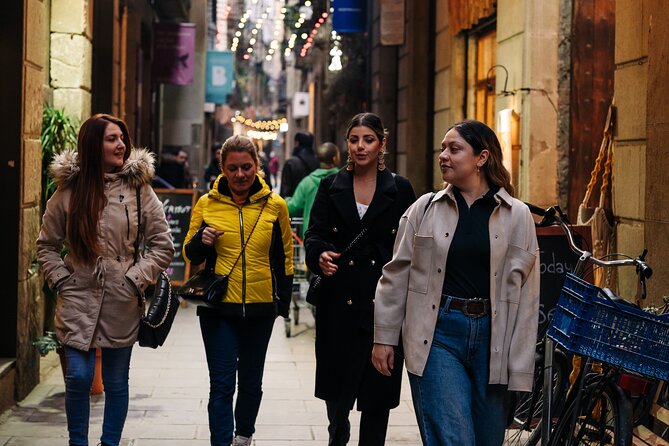
Barcelona’s old center can feel confusing at first. Streets twist, buildings hide behind plain doorways, and important history is often under your feet rather than in front of you. A guide gives the route a shape.
This walk does not try to cover Park Güell, the Sagrada Família, or the broad modern avenues. Instead, it stays in Ciutat Vella, where Barcelona’s Roman, medieval, religious, artistic, and political stories sit close together.
That focus is useful on a first day. You get a working map of the Gothic Quarter and El Born, then can return to the places that caught your attention. Guides have also offered useful follow-up advice, including restaurant suggestions such as Tapas 2254.
The route is conducted in English and accepts mobile tickets. The maximum group size is 20, so this is not a one-to-one experience unless you choose the private upgrade. Most people can take part, but remember that this is a continuous walk over old streets and squares. Good shoes are sensible, and sun protection matters on bright days.
More Historical Tours in Barcelona
- Barcelona: Tapas Walking Tour with Food, Wine, and History
★ 4.8 · 4,261 reviews - Barcelona Tapas Walking Tour: Food, Wine & History
★ 4.5 · 1,928 reviews - Barcelona: 2.5-Hour Bike or E-Bike Historical Tour
★ 4.5 · 1,262 reviews
Starting at Els 4 Gats with Picasso and Gaudí
The meeting point is Plaça del Vuit de Març in the old city. The first stop, Els 4 Gats, sets the tone well.
This café and restaurant became a meeting place for artists and thinkers. Picasso and Gaudí were among the figures connected with it, and its Art Nouveau exterior offers an early reminder that Barcelona’s artistic identity grew from cafés, workshops, and social circles, not only from grand monuments.
You do not pay an admission fee for this stop. The visit is mainly about the exterior and the stories attached to the place, so do not expect a long sit-down meal or a full interior tour as part of the two-hour walk.
I like this opening because it gives Barcelona a human scale. You begin with a place where people talked, argued, sketched, and developed ideas. That makes the city’s later architecture and art easier to understand.
The kiss mosaic and the meaning behind La Diada
Next comes El Món Neix en Cada Besada, the well-known photo mosaic made from images of kisses. It is easy to treat the wall as a quick photo stop, but the important part is the political story behind it.
The image connects with Catalonia’s defeat on September 11, 1714. That date later became La Diada, Catalonia Day, a major expression of Catalan identity.
This is one of the tour’s most useful lessons. Barcelona is not simply an attractive Spanish city with unusual architecture. Its public spaces also carry arguments about language, memory, autonomy, and independence.
The stop lasts about 10 minutes and is free. Your guide can explain the meaning, then keep the group moving before the route loses its rhythm.
Barcelona Cathedral and Saint Eulalia

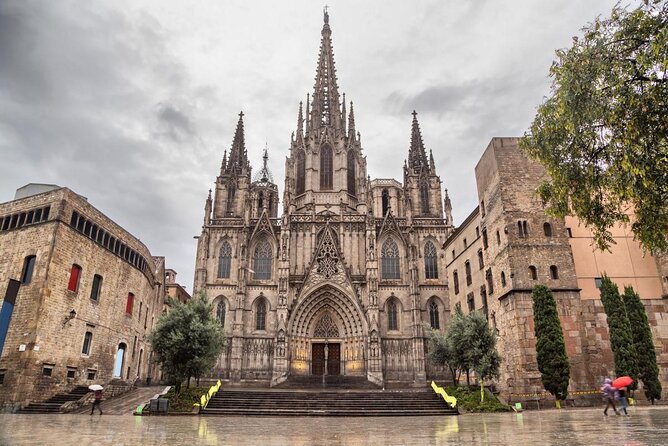
Barcelona Cathedral rises from the center of the Gothic Quarter. Construction took place over many centuries, which helps explain the layered look of the building and its long connection with the city.
The Cathedral is linked with Saint Eulalia, Barcelona’s patron saint. Her death made her a martyr, and the building preserves stories about her life and suffering.
The exterior is part of the walking route, but admission is not included. That distinction matters. You can see the Cathedral during the tour, then decide if you want to return and pay for entry at a time that suits you.
The guide’s role here is especially helpful because a Gothic church can otherwise become a quick photograph. You get the religious story, the connection to Barcelona, and a sense of how much time it took to build and adapt such a central place.
More Walking Tours in Barcelona
- Barcelona Tapas and Wine Experience Small-Group Walking Tour
★ 5.0 · 5,804 reviews - Barcelona: Tapas Food Crawl Walking Tour with Tastings
★ 4.9 · 1,798 reviews - Barcelona: Gothic Quarter Ghosts and Legends Walking Tour
★ 4.7 · 1,443 reviews - Barcelona Helicopter, Sailboat & Old Town Private Walking Tour
★ 5.0 · 1,395 reviews
Casa de l’Ardiaca and traces of Roman Barcino
Casa de l’Ardiaca is a small architectural surprise. It combines Gothic and Renaissance elements, and its Roman remains connect the modern Gothic Quarter with Barcino, the Roman city beneath present-day Barcelona.
Look for remnants of the old wall and the arcades of the aqueduct that once carried water into the city. These details are easy to miss when you walk alone, since they can look like ordinary parts of an old building.
There is no admission fee for this stop. The visit is short, but it gives you a useful habit for the rest of Barcelona: look down, look up, and question what appears to be a normal wall.
Pont del Bisbe and a legend in stone
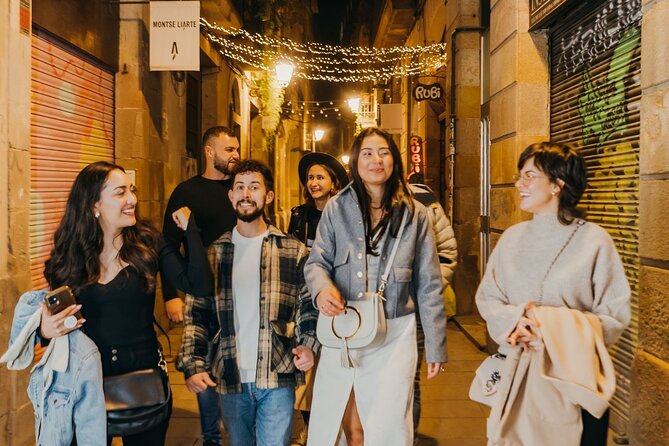
Pont del Bisbe, or Bishop’s Bridge, crosses a narrow lane in the Gothic Quarter. Its carved underside and dramatic shape make it one of the city’s favorite photo spots.
The bridge also carries a legend involving a skull. The story is meant to unsettle people who walk beneath it, even if you do not accept the superstition. That small dose of folklore adds a lighter moment after the heavier political and religious material.
The guide can point out how the bridge fits into the surrounding streets and explain why it attracts so much attention. The stop is free, but it can be crowded, so keep close enough to hear and avoid blocking the lane.
Plaça Sant Felip Neri and the city’s wounds
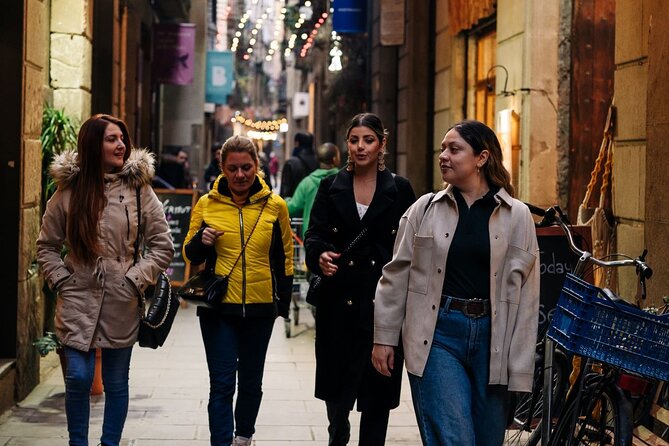
Plaça Sant Felip Neri changes the mood. This quiet square holds a painful story tied to Catalonia’s struggle for independence and still shows marks from its past.
The square is not just a pretty corner. Its damaged surfaces and subdued atmosphere make the city’s conflicts feel physical. You are looking at a place where public space preserves memory.
Allow yourself a moment here. The tour moves quickly, but this is one of the stops where the emotional weight matters as much as the facts. A guide who can explain the background clearly makes a real difference.
El Call and Barcelona’s former Jewish quarter
The route then enters MUHBA El Call, the area associated with Barcelona’s former Jewish population. Narrow streets and medieval buildings give the district a distinct feel, though it is easy to pass through without understanding what you are seeing.
This is a good example of why a walking guide adds value. The streets themselves cannot explain the community that once lived and worked here. Your guide supplies the missing names, context, and connections.
The stop is free and compact. You will not receive a full museum visit in 10 minutes, but you will gain enough orientation to return later if the area interests you.
Plaça de Sant Jaume, where Barcelona makes its politics public
Plaça de Sant Jaume is the city’s main civic square. It contains the seat of the Catalan government and City Hall, making it a natural stage for ceremonies, demonstrations, celebrations, and political debate.
The square helps bring the earlier discussion of La Diada and Catalan identity into the present. Here, history is not safely behind glass. The buildings still serve public power.
The guide also connects the square with an important figure honored during one of Catalonia’s beloved holidays. Listen closely, since this stop combines civic architecture, local tradition, and political history in a short explanation.
Plaça del Rei and the Spanish Inquisition
Plaça del Rei feels more formal than the tight lanes around it. The Royal Palace gives the square a strong medieval presence, but the guide also addresses its darker association with the Spanish Inquisition.
That contrast is valuable. Barcelona’s old center is not only a collection of beautiful façades. Royal authority, religious pressure, and fear also shaped life here.
You will have time to take in the square and hear the main story, but not to explore every building in detail. If the Royal Palace interests you, treat this as an introduction rather than a substitute for a separate visit.
Plaça de l’Àngel and Saint Eulalia’s legend
The route continues to Plaça de l’Àngel, once known as Wheat Square because it was a center for grain trading. Its later name came from a reported heavenly apparition during a procession carrying Saint Eulalia’s body.
This is a small but memorable piece of local tradition. It shows how names develop from trade, religion, and stories passed through generations.
The stop also brings Saint Eulalia back into the route after the Cathedral. That kind of repetition helps the many short explanations form a connected story instead of a string of unrelated facts.
Santa Maria del Mar and the finish in El Born
The walk ends at the Basilica de Santa Maria del Mar in El Born. This Gothic basilica is tied to Barcelona’s maritime past and gives the tour a fitting finish.
Compared with the Cathedral, Santa Maria del Mar has its own character and its own place in the city’s story. Its setting in El Born also marks a change in atmosphere as the route leaves the Gothic Quarter.
Admission is not included, so check the entry arrangements if you want to go inside. The tour ends at Plaça de Santa Maria, 1, which is useful for continuing your day in El Born. You can stop for food, explore nearby streets, or return to one of the earlier sites.
What $22.99 buys you
At $22.99, this is priced as an affordable introduction rather than a full historical seminar. You get about two hours with an English-speaking guide, a carefully connected route, and eleven stops that would be difficult to arrange efficiently on your own.
The value is strongest if you are new to Barcelona. The tour helps you understand why the Gothic Quarter matters, how El Born fits into the city, and which places deserve more of your time later.
The value is less clear if you already know the old city well or want extended interior visits. The schedule allows roughly 10 minutes at each stop, and some of that time goes to walking between locations. You are paying for explanation, direction, and context, not long stays at every monument.
A private upgrade is available if you want more personal attention. The standard group can include up to 20 people, which keeps the cost reasonable but may affect how easily you ask questions.
The guides and the listening challenge
The strongest part of this experience is the guide’s delivery. Darren is described as clear and enthusiastic, Petra as especially good at bringing Catalan culture into the walk, and Jorge as helpful with hidden spots and local tips.
Sonia’s archaeological approach adds another useful angle, while Vanessa is praised for handling questions and linking art, religion, government, and archaeology. Lydia is described as conversational and energetic, and Sarah as spirited and engaging.
Those differences matter. This route covers difficult subjects, including defeat, independence, religious persecution, and tragedy. A guide who tells stories well can keep the material understandable without turning the walk into a lecture.
One practical warning: street noise can interfere with the explanations. At least one participant found it difficult to hear without a speaker or audio guide. Stay near the guide, ask for repetition when needed, and consider the private option if hearing every detail is important to you.
Who should book this walk?
I would choose this tour for a first day in Barcelona, especially if you want a quick orientation before exploring independently. It suits history-minded visitors, architecture fans, and anyone curious about Catalan identity beyond the usual Gaudí highlights.
It also works well for people with limited time. In two hours, you see the Gothic Quarter and El Born without committing half a day to a large museum or a single monument.
Families and mixed-interest groups may also find the variety useful. The route shifts from café culture to Roman remains, legends, religion, politics, Jewish history, royal power, and maritime architecture.
I would be more cautious if you need a slow pace, extended time indoors, or guaranteed quiet listening conditions. The tour is compact and information-heavy. Good footwear and sun protection are wise, and you should plan separate admission if you want to enter the Cathedral or Santa Maria del Mar.
The tour is available in English, is near public transportation, and offers free cancellation up to 24 hours before the start time. Confirmation arrives when you book, and bookings made around six weeks ahead are common, so reserving early may be sensible for a particular date.
Should you book Barcelona in 2 Hours?
Yes, if you want context fast. For $22.99, you receive a strong introduction to the oldest parts of Barcelona, with stories that go well beyond photographing buildings.
Book it near the start of your stay, stay close to the guide, and keep your afternoon open for a second look at the places that interest you most. Choose the private upgrade if personal questions and close attention matter more than the low group price.
Skip it if you already know the Gothic Quarter and El Born or prefer to explore at your own slow pace. For most first-time visitors, though, this is a practical way to get oriented and understand the city’s complicated identity before setting off on your own.
FAQ
How long does the Barcelona walking tour last?
The tour lasts approximately two hours.
Where does the tour begin?
It begins at Plaça del Vuit de Març in Ciutat Vella, Barcelona.
Where does the tour end?
The walk ends at Basílica de Santa Maria del Mar, Plaça de Santa Maria, 1, in Ciutat Vella.
What language is the tour offered in?
The tour is offered in English.
Are admission tickets included?
Admission is free for most listed stops. Entry to Barcelona Cathedral and Basilica de Santa Maria del Mar is not included.
How large is the group?
The maximum group size is 20 people.
Can I cancel for a full refund?
Yes. You can cancel at least 24 hours before the experience start time for a full refund. Cancellations or changes made less than 24 hours in advance are not accepted or refunded.
More 2-Hour Experiences in Barcelona
- Barcelona: Two-Hour Midday or Sunset Sailing Cruise
★ 4.8 · 1,732 reviews - Barcelona: 2-Hour City Sights Guided Segway Tour
★ 4.9 · 453 reviews - Barcelona: 2-Hour Sailboat Tour with Snacks and Drinks
★ 4.8 · 357 reviews - Barcelona: Jewish Quarter 2-Hour Walking Tour
★ 4.8 · 333 reviews
Recently reviewed around Barcelona
- Excursion Aigüestortes – Estany Llebreta (1/2 day)★ 5.0 · 138 reviews
- E-Bike tour in Barcelona with English Guide★ 5.0 · 128 reviews
- Wine Tasting Experience in Barcelona★ 5.0 · 172 reviews
- Barcelona Luxury Yacht Cruise – Day or Sunset, Open Bar & Snacks★ 5.0 · 154 reviews
- Montserrat: Cog-Wheel, Basilica, Black Madonna & Licor Tasting★ 4.5 · 886 reviews
- Barcelona Wax Museum Admission Ticket★ 4.5 · 237 reviews
- Barcelona: Wine Tasting and 5 Course Tapas Pairing Dinner★ 4.5 · 129 reviews
- Andorra Original History and Sightseeing Tour (Private, Pickup)★ 5.0 · 350 reviews
Historical Tours, compared.
Madrid Essential: Historic Center, Plaza Mayor & Royal Palace
Read our review →
Tapas Walking Tour with Food, Wine, and History
Read our review →
Sevilla Food Tour: Tapas, Wine, History & Traditions
Read our review →
Valencia Old Town Tour with Wine & Tapas in 11th Century Historic Monument
Read our review →
Barcelona Tapas Walking Tour: Food, Wine & History
Read our review →
Ultimate Seville Tapas, Wine & History Small Group Tour
Read our review →
Skip-the-Line Great Mosque-Cathedral History Tour
Read our review →
Browse the lists this tour appears in