
Reviewed · AQUARIUMS
Barcelona: Hop-On Hop-Off Bus & Aquarium Tour
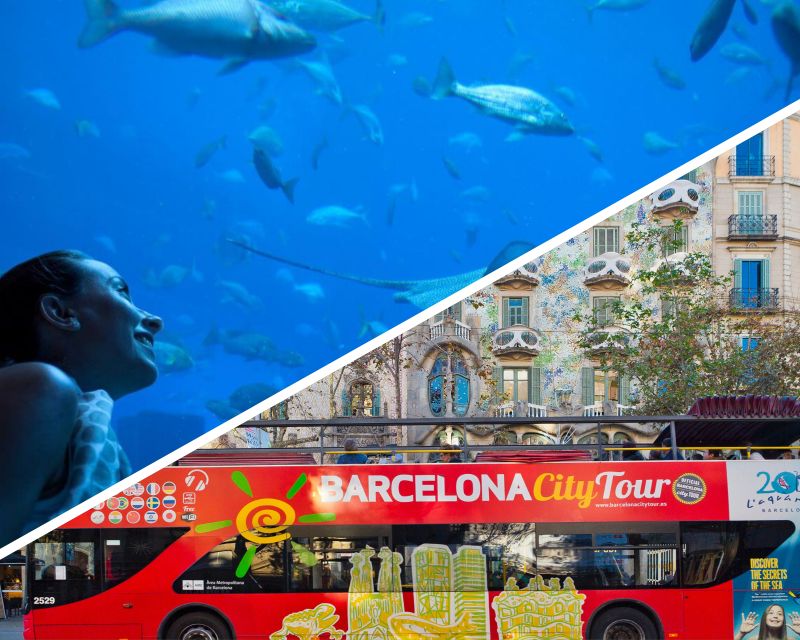
Barcelona’s best feature is its variety: Gaudí buildings, Olympic hills, beaches, old neighborhoods, football, and modern waterfront architecture. This combo lets you cover that spread without solving the city’s transit puzzle every few hours. The two bus routes reach most major sights, and the aquarium gives you a slower indoor break.
I like the freedom to ride one full loop first, then return to the stops that interest me. I also like that the Aquarium of Barcelona is included, with Mediterranean habitats, the Ebro Delta, the Medes Islands, and a long acrylic tunnel through the Oceanarium. The main drawback is practical: stop signs can be hard to spot, so finding the bus again after getting off may take some patience.
In This Review
- Key points to know before you go
- How this Barcelona combo works
- The orange West route, from the harbor to Montjuïc
- The green East route, from Barceloneta to Park Güell
- What you get at the Barcelona Aquarium
- Planning a useful one-day visit
- Why the 48-hour option can be worth the extra time
- The main practical weakness: finding your stop again
- Who will get the most from this experience
- My recommendation
- FAQ
- Where can I start the Barcelona Hop-On, Hop-Off Bus Tour?
- How long is the bus ticket valid?
- Can I use the ticket on both bus routes?
- How often do the buses run?
- How long does each route take?
- Is the Barcelona Aquarium entrance included?
- Can I enter the aquarium more than once?
- Which languages are available for the audio guide?
- Is the bus air-conditioned?
- Are meals and drinks included?
Key points to know before you go

- Two routes on one ticket: The orange West route and green East route cover Barcelona’s major cultural, architectural, beach, and waterfront sights.
- One or two consecutive days: Choose 24 or 48 hours, with unlimited hopping during the selected period.
- The aquarium is a single-use visit: Plan it carefully rather than treating it like an attraction you can enter and leave several times.
- Loops take about two hours: A full ride is useful for orientation, but frequent hopping can make the day feel rushed.
- Buses may arrive every 5 to 30 minutes: Frequency changes with the season, so leave time between stops.
- Audio is available in 18 languages: The system also includes a multilingual loop adapted for people with auditory disabilities.
How this Barcelona combo works

You can begin at Plaça Catalunya, the main stop, or board at any Barcelona City Tour stop. That flexibility matters because you may already be near Sagrada Familia, the waterfront, Plaça d’Espanya, or another point on the routes.
Your bus ticket works on both lines. The orange West route and green East route overlap at several useful points, including La Pedrera and the waterfront area, with connections that save you from riding an entire loop just to reach one nearby sight.
The bus operates from about 9:00 AM until 7:00 PM for the last return. A complete route takes roughly two hours, and buses generally come about every 30 minutes, though seasonal frequency can range from 5 to 30 minutes. I would not build a tight chain of timed attractions around the schedule. Use the bus as a flexible sightseeing frame, not as a minute-by-minute transport plan.
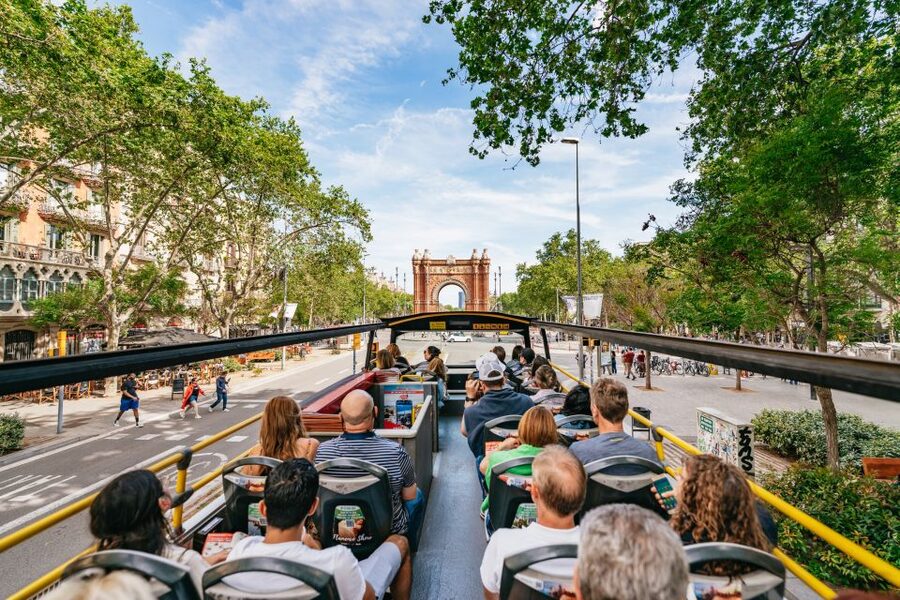
You receive a multilingual audio guide in English, Catalan, Spanish, French, German, Russian, Portuguese, Chinese, Japanese, Dutch, Hebrew, Italian, Arabic, Swedish, Norwegian, Turkish, and other listed languages. The open double-decker coaches are air-conditioned, which helps when the sun is strong, though the upper deck can still feel exposed.
More Barcelona trips worth a second look
- Barcelona Aquarium: Entry Ticket
★ 4.3 · 13,335 reviews - Barcelona Aquarium Skip the Line Ticket
★ 4.0 · 109 reviews - Mallorca: Palma Aquarium Entry Ticket w/ Optional 3D Cinema
★ 4.5 · 2,280 reviews
The orange West route, from the harbor to Montjuïc
The orange route is the better choice when you want Barcelona’s grand public spaces, hilltop views, museums, and western landmarks. Start at World Trade Center if you are near the port, or use Plaça Catalunya if you want a central launch point.
At World Trade Center, you are at the modern harbor end of the route. From there, the bus moves toward Montjuïc and its chain of cultural stops. Jardins de Miramar provides a garden setting on the hill, while Fundació Joan Miró is the obvious stop for anyone interested in modern art.
The Anella Olímpica marks Barcelona’s Olympic area. It works well as a quick photo and orientation stop, especially if you want to see how the city uses Montjuïc’s broad public spaces. Nearby, the Museu Nacional d’Art de Catalunya, usually known as MNAC, gives the route one of its strongest museum stops. Poble Espanyol offers a constructed display of Spanish regional architecture and crafts. These stops are close enough in theme to group together, but visiting all of them properly will take far longer than a quick bus break.
Caixafòrum and the Mies van der Rohe Pavilion appeal to visitors who enjoy design and architecture. The pavilion is especially useful for a short stop because the building itself is the point. Plaça d’Espanya is one of the route’s most practical places to get off, with its broad ceremonial layout and easy connection to the Montjuïc attractions.
The bus then reaches Estació de Sants, Barcelona’s main railway station, before heading toward Camp Nou and the FC Barcelona Museum. The football stop is a natural priority for supporters, though the included ticket does not cover every attraction at each stop. You should check separate admission needs if a museum or site is your main reason for getting off.
Plaça Pius XII, L’Illa Diagonal, and Avinguda Diagonal show a different side of Barcelona, with major avenues and contemporary commercial areas. These are less likely to be your main sightseeing stops, but they can be useful if you are staying in the western part of the city.
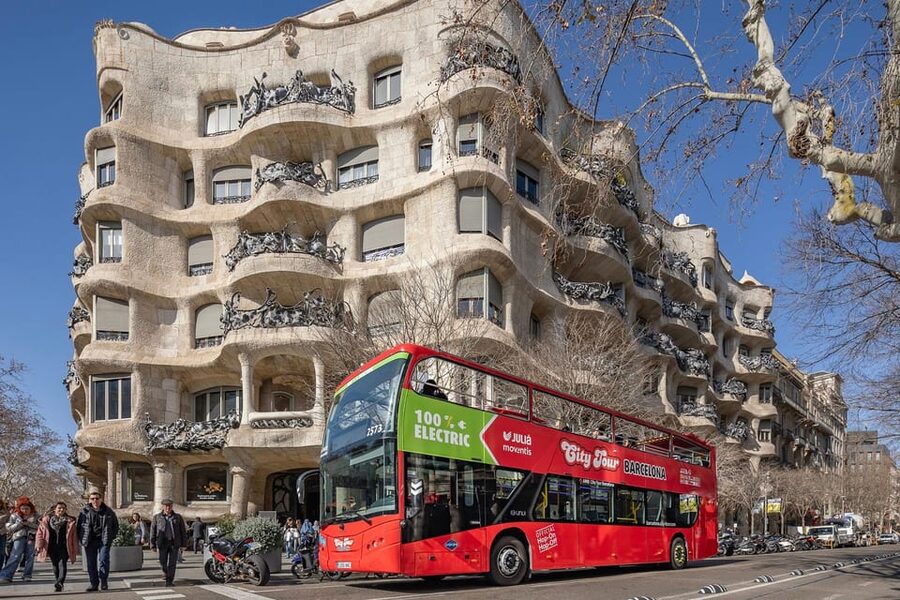
La Pedrera is one of the key transfer points between the routes and one of Antoni Gaudí’s most famous buildings. Sagrada Familia is also served on this route. The route notes a useful connection here: orange-route riders can switch toward Parc Güell without completing the full ride to Port Olímpic, while green-route riders can reach Sagrada Familia without riding the entire green loop.
The orange route then continues to Estació del Nord, the Zoo and Poblenou, Port Olímpic, Pla de Palau, and Passeig de Colom. The final stretch brings you back toward the old harbor and central waterfront. If you want a broad first look at Barcelona, this loop covers a lot of ground, but allow time for traffic and the full two-hour circuit.
The green East route, from Barceloneta to Park Güell

The green route is especially useful for Barcelona’s eastern districts, beaches, Gaudí architecture, and the modern waterfront. Pla de Palau is a practical place to join, and the route continues through Barceloneta, one of the city’s best-known seaside areas.
From Barceloneta, the bus heads to Port Olímpic, Platja del Bogatell, and Nova Mar Bella. These stops give you access to different sections of Barcelona’s urban coast. You can use this part of the route for a change of pace after museums and church interiors. The beaches are spread out, so check the stop name carefully before getting off.
The route continues to Fòrum, a large modern waterfront zone, and Torre Glòries, one of the city’s most recognizable contemporary buildings. Recinte Modernista de Sant Pau is one of the most rewarding cultural stops on this side of town. Its name refers to a modernist complex, making it a strong companion to the more famous Gaudí sights.
Park Güell is the green route’s major hilltop stop. The bus gets you near the attraction, but the included package description does not state that Park Güell admission is included. If you want to enter the monumental area, confirm the separate ticket situation before planning your day around it.
The route returns through La Pedrera and Casa Batlló, two major Gaudí buildings on Passeig de Gràcia. Even if you do not go inside, these stops give you a useful look at Barcelona’s modernist architecture. Plaça Catalunya is the central anchor, and it is the easiest starting point if you want to connect your sightseeing with the city center.
From there, the green route reaches Arc de Triomf and El Born, with Parc de la Ciutadella nearby. These stops are useful for combining architecture, public space, and old-city streets. The connection at Recinte Modernista de Sant Pau allows green-route passengers heading to Sagrada Familia to switch without taking the full route to La Pedrera.
The green loop gives you more beach and Gaudí coverage than the orange line. I would use it for Park Güell, Casa Batlló, Sagrada Familia, and the waterfront, then use the orange route for Montjuïc, MNAC, Poble Espanyol, and Camp Nou.
What you get at the Barcelona Aquarium
The aquarium is not a quick decorative add-on. It is the largest Mediterranean-themed aquarium in the world, and its focus gives the city tour a clear local connection. Instead of only seeing tropical fish, you get displays built around marine communities from the Mediterranean.
You can learn about the defining traits of species in each aquarium and see habitats inspired by protected areas on Spain’s coast. The Ebro Delta and the Medes Islands receive specific attention, giving the visit a stronger sense of place than a general collection of tanks.
The main visual payoff is the Oceanarium tunnel. The acrylic passage runs through the length of the tank, giving you views of sharks and other sea life from below and beside you. It is the sort of stop that works well for families, marine-life fans, and anyone who wants a quiet indoor hour after riding around the city.
Your aquarium ticket is valid for a single use. That detail affects the order of your day. I would not enter simply to kill a short gap between buses unless you are ready to count the visit as complete. Set aside enough time to see the Mediterranean displays and walk through the Oceanarium tunnel without rushing.
A different way to spend the day, same corner of Spain:
- Barcelona: Sagrada Familia Entry Ticket with Audio Guide
★ 4.6 · 105,312 reviews - Barcelona: Park Güell Admission Ticket
★ 4.4 · 76,534 reviews - Barcelona: Casa Batlló Entry with Self-Audioguide Tour
★ 4.7 · 25,359 reviews - Barcelona: 24 or 48-Hour Hop-On Hop-Off Bus Tour
★ 4.4 · 20,872 reviews
Planning a useful one-day visit

The 24-hour option can work well if you choose only a few stops. Start early at Plaça Catalunya, ride part of the green route toward Sagrada Familia or Park Güell, then return toward the center and continue to the aquarium. Afterward, switch to the orange route for Plaça d’Espanya, Montjuïc, or Camp Nou.
That plan is ambitious. The full loops take about two hours, and buses may be half an hour apart. If you get off at several places, you may spend a large part of the day waiting or walking between stops. Pick two or three major stops, then use the bus for the views between them.
A better one-day approach may be to ride one full loop in the morning, choose the aquarium for the middle of the day, and make one or two afternoon stops. You will see more from the upper deck if you avoid treating every stop as an obligation.
Why the 48-hour option can be worth the extra time
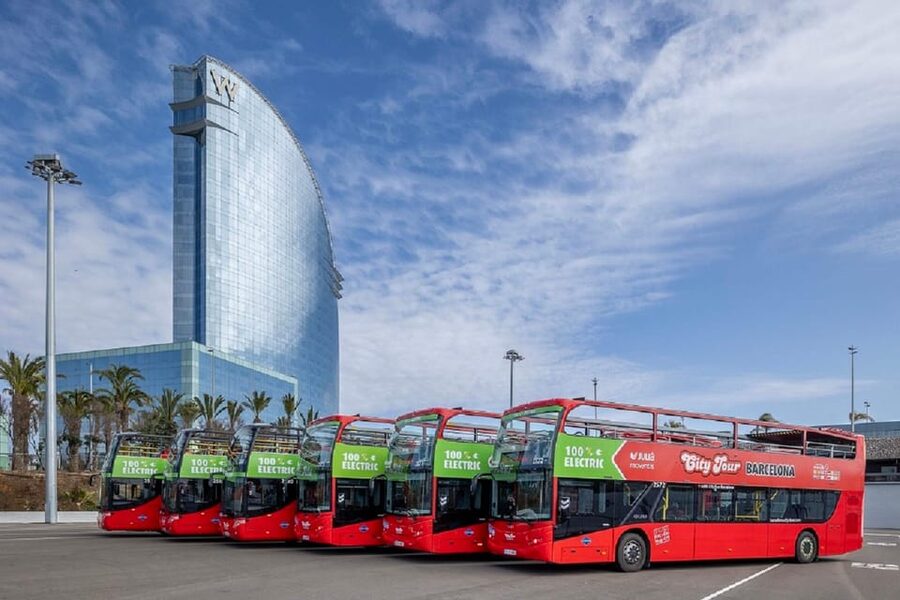
The 48-hour ticket is the easier choice if Barcelona is new to you or if you want to enter several attractions along the way. Use the first day for orientation and the second for selected stops. This reduces the pressure created by traffic, bus gaps, lunch, and the single-use aquarium visit.
The extra day also makes the less central stops more realistic. You can spend time at MNAC, the Joan Miró Foundation, Poble Espanyol, the FC Barcelona Museum, Park Güell, or the modernist complex at Sant Pau without sacrificing the waterfront.
At $73 per person, the value depends on how actively you use the bus. If you ride only once and visit the aquarium, the price is harder to justify. If you use both routes, make several hops, and replace some separate transport rides, the package becomes more practical. The discount booklet may add value, but the available details do not specify the exact discounts, so treat them as a possible bonus rather than part of your main calculation.
The bus also gives you a broad view of Barcelona that ordinary point-to-point transport does not. You can compare the old harbor, Olympic waterfront, Montjuïc, modernist avenues, and eastern beaches in one connected outing. That visual overview is the strongest reason to choose this format.
The main practical weakness: finding your stop again
Stop identification deserves attention. The route can be easy to understand on paper, but after you get off, locating the boarding point again may not be obvious. One recent booking note specifically points to a lack of clear signage at some stops.
Before leaving the bus, study the stop guide and remember the exact stop name. Keep the Barcelona City Tour guide with you, and ask where the return bus boards if the location is unclear. Do not assume the next bus will use the same curb where you were dropped off.
The route can also change because of demonstrations, sports events, cultural events, or other city conditions. The listed itinerary is a useful plan, not a guarantee that every street will be open at every moment.
Who will get the most from this experience

I would recommend this combo to first-time Barcelona visitors who want a city overview without committing to a private guide or a packed walking schedule. It also suits families, older visitors, and anyone who prefers to limit long stretches on foot.
The multilingual audio system is helpful for mixed-language groups. The adapted audio loop for people with auditory disabilities is another useful feature, though the supplied details do not explain the exact equipment or settings.
This is less suitable if you already know Barcelona well and plan to use the metro for fast point-to-point trips. It is also not the best match for someone who wants a tightly timed itinerary. Traffic and bus frequency make this a flexible sightseeing tool, not a precision shuttle.
My recommendation
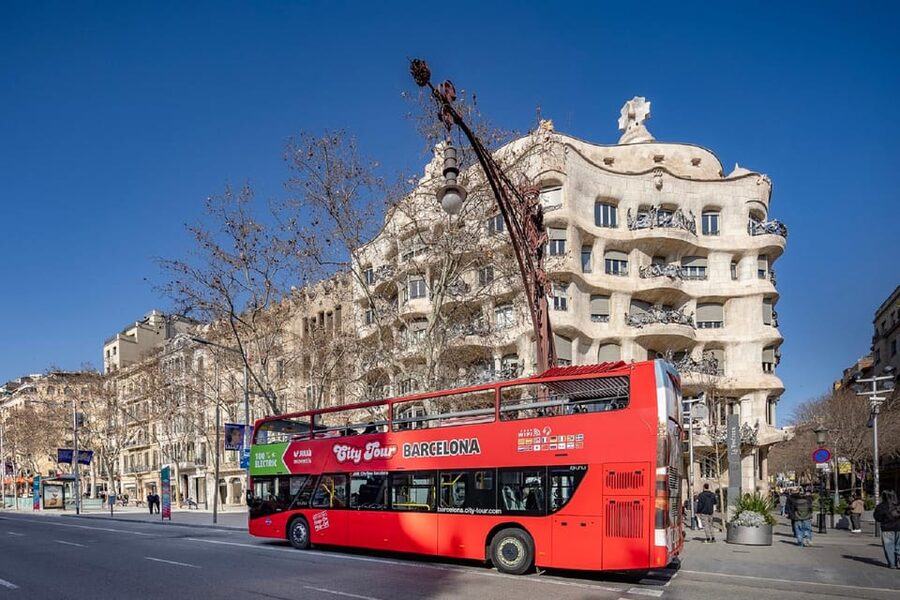
Book this tour if you want a broad first look at Barcelona, value the freedom to change plans, and will use the aquarium as a real part of the day. The best value comes from choosing the 48-hour option and visiting several areas, especially if you plan to ride both routes.
Choose the 24-hour option if your schedule is short and you mainly want the aquarium plus a quick city overview. In either case, mark your return stop before getting off, allow generous time between rides, and do not try to see every listed attraction in one day. The experience works best when you let Barcelona unfold in sections rather than racing from stop to stop.
FAQ
Where can I start the Barcelona Hop-On, Hop-Off Bus Tour?
You can start at Plaça Catalunya, the main stop, or board at any stop served by the Barcelona City Tour.
How long is the bus ticket valid?
The ticket is valid for one or two consecutive days, depending on the option selected.
Can I use the ticket on both bus routes?
Yes. A single ticket includes all stops and both the orange West route and green East route.
How often do the buses run?
Bus frequency varies by season, from about every 5 to 30 minutes. The stated operating information gives approximately 30-minute departures, from 9:00 AM until 7:00 PM for the last return.
How long does each route take?
Each complete route takes approximately two hours.
Is the Barcelona Aquarium entrance included?
Yes. Aquarium admission is included in the combo ticket.
Can I enter the aquarium more than once?
No. The aquarium ticket is valid for a single use.
Which languages are available for the audio guide?
The audio guide is available in English, Catalan, Spanish, French, German, Russian, Portuguese, Chinese, Japanese, Dutch, Hebrew, Italian, Arabic, Swedish, Norwegian, and Turkish.
Is the bus air-conditioned?
Yes. The experience uses air-conditioned double-decker open coaches.
Are meals and drinks included?
No. Lunch, drinks, pickup, drop-off, and services not specifically listed are not included.
Recently reviewed around Barcelona
- Excursion Aigüestortes – Estany Llebreta (1/2 day)★ 5.0 · 138 reviews
- E-Bike tour in Barcelona with English Guide★ 5.0 · 128 reviews
- Wine Tasting Experience in Barcelona★ 5.0 · 172 reviews
- Barcelona Luxury Yacht Cruise – Day or Sunset, Open Bar & Snacks★ 5.0 · 154 reviews
- Montserrat: Cog-Wheel, Basilica, Black Madonna & Licor Tasting★ 4.5 · 886 reviews
- Barcelona Wax Museum Admission Ticket★ 4.5 · 237 reviews
- Barcelona: Wine Tasting and 5 Course Tapas Pairing Dinner★ 4.5 · 129 reviews
- Andorra Original History and Sightseeing Tour (Private, Pickup)★ 5.0 · 350 reviews
Aquariums, compared.


Palma Aquarium Entry Ticket w/ Optional 3D Cinema
Read our review →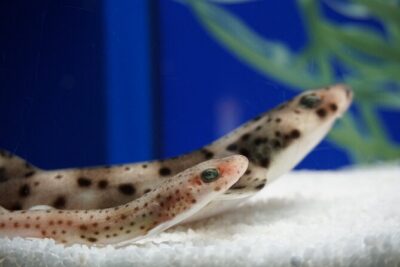



Cala Salada and Unspoiled North Beach Tour. Snorkelling and Aquarium
Read our review →
Browse the lists this tour appears in