
Reviewed · WALKING TOURS
Barcelona 2-Hour Gothic Walking Tour
Barcelona’s Gothic Quarter is best understood one doorway, courtyard, and oddly placed stone at a time. This two-hour walk connects Roman Barcino, medieval royal power, Gothic churches, and Civil War scars, with guides such as Olga Escribano, Jordi, Pilar, and Alex bringing the streets into focus. I especially like the visit to the Cathedral cloister and the stop at Plaça Sant Felip Neri, two places easy to miss when exploring alone.
The second strong point is the pace. Most sights are close together, so you cover a great deal without marching across the city. The English tour also includes free time at Museu Frederic Marès, a useful cultural bonus. The main consideration is simple: you will be on your feet for the full two hours, often on old cobbles, so eat beforehand, carry water, and wear sensible shoes.
In This Review
- Key points at a glance
- Why two hours works in Barcelona’s Gothic Quarter
- Starting at Plaça Seu and Barcelona Cathedral
- Roman Temple of Augustus and the first city
- Palau Reial Major, Santa Àgata, and the Saló del Tinell
- Plaça del Rei and the quarter’s medieval lanes
- Carrer del Bisbe and Plaça Sant Felip Neri
- The English tour’s Museu Frederic Marès finale
- Pace, footwear, and practical comfort
- Who will get the most from this walk
- Is the $32 price good value?
- Should you book the Barcelona Gothic walking tour?
- FAQ
- How long is the Barcelona Gothic walking tour?
- How much does the tour cost?
- Where does the tour meet?
- What language is the live tour conducted in?
- Does the tour visit Barcelona Cathedral?
- Is Museu Frederic Marès included?
- Can I cancel the booking?
- Can I reserve now and pay later?
Key points at a glance
- Roman Barcelona behind medieval walls: See the Temple of Augustus and traces of ancient Barcino tucked into the Gothic streets.
- A close look at the Cathedral: Explore the Gothic building and its cloister with a guide who explains what you are seeing.
- Royal rooms and major events: Visit the Palau Reial Major, Capella de Santa Àgata, and Saló del Tinell.
- The moving Plaça Sant Felip Neri: Learn how the square’s damaged walls reflect Barcelona’s difficult 20th-century past.
- Museu Frederic Marès included in English: Finish with free time among sculptures, religious art, and antique objects.
- Strong value at $32: Two hours of guiding plus museum admission gives first-time visitors a useful introduction to the old city.
Why two hours works in Barcelona’s Gothic Quarter
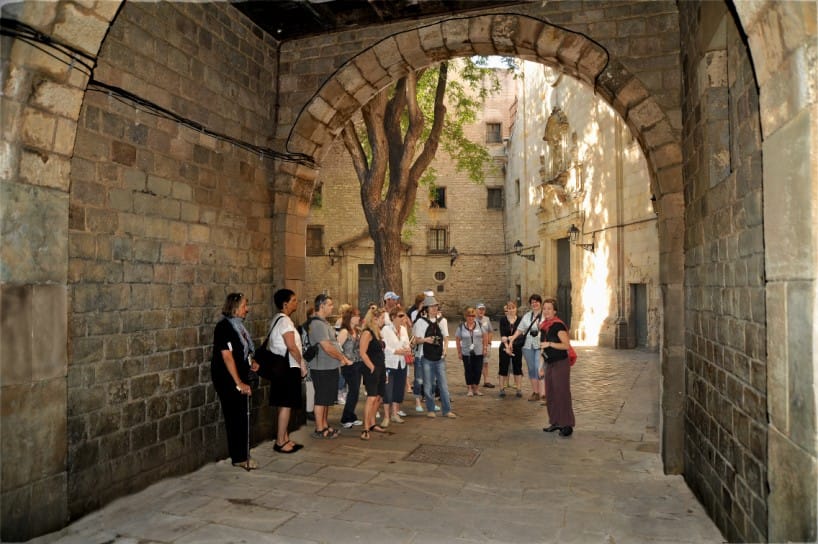
The Gothic Quarter can feel confusing in the best possible way. Its narrow lanes twist around small squares, church walls, former palaces, and bits of Roman masonry. You may walk past an unremarkable arch or courtyard and never guess that it marks an important chapter in Barcelona’s past.
That is where this tour earns its keep. A local guide gives the streets a clear sequence. You begin with the Roman city, move into medieval Catalonia, and then see how the old quarter still functions as part of modern Barcelona. The guide does not simply point at façades. The aim is to explain how the buildings, squares, and power centers fit together.
At $32 per person, I see this as a fairly priced orientation walk. You are not paying for transport or a long list of distant admissions. You are paying for two hours of interpretation in one of the city’s most layered areas, along with the English tour’s admission to Museu Frederic Marès.
The compact route also matters. Several visitors found the pace comfortable, including one person with movement difficulty. Another visitor noted that the sights are close together, although you should still expect continuous walking. That combination makes the tour easier than a citywide walking route, but it is not a seated history talk.
More Walking Tours in Barcelona
- Barcelona Tapas and Wine Experience Small-Group Walking Tour
★ 5.0 · 5,804 reviews - Barcelona: Tapas Walking Tour with Food, Wine, and History
★ 4.8 · 4,261 reviews - Barcelona Tapas Walking Tour: Food, Wine & History
★ 4.5 · 1,928 reviews
Starting at Plaça Seu and Barcelona Cathedral
The meeting point is at the tourist information office at Plaça Seu, 2. Look for the office marked with the familiar i symbol. This is a practical place to begin because the Cathedral gives you an immediate sense of the quarter’s scale and age.
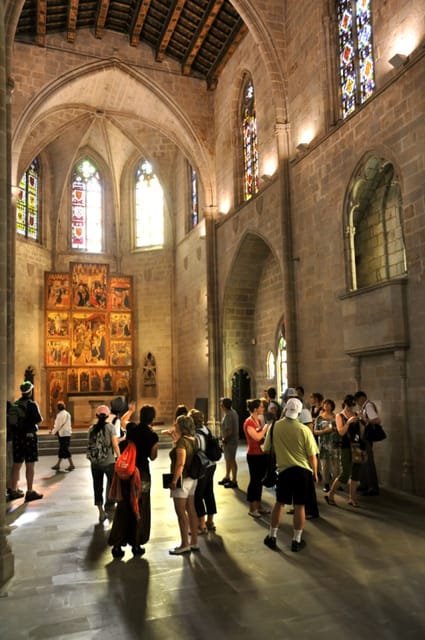
Barcelona Cathedral is more than a quick photo stop here. The guide leads you closer to its Gothic architecture and explains details that can blur together when you are looking at a large stone façade. The visit includes the cloister, one of the most rewarding parts of the experience.
The cloister offers a quieter change from the streets. It gives you time to look at the building from within rather than simply admire its towers from outside. The guided explanation helps you read the architecture, understand its role, and notice details you might otherwise pass without a second thought.
This is also the point where the tour establishes its style. You are not rushing through a checklist of famous buildings. You are moving a short distance, pausing often, and listening to the story behind each place. In a busy part of Barcelona, that measured approach is useful.
Roman Temple of Augustus and the first city
The Gothic Quarter is not only Gothic. Beneath and between its medieval structures are remains of Roman Barcelona, known as Barcino. The Roman Temple of Augustus is a particularly striking example because it is tucked into a medieval setting rather than displayed in a broad, open ruin field.
A guide is valuable here because the remains can be easy to misunderstand. You need context to picture the Roman city and to see how later construction grew around it. The stop gives the tour its long time span, reaching back roughly 2,000 years before returning to the better-known medieval quarter.
I like this contrast. One minute you are looking at narrow lanes and Gothic stonework, and the next you are considering the Roman grid and civic life beneath the present-day neighborhood. It is a good reminder that Barcelona’s oldest central district was rebuilt and repurposed many times.
Do not expect an archaeological museum visit at this point. This is a guided street stop, designed to help you recognize the remains and place them in the city’s story. If you want a long, technical study of Roman Barcelona, you will need a separate museum visit. For a first introduction, the explanation is more important than the amount of time spent standing at the ruins.
Palau Reial Major, Santa Àgata, and the Saló del Tinell
The route then moves into the former royal center of Barcelona. The Palau Reial Major was home to Catalan kings, and it gives the tour a strong sense of medieval political power. Here, the quarter’s streets stop feeling like a collection of pretty old buildings and start to resemble the center of a working court.
The Capella de Santa Àgata adds a religious dimension. Its setting is atmospheric, and the guide’s job is to connect the chapel to the larger royal complex rather than treat it as an isolated church. You get a better understanding of how faith, ceremony, and government occupied the same small area.
The Saló del Tinell is another major stop. This grand medieval hall is linked with important royal events, including the meeting where Ferdinand and Isabella received Columbus after his return from the New World voyage. That story gives the room a wider reach than its walls suggest, connecting Barcelona to one of the most consequential moments in European history.
I find this section especially useful for visitors who know Barcelona mainly through Gaudí and modernist architecture. The city’s identity did not begin in the 19th century. These royal spaces show Catalonia as a political and cultural center long before the familiar modern skyline took shape.
The drawback is that historical sites can be visually subtle. Some rooms and chapels may not deliver the instant drama of a huge cathedral interior. You get more from them if you listen closely and allow the guide to supply the background.
More Barcelona walks with a guide:
- Barcelona: Tapas Food Crawl Walking Tour with Tastings
★ 4.9 · 1,798 reviews - Barcelona: Gothic Quarter Ghosts and Legends Walking Tour
★ 4.7 · 1,443 reviews - Barcelona Helicopter, Sailboat & Old Town Private Walking Tour
★ 5.0 · 1,395 reviews - Barcelona: Old Town and Gothic Quarter Walking Tour
★ 4.8 · 1,393 reviews
Plaça del Rei and the quarter’s medieval lanes
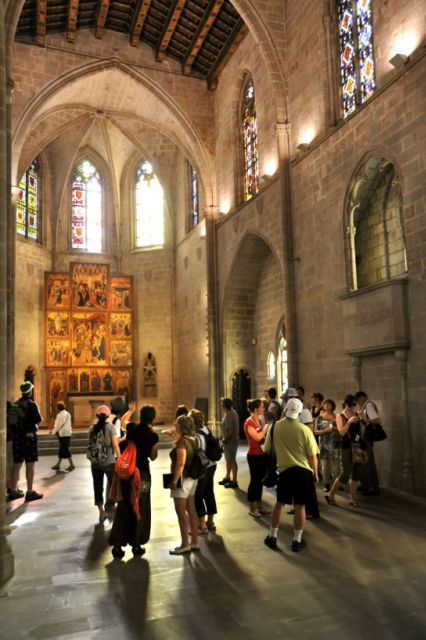
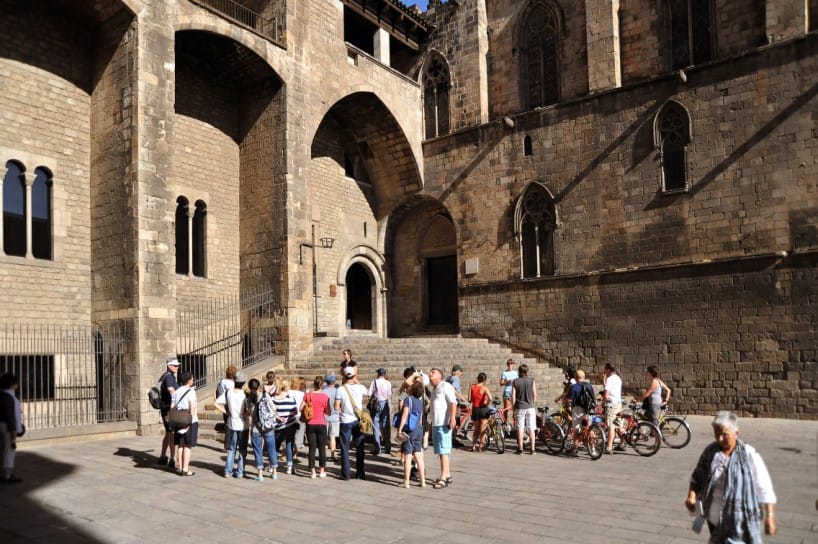
Plaça del Rei is one of the most atmospheric squares on the route. Its enclosed feeling helps you imagine medieval Barcelona, when royal buildings, churches, and civic spaces were concentrated within a much smaller city.
This is a good place for photographs, but the tour’s value is not limited to the view. Your guide points out how the surrounding buildings relate to one another and explains the square’s place in Barcelona’s political past. You may also hear stories of merchants, knights, saints, conflicts, and personal dramas connected with the old lanes.
That storytelling is one of the experience’s strongest features. Several guides received praise for making facts entertaining, answering questions, and adapting explanations to the group. Olga Escribano was repeatedly singled out for her enthusiasm and command of local history. Jordi, Alex, Pilar, Olga, Luca, Theo, Miguel, and others were also praised for warmth, humor, and helpful recommendations.
Guide quality can vary from one departure to another, as it does on any live tour. Still, the experience depends heavily on the person leading it, and the available feedback points to a consistently strong standard. You should expect a guide who explains the quarter rather than simply naming buildings.
Carrer del Bisbe and Plaça Sant Felip Neri
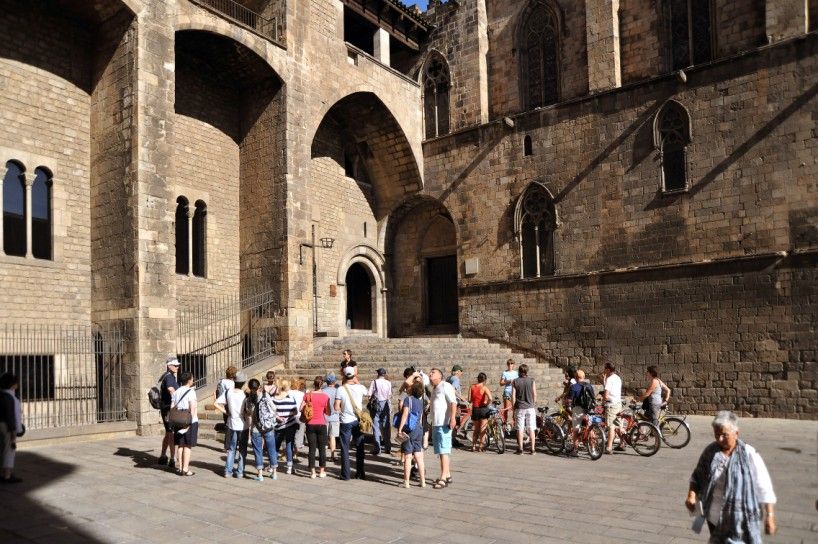
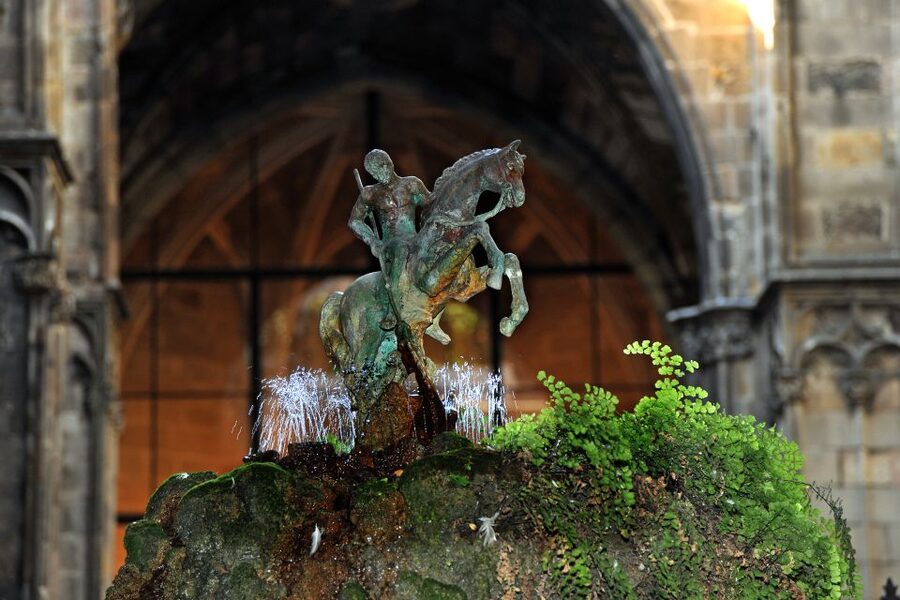
Carrer del Bisbe is one of the Gothic Quarter’s most photographed lanes. Its Gothic façades, balconies, and narrow perspective make it an obvious camera stop. A guide helps you look beyond the picture and understand how the street fits into the old quarter’s changing identity.
The most emotionally powerful stop is Plaça Sant Felip Neri. It is a quiet square with a Baroque church and walls marked by damage from Spanish Civil War bombings. The scars are not decorative old-world details. They are a direct reminder of violence and loss.
The square’s present-day calm creates a sharp contrast. Children play there, and musicians may fill the space with sound, while the damaged walls remain in view. That combination makes the stop more moving than a standard architecture pause. It shows how Barcelona’s old center carries both beauty and painful memory.
I would not rush this part. Listen to the explanation, look carefully at the walls, and notice how different the square feels from the busier lanes nearby. The tour is at its best when it connects architecture with ordinary human lives.
The English tour’s Museu Frederic Marès finale
After the walking portion, the English-language tour includes admission to Museu Frederic Marès, housed in a medieval palace. You receive free time there rather than another tightly guided sequence of stops.
The museum contains sculptures, medieval religious art, antique curiosities, and everyday objects collected by Frederic Marès. Its displays reach from sacred medieval pieces to 19th-century personal and household items. That range makes it a fitting end to the walk because you continue moving through Barcelona’s past, but now at your own speed.
This bonus adds real value to the $32 price. If you are interested in art, collecting, sculpture, or unusual historical objects, allow enough energy for the museum after the streets. If you are already tired, you can treat it as an optional final stop within the included admission rather than forcing yourself through every gallery.
The museum also gives you a break from the group. The walking tour supplies structure and explanation; the free museum time lets you follow your own interests. That balance works well.
One point to check when booking is the language. The included Museu Frederic Marès visit is specifically attached to the English tour. The stated live guide language is English, so choose that departure if you want the museum addition.
Pace, footwear, and practical comfort
Two hours sounds short, but a walking tour can feel long if you arrive unprepared. Have something to eat first and bring water. One visitor gave particularly useful advice after seeing members of the group become hungry near the end.
Wear shoes with good grip. The route stays in a compact area, but the Gothic Quarter is defined by old streets and cobbles. You will stop often, yet you remain on your feet throughout the walk.
Weather can change the feel of the experience. The tour operates in rain, and one person found it worthwhile even on a wet day, though rain did affect access to a tower on one earlier outing. An umbrella and a light waterproof layer will help. On hot days, water and a hat make the pauses more comfortable.
The meeting point is central, and the tour returns to Plaça Seu, 2. There are no transport segments, so you do not lose time boarding a bus or moving between distant districts. That is one reason the route manages to include so many historic sites in two hours.
The tour’s exact start time varies, so check the available departures before booking. Free cancellation is available up to 24 hours ahead for a full refund, and you can reserve now and pay later. Those policies are useful if your Barcelona schedule is still shifting.
Who will get the most from this walk
I would put this tour near the start of a first Barcelona visit. It gives you a mental map of the Gothic Quarter and helps you decide where to return for a longer look. It also works well on your first morning or afternoon because the route stays focused and does not consume an entire day.
History-minded visitors will get the most from the Roman, royal, religious, and Civil War connections. Architecture fans will appreciate the Cathedral, cloister, Gothic lanes, chapel, and palace spaces. Families with older children and teenagers can also enjoy it because the guide’s stories turn buildings into human events rather than a string of dates.
The tour suits people who prefer explanation to wandering. If you love getting lost and forming your own impressions, you may find the guided structure a little restrictive, though the free museum time gives you some independence at the end.
It is less suitable for anyone who cannot comfortably walk or stand for two hours. The route is compact, and one guide handled a guest with movement difficulty thoughtfully, but the experience remains a walking tour over historic streets. Ask about current conditions if mobility is a major concern.
Is the $32 price good value?
For $32, you receive a two-hour guided tour, visits to several major Gothic Quarter sites, and free admission to Museu Frederic Marès on the English departure. I consider that good value if this is your first serious look at Barcelona’s old center.
The value comes from the connections. You see Roman remains, the Cathedral, royal halls, a chapel, a historic square, and a Civil War site in one compact outing. Without a guide, you could find some of these places, but you might not understand why they matter or how they fit together.
It is not the right purchase if you only want interior access to the Cathedral or a long museum visit. The tour gives you a broad, guided introduction, not hours at one monument. Think of it as a strong foundation for exploring the quarter on your own later.
Should you book the Barcelona Gothic walking tour?
Book it if you want Barcelona’s oldest district to make sense quickly. The best reasons are the Cathedral cloister, the Roman Temple of Augustus, the royal complex, Plaça Sant Felip Neri, and the extra museum time in English.
I would skip it only if you dislike guided groups, cannot manage two hours of walking, or have already spent considerable time studying the Gothic Quarter. For most first-time visitors, $32 buys useful context, a sensible route, and access to details you would likely miss on your own. Arrive fed, bring water, wear good shoes, and let the guide handle the detective work.
FAQ
How long is the Barcelona Gothic walking tour?
The tour lasts two hours. The English-language experience also includes free time at Museu Frederic Marès after the walking portion.
How much does the tour cost?
The listed price is $32 per person.
Where does the tour meet?
Meet at the tourist information office at Plaça Seu, 2. Look for the office marked with the i symbol.
What language is the live tour conducted in?
The live guided tour is conducted in English.
Does the tour visit Barcelona Cathedral?
Yes. The itinerary includes a guided visit to Barcelona Cathedral, including a closer look at its cloister.
Is Museu Frederic Marès included?
The English tour includes a visit to Museu Frederic Marès after the walk, with free time there.
Can I cancel the booking?
You can cancel up to 24 hours in advance for a full refund.
Can I reserve now and pay later?
Yes. The activity allows you to reserve your place and pay later.
More 2-Hour Experiences in Barcelona
- Barcelona: Two-Hour Midday or Sunset Sailing Cruise
★ 4.8 · 1,732 reviews - Barcelona: 2-Hour City Sights Guided Segway Tour
★ 4.9 · 453 reviews - Barcelona: 2-Hour Sailboat Tour with Snacks and Drinks
★ 4.8 · 357 reviews - Barcelona: Jewish Quarter 2-Hour Walking Tour
★ 4.8 · 333 reviews
Recently reviewed around Barcelona
- Excursion Aigüestortes – Estany Llebreta (1/2 day)★ 5.0 · 138 reviews
- E-Bike tour in Barcelona with English Guide★ 5.0 · 128 reviews
- Wine Tasting Experience in Barcelona★ 5.0 · 172 reviews
- Barcelona Luxury Yacht Cruise – Day or Sunset, Open Bar & Snacks★ 5.0 · 154 reviews
- Montserrat: Cog-Wheel, Basilica, Black Madonna & Licor Tasting★ 4.5 · 886 reviews
- Barcelona Wax Museum Admission Ticket★ 4.5 · 237 reviews
- Barcelona: Wine Tasting and 5 Course Tapas Pairing Dinner★ 4.5 · 129 reviews
- Andorra Original History and Sightseeing Tour (Private, Pickup)★ 5.0 · 350 reviews
Walking Tours, compared.
Barcelona Tapas and Wine Experience Small-Group Walking Tour
Read our review →
Tapas Walking Tour with Food, Wine, and History
Read our review →
Albaicín and Sacromonte Guided Sunset Walking Tour
Read our review →
Toledo Tour & Vineyard Walk with Wine Tasting from Madrid
Read our review →

Barcelona Tapas Walking Tour: Food, Wine & History
Read our review →
Madrid Old Town & Royal Palace Walking Tour Skip the Line Ticket
Read our review →
Browse the lists this tour appears in