
Reviewed · SEVILLE TOURS
Seville: Casa de Pilatos Ground Floor Entry Ticket
Casa de Pilatos is Seville’s great lesson in how Islamic, Gothic, and Renaissance styles can share one address. You enter through a marble gate, pass into a courtyard ringed with Roman busts, and move through rooms where tiles, carved ceilings, fountains, and sculpture compete for your attention.
I like the quiet courtyards and gardens, which give this palace a slower feel than the Royal Alcázar. I also like the audio guide, since it lets you stop for photos or sit in a window while still learning about the house. The main drawback is clear: the $14 ticket covers only the ground floor, and the audio commentary can feel too detailed for some visitors.
In This Review
- Key points
- Why Casa de Pilatos deserves a place in your Seville plans
- The marble gate and the first courtyard
- Tilework that rewards a slow pace
- The Chapel of Flagellation and the palace’s oldest layer
- Renaissance rooms and the Salón del Pretorio
- Pallas Pacifera and the language of power
- Gardens that slow the visit down
- How the audio guide works in practice
- Ground floor value at $14
- Best times and useful planning details
- Who will enjoy this visit most
- Should you book Casa de Pilatos?
- FAQ
- What does the Casa de Pilatos ticket include?
- Is the upper floor included?
- Which languages are available for the audio guide?
- Is there a live guide?
- When is the last entry?
- Can I visit for free on Monday?
Key points
- Roman sculpture in an Andalusian courtyard: See 24 busts of Roman emperors, along with figures such as Hadrian, Aphrodite, and Apollo.
- A meeting of architectural styles: Mudejar-Gothic details share space with Renaissance design, creating Casa de Pilatos’s distinctive look.
- The Chapel of Flagellation: Visit the oldest section of the palace, with a basket-handle arch and a blend of Christian and Islamic forms.
- Tilework at every turn: Glazed ceramics cover walls and floors, making even passageways part of the display.
- Peaceful gardens: Wander among Renaissance-style gardens and sculptures at your own pace.
- Ground floor only: The upper floor is not included, though it may be possible to add a separate visit on arrival.
Why Casa de Pilatos deserves a place in your Seville plans
Seville has no shortage of grand buildings. The Royal Alcázar gets the crowds, the cathedral gets the postcard shots, and Casa de Pilatos often slips quietly between them. That is part of its appeal.
This is not a huge palace complex. It is a private aristocratic residence, built and developed by the Enríquez de Ribera family during the 15th century and later shaped by Renaissance taste. The result feels intimate enough to study closely. You are not simply walking past one grand room after another. You are looking at a home arranged around patios, drawing rooms, chapels, and gardens.
I find the building most rewarding when you pay attention to the contrasts. Christian symbols sit beside Islamic-influenced tilework. Classical Roman sculpture appears in an Andalusian courtyard. Renaissance ceilings hang above rooms whose patterns and forms still recall Seville’s Mudejar tradition.
That mixture tells you something useful about the city. Seville’s architecture did not develop in neat chapters. Styles overlapped, families borrowed from earlier traditions, and wealthy owners used art and design to show their connections and status.
More Seville trips worth a second look
- Seville: Royal Alcázar Entry Ticket
★ 4.6 · 28,378 reviews - Seville: Cathedral and La Giralda Entry Ticket
★ 4.5 · 24,592 reviews - Seville: Live Flamenco Dancing Show Ticket at the Theater
★ 4.7 · 16,396 reviews
The marble gate and the first courtyard
Your visit begins at a detailed Renaissance-style marble gate. It prepares you for a palace that wants to impress, but the real payoff comes just beyond it.
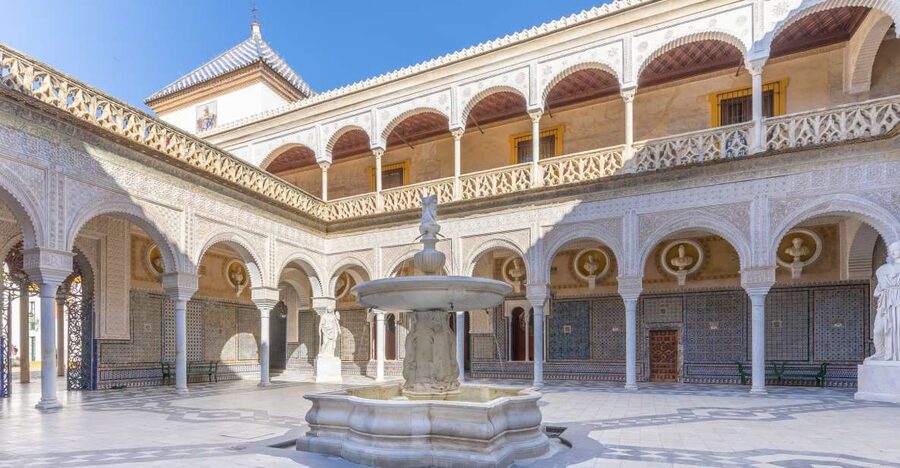
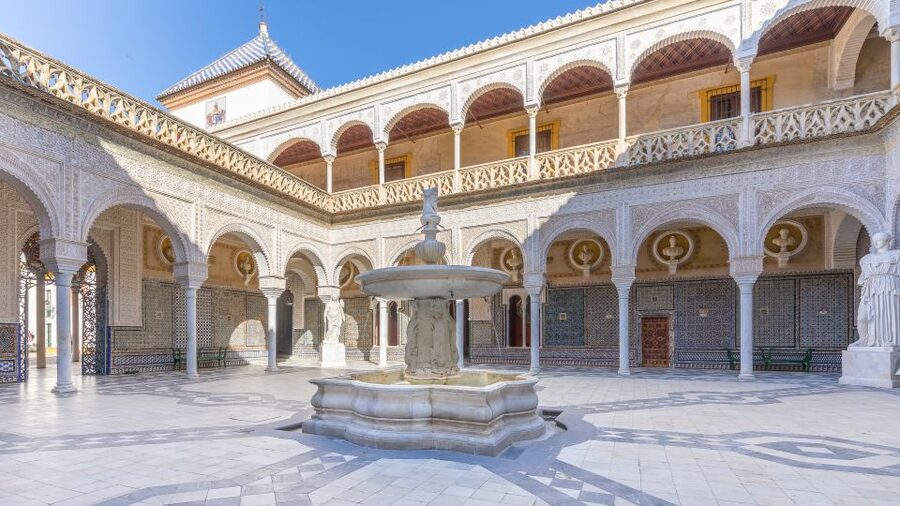
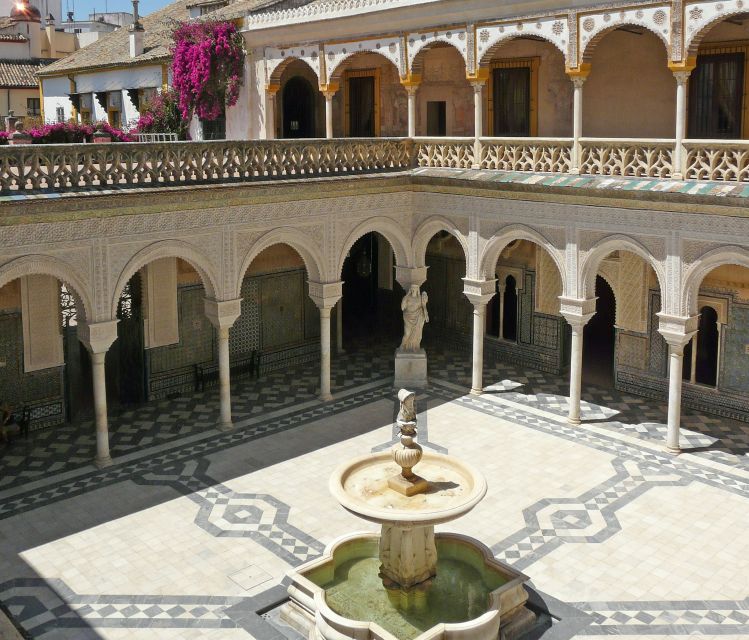
The main courtyard is the visual center of the ground floor. Fountains, tilework, columns, and sculpture frame the open space, while 24 busts of Roman emperors look down from their positions around the courtyard. You also see figures associated with Classical antiquity, including Emperor Hadrian, Aphrodite, and Apollo.
This collection gives the courtyard a museum-like quality, but the setting keeps it from feeling formal or stiff. Water, plants, patterned ceramics, and open sky soften the display. Take a slow lap before following the audio guide. You will understand the layout better if you first get a feel for how the rooms connect around the courtyard.
The sculpture collection is particularly valuable if you enjoy ancient art but do not want to spend an entire day in a museum. You see the pieces as part of a lived-in palace, where they were collected and displayed to shape the identity of the family.
Tilework that rewards a slow pace
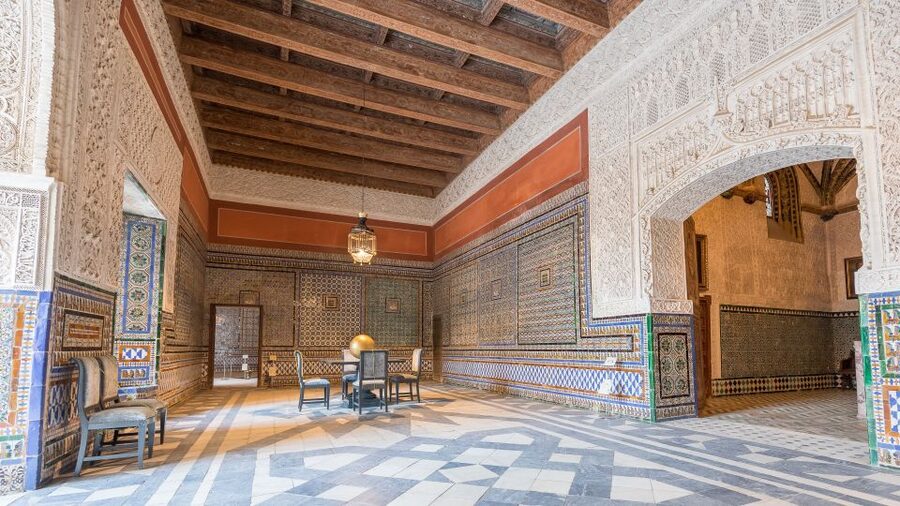
The glazed tiles are among Casa de Pilatos’s strongest features. They cover walls and floors in patterns that shift from room to room, and they give the palace a cool, decorative character.
This is not a place to rush through while looking only at ceilings. Pause near the tiled walls and look at how the patterns frame doorways, benches, arches, and courtyards. The ceramics are not just decoration added at the end. They help organize the rooms and tie the separate architectural traditions together.
For many visitors, the tilework becomes the main reason to linger. It also makes Casa de Pilatos a good stop for photographers. The palace has many strong details, but the patterned surfaces give you an easy way to focus your eye. Morning and early afternoon visits can be especially pleasant when the rooms are less crowded, though conditions vary.
The ground floor route is easy to follow, with signs that match the audio guide. You can stop the commentary, take pictures, or return to a room without being tied to a group schedule. That freedom matters in a building where a small tile panel or carved doorway may deserve more time than the room beside it.
The Chapel of Flagellation and the palace’s oldest layer
The Chapel of Flagellation is the oldest part of Casa de Pilatos. It is one of the most useful stops for understanding why the palace feels so different from a straightforward Renaissance mansion.
Look for the ornate basket-handle arch and the mixture of Christian and Islamic-influenced forms. Here, Mudejar-Gothic design meets later Renaissance work. The transition is not hidden or smoothed over. It is visible in the shapes, decoration, and structure.
The chapel also gives the visit a sense of time. The palace was not created in one burst according to a single plan. It developed as the family expanded, renovated, and adapted the residence. The audio guide adds background on the building’s construction and the family connected with it, helping you place the chapel within the wider story.
If you are mainly interested in grand rooms and gardens, this section may feel more restrained. I would still make time for it. It is one of the places where Casa de Pilatos explains itself best.
A different way to spend the day, same corner of Spain:
- Seville: Casa de la Memoria Flamenco Show
★ 4.8 · 12,964 reviews - Seville: 1-Hour Guadalquivir River Sightseeing Eco Cruise
★ 4.2 · 10,281 reviews - Seville: Cathedral, Giralda, and Royal Alcázar Guided Tour
★ 4.7 · 9,165 reviews - Seville: Setas de Sevilla Entry Ticket
★ 4.6 · 8,901 reviews
Renaissance rooms and the Salón del Pretorio
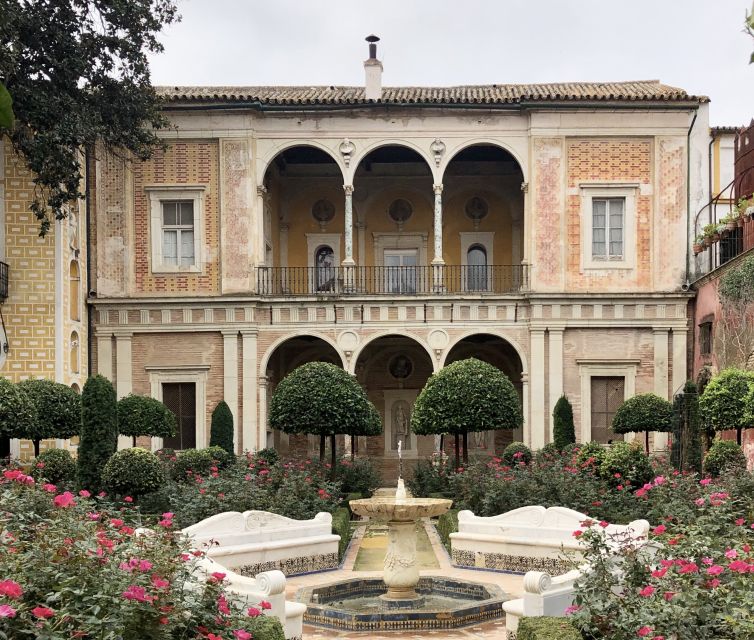
From the courtyard, you move through drawing rooms and other decorated spaces filled with sculpture, paintings, carved details, and tiled surfaces. The rooms are not all equally dramatic, but that variety is part of the experience. Some reward a quick look, while others invite you to sit and study the ceiling or wall patterns.
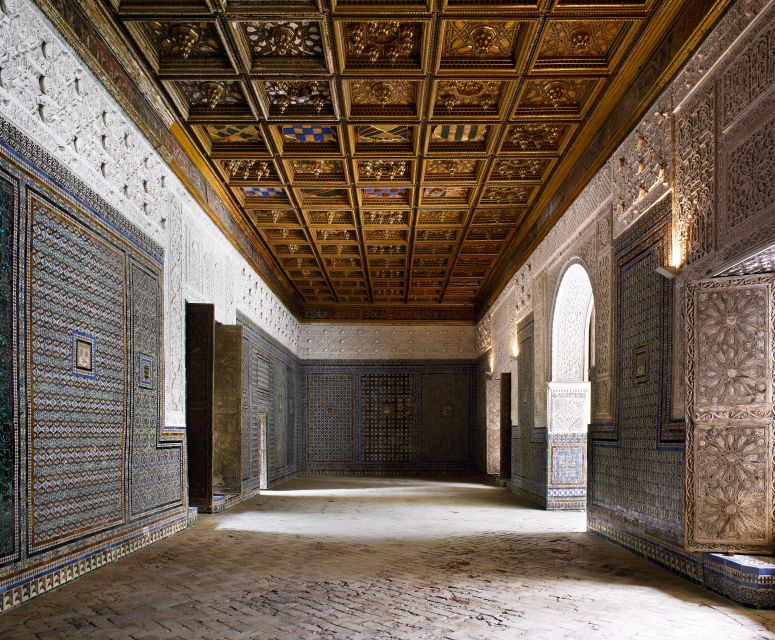
The Salón del Pretorio is a key stop. Its coffered ceiling is decorated with ornamental bows, creating a strong overhead focal point. Look up before you move on. Ceilings are easy to miss when the walls and floors are so busy, yet the palace uses them to show its wealth and artistic ambition.
This is also where the audio guide can be useful and slightly demanding. It provides plenty of information about construction, design, and historical meaning. If you listen to every word in every room, the visit may begin to feel like homework. I suggest using it selectively: listen fully in the courtyard, chapel, and Salón del Pretorio, then skim or pause in rooms where you mainly want to enjoy the design.
The guide is available in Spanish, French, English, Portuguese, German, Japanese, and Italian. The host or greeter is Spanish-speaking, but the self-guided format means you do not need to depend on a live English tour.
Pallas Pacifera and the language of power
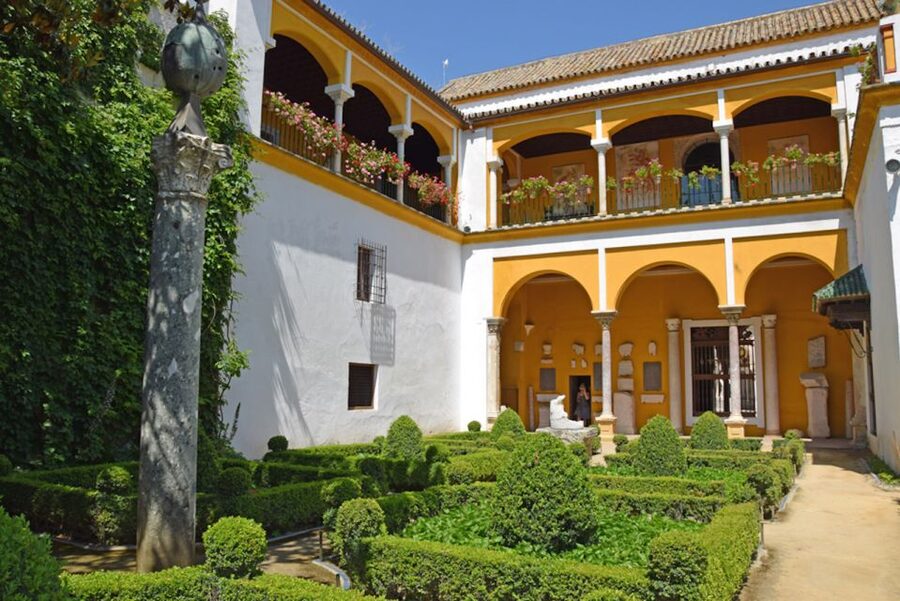
Casa de Pilatos is full of symbols that helped the family present itself as cultured, wealthy, and connected to the wider world. The war ornaments of Pallas Pacifera are a good example.
You can see a stone-carved shield and helmet associated with the goddess. These objects are not simply attractive decorations. They connect military strength with peace, education, and classical culture, all qualities an elite household wanted to display.
The palace’s collection of Renaissance artwork works in the same way. The Duke of Alcalá collected works that brought contemporary European taste into Seville. Casa de Pilatos helped introduce Renaissance style to the city, but it did so within a building that retained strong local and Islamic-influenced features.
That makes the palace more interesting than a pure style exercise. You can see how an influential family used art and architecture to keep up with new fashions while remaining rooted in Andalusia.
Gardens that slow the visit down
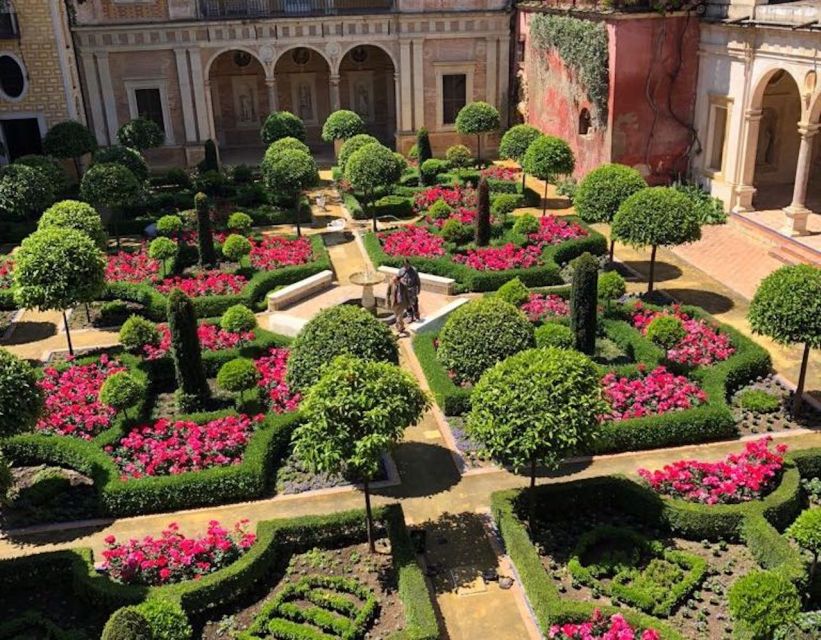
After the decorated rooms, the gardens offer a welcome change. They are picturesque rather than enormous, with Renaissance-style design, sculpture, and planted areas that make the palace feel calmer.
The gardens are a good place to plan extra time. Many people move quickly indoors and then discover that the outdoor sections are where they most want to linger. You might prefer to sit quietly, take pictures, or move between the house and garden several times.
The outdoor areas also help you understand Casa de Pilatos as a residence. The palace was not designed only for ceremony. It had to provide private space, shade, views, and places to escape the heat. That practical side is easy to appreciate in Seville, especially during summer.
A visit around midafternoon can be very quiet, though August heat may be intense. The garden itself can feel peaceful at that hour, but you should take the weather seriously and avoid treating the visit as a fast indoor attraction. If you want cooler conditions, an earlier visit is the safer choice.
How the audio guide works in practice
This is a self-guided visit, not a conventional tour led by a person. You receive an audio guide, and the route uses clear signs to show which section to play. Some arrangements use QR codes so you can listen as you move through the rooms.
The system is straightforward once you get started. You can walk at your own speed, repeat a section, or skip one. That makes it a good match for independent visitors, couples, and families with different levels of interest.
The guide’s strength is its detail. It covers the palace’s construction, the family, the art, and the meaning behind many features. Its weakness is the same thing. Some sections are long, and a few descriptions can become hard to follow when you are also looking around, taking pictures, and trying to match commentary with the correct room.
I would not attempt to listen to everything from start to finish. Choose the stops that matter most to you, then let the palace itself do some of the work. If you prefer a lively, conversational explanation from a guide, this may feel less satisfying than a live tour. If you like privacy and control, it is a real advantage.
Ground floor value at $14
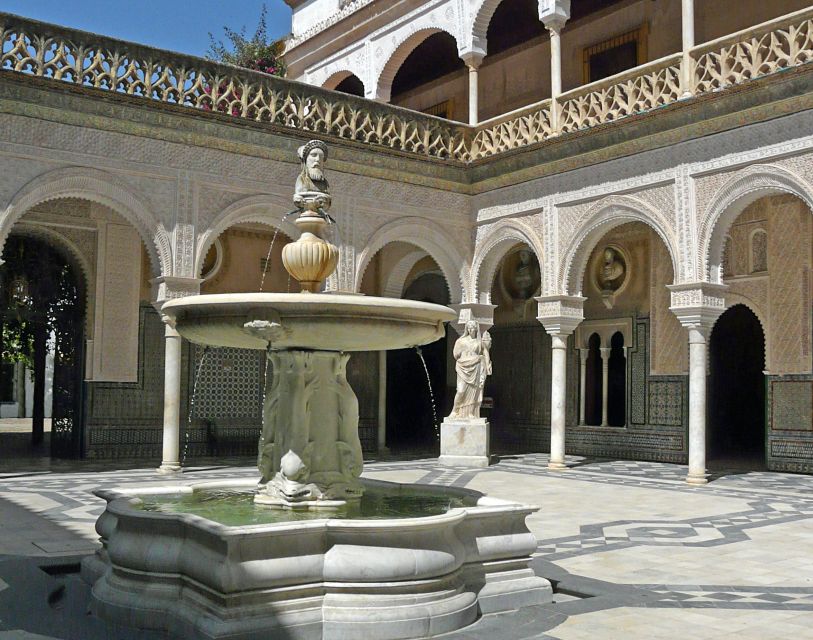
At $14 per person, Casa de Pilatos is reasonably priced for a major Seville sight, but the value depends on what you want from the visit.
The ground floor includes the principal courtyard, decorated rooms, the chapel, sculptures, tilework, and gardens. That is enough for a substantial visit, especially if you take your time. Several people spend longer than expected because the palace is calm and easy to explore without a fixed group pace.
Still, the ticket does not include the upper floor. That is the main point to check before booking. If you want the full story of the residence and its family, you may feel that the ground-floor ticket leaves you wanting more. A separate upstairs tour may be available on arrival, but the included access here is specifically limited to the ground floor.
Compared with Seville’s biggest paid sights, this ticket can feel like good value because the visit is less exhausting and often less crowded. Compared with free historic buildings elsewhere in Andalusia, $14 may seem high for a residence where only one level is included. I would call it fair value for anyone who enjoys architecture, ceramics, gardens, and sculpture, but less essential for someone who only wants a quick photo stop.
Best times and useful planning details
The ticket is valid for one day, with the available starting time selected when you check availability. From Tuesday through Sunday, the last entry is at 5:30 PM, so do not plan to arrive at the last minute if you want to hear the audio guide and see the gardens without rushing.
Monday offers a useful budget option: entry is free between 3 PM and 5:30 PM. Check the current availability and conditions before relying on that window, but it may make sense if your schedule is flexible.
Early morning visits can be quiet. Early afternoon can also work well, particularly outside the busiest periods. In summer, the building provides relief from the heat, but outdoor sections may still be hot. A visit around 2 or 3 PM can feel tranquil, while later afternoon may bring more organized groups.
Allow enough time to enjoy the courtyard, listen to selected audio sections, and walk through the gardens. The official activity lasts one day in the booking sense, not one full day inside the palace. You can treat Casa de Pilatos as a focused stop rather than a full-day attraction.
The cancellation policy is generous: you can cancel up to 24 hours before the visit for a full refund. You can also reserve now and pay later, which helps if you are arranging several Seville sights before your schedule is settled.
Who will enjoy this visit most
I would recommend Casa de Pilatos to you if you enjoy beautiful architectural details more than grand scale. It is especially good for anyone who wants to see Seville’s mixture of Mudejar-Gothic and Renaissance design in one compact setting.
It also suits photographers, art lovers, and people who prefer a calm visit. The courtyards and gardens give you room to pause, and the self-guided format lets you avoid being hurried from one room to the next.
Families can make it work, but younger children may not want to listen to long audio sections. Use the courtyard, sculpture, and gardens as the main attractions, then offer the commentary in short portions.
I would be more cautious if the upper floor is important to you, or if you strongly prefer live guiding. In those cases, confirm what additional access is available before paying for the ground-floor ticket.
Should you book Casa de Pilatos?
Yes, if you have at least a little time beyond Seville’s headline sights. Casa de Pilatos gives you striking tiles, Roman sculpture, a remarkable courtyard, a historic chapel, decorated Renaissance rooms, and peaceful gardens without the scale or pressure of the Royal Alcázar.
Book it when you want a quieter cultural stop, and arrive early or in the afternoon before the final entry period. Use the audio guide as a tool, not a test. Listen to the most important rooms, then slow down and enjoy the building.
Skip it only if your schedule is extremely tight, the upper floor is essential, or $14 for ground-floor access does not fit your budget. For most visitors who value detail, atmosphere, and a visit at their own pace, it is a worthwhile addition to Seville.
FAQ
What does the Casa de Pilatos ticket include?
The ticket includes entry to the ground floor of Casa de Pilatos and an audio guide.
Is the upper floor included?
No. The upper floor is not included in this ticket. A separate upstairs visit may be available on arrival.
Which languages are available for the audio guide?
The audio guide is available in Spanish, French, English, Portuguese, German, Japanese, and Italian.
Is there a live guide?
No live guide is included with this activity. The visit is self-guided with audio commentary. The host or greeter is Spanish-speaking.
When is the last entry?
From Tuesday through Sunday, the last entry is at 5:30 PM.
Can I visit for free on Monday?
Entry is free on Mondays between 3 PM and 5:30 PM. Check availability before planning your visit around this time.
Recently reviewed around Seville
- Seville: Alcázar Fast-Track Access with Guided Tour★ 4.2 · 432 reviews
- Seville: Small Group Jewish Quarter Tour with Tapas & Drinks★ 5.0 · 119 reviews
- Seville: Sunset Roof Top Walking Tour★ 4.5 · 122 reviews
- Seville: VIP Exclusive Early Access Tour of The Alcazar★ 4.8 · 276 reviews
- Seville: Small-Group Jewish Quarter Discovery Walking Tour★ 4.9 · 499 reviews
- Seville: Flamenco Show at Tablao Almoraima in Triana★ 4.6 · 483 reviews
- Seville: Authentic and Romantic Horse-Drawn Carriage Ride★ 4.5 · 341 reviews
- Seville: Sunset and Evening Paddle Boarding Tour★ 4.8 · 355 reviews
Seville Tours, compared.


Live Flamenco Dancing Show Ticket at the Theater
Read our review →

1-Hour Guadalquivir River Sightseeing Eco Cruise
Read our review →
Cathedral, Giralda & Alcazar Entry With Guided Tour
Read our review →
Priority Access Cathedral, Giralda & Alcázar Tour
Read our review →Browse the lists this tour appears in