Reviewed · TICKETS
Palau de la Musica Catalana Admission Ticket with Audioguide
The great surprise here is how much artistry is packed into one concert hall. The Palau de la Música Catalana is a UNESCO World Heritage site, but it does not feel like a quiet monument behind glass. You walk through a living music venue, climb its grand stairs, study flowers and fruit worked into the decoration, and may even hear a rehearsal or organ playing.
I like the freedom of the self-guided audio tour, since you can pause for photos or sit in the hall as long as you wish. I also like the chance to step onto the stage where famous musicians have performed. The main drawback is the phone-based audio system: you must download it yourself, and you need to bring headphones. Some visitors have had trouble connecting or keeping the app running.
In This Review
- Key points before you book
- Why the Palau is worth your time
- The entrance stairs and Sala Millet
- The concert hall, stained glass, and balconies
- Stepping onto the stage
- How the phone audio works in practice
- A realistic 50-minute visit
- Price, value, and what you are really buying
- Getting there and handling the entry
- Who will enjoy this visit most
- Booking ahead and cancellation
- My verdict on the Palau de la Música Catalana ticket
- FAQ
- How long does the Palau de la Música Catalana visit take?
- What does the admission ticket include?
- Are headphones included?
- Can I use my own phone for the audio guide?
- Is the audio guide offered in English?
- Where does the visit start?
- Where does the activity end?
- Is food or drink included?
- Can I cancel for a refund?
Key points before you book
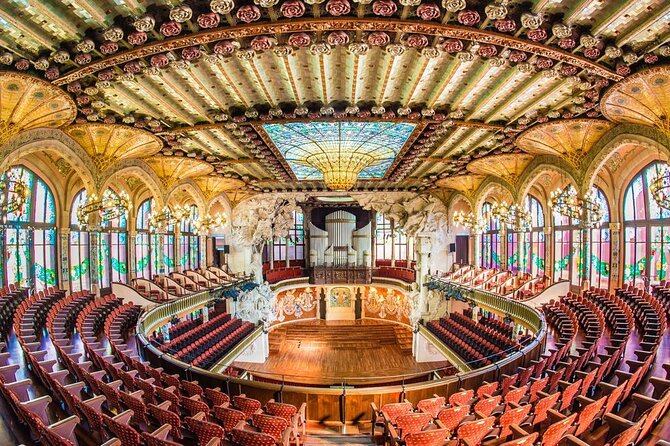
- The concert hall is the main event: Look up at the stained glass, columns, flowers, palms, and sculpted figures.
- The tour lasts about 50 minutes: You can move at your own pace, though access to areas may vary during rehearsals or other events.
- The guide runs on your phone: It includes spoken explanations, images, music, video, and a 360-degree concert feature.
- Headphones are not supplied: Bring earbuds or headphones so you can listen while viewing images on your screen.
- A rehearsal can add real atmosphere: Organ or piano music may be heard during your visit, but this is not guaranteed.
- The $28.96 price suits architecture fans: It is a fair admission cost if you want a close look inside this unusual building, but less appealing if you mainly want a live concert.
Why the Palau is worth your time
Barcelona is full of Modernisme architecture, but the Palau de la Música Catalana offers a different kind of visit. Instead of viewing a house facade or walking through a former hospital, you enter a working concert hall designed around music, light, and ceremony.
The building was created by Lluís Domènech i Montaner, one of the major Catalan Modernisme architects. The visit lets you see his work from inside, where decoration is not limited to one feature. It climbs, curves, glows, and fills nearly every surface.
I would not come here expecting a large museum with room after room of exhibits. The route is compact. Its strength is the quality of what you are seeing, not the number of stops. If you pay attention, the visit becomes a lesson in how architecture can shape the mood of a performance.
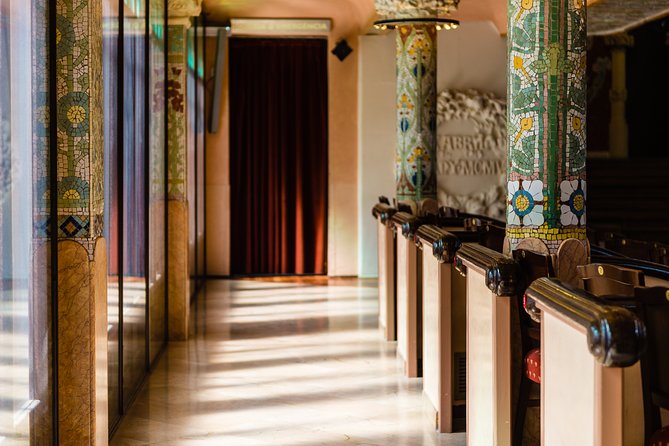
The hall can feel almost dreamlike. Flowers, fruit, palms, figures, colored tiles, and stained glass turn the interior into a kind of musical sculpture. Even people who are not especially interested in concert venues may find themselves stopping often for photographs.
More Barcelona trips worth a second look
- Barcelona: Sagrada Familia Entry Ticket with Audio Guide
★ 4.6 · 105,312 reviews - Barcelona: Park Güell Admission Ticket
★ 4.4 · 76,534 reviews - Barcelona Aquarium: Entry Ticket
★ 4.3 · 13,335 reviews
The entrance stairs and Sala Millet
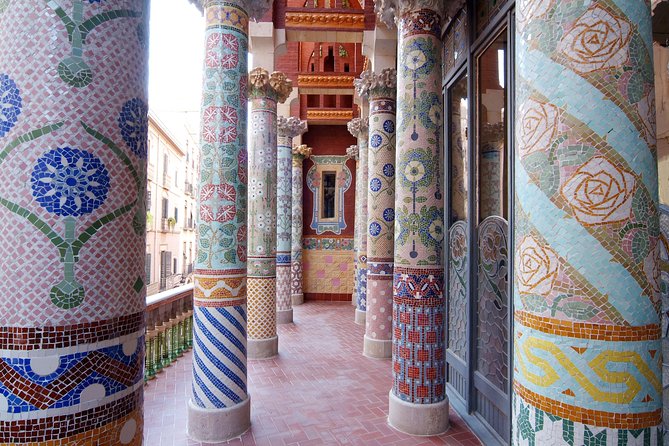
Your visit begins at the Palau de la Música Catalana, at C/ Palau de la Música, 4-6, in Barcelona’s Ciutat Vella. Show your mobile ticket near your scheduled entry time. Staff scan it, and you continue upstairs into the building.
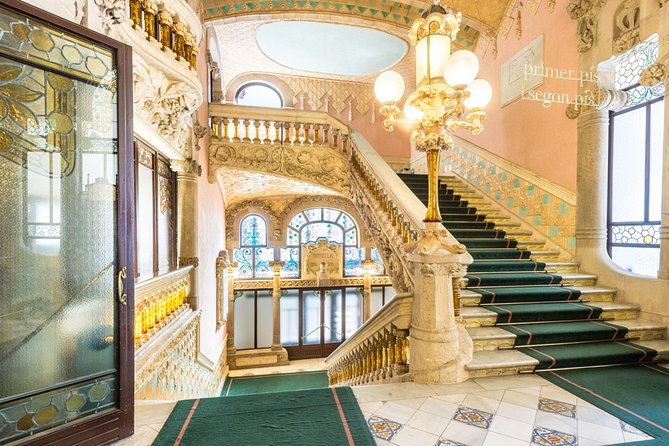
The access stairs are more than a way to reach the hall. They introduce the building’s decorative language, with ornament and structure working together. The audio guide gives context as you move, so do not rush this first section.
One important practical point: this is not a traditional guided tour with a person leading a group. You receive access to the audio guide on your own phone. The system is designed for independent use, but the setup can take extra time if your phone has trouble connecting.
Sala Millet is described as a Modernisme encyclopaedia, and it gives you a useful pause before the main concert hall. This room helps show how Domènech i Montaner used decorative details to carry ideas about nature, culture, and music.
I recommend looking first, then starting the audio. If you begin by staring at your screen, you can miss the fine work around you. The guide includes images and other media, so headphones let you listen while keeping your phone free for the visual material.
The concert hall, stained glass, and balconies
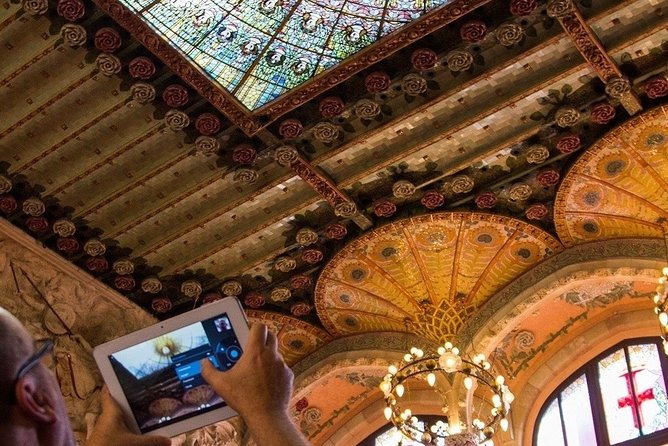
The concert hall is where the admission earns its keep. Light enters through the famous stained-glass ceiling, giving the room a bright, open feeling. The colors and forms are not simply decoration added at the end. They help make the hall feel like a place built for music rather than a plain auditorium.
Look closely at the columns and balcony details. The decoration shifts as you move through the room, with plant forms, sculpted figures, and small symbolic touches competing for your attention. I found the best approach is to make one slow circuit, then sit for a few minutes and look upward.
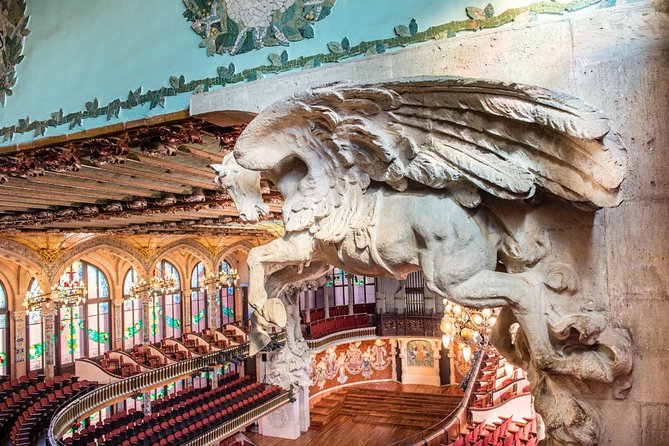
The balcony is one of the strongest photo spots. It gives you a different view of the hall and makes the scale easier to understand. Try to visit when it is not filled with a large group, since the space can become crowded quickly.
The audio tour explains the architecture as you go. Its pace is flexible, which is useful here because you may want to stop every few steps. The audio also adds music and video elements, including a 360-degree view connected with a concert night. These features give you a sense of how the Palau looks and sounds in performance.
Do not count on a live musical moment, but be ready for one. Piano practice or organ music has been heard during visits, and it can transform the experience. The unamplified sound inside the hall helps you understand why the building was designed as a temple of music, not just as an elaborate room.
Stepping onto the stage
The route continues to the stage, where musicians have made history. This is one of the more unusual parts of the visit because you are not only looking into the performance space from the audience. You can stand where performers appear and turn back toward the hall.
That change in viewpoint matters. From the stage, you see the balconies, ceiling, stained glass, and audience area as one carefully arranged composition. It also shows how the room was built to connect performers and listeners.
Access can change depending on what is happening inside the Palau. One visit may allow access to a particular level, while another may have an area blocked off. A rehearsal, concert preparation, or building operation can affect the route. I would treat the listed itinerary as the intended path, not an absolute guarantee that every corner will be open.
The building remains the star even if one section is unavailable. Still, if you have limited mobility or a strong interest in seeing every level, it is sensible to ask staff what is open when you arrive.
A different way to spend the day, same corner of Spain:
- Barcelona: Casa Batlló Entry with Self-Audioguide Tour
★ 4.7 · 25,359 reviews - Barcelona: 24 or 48-Hour Hop-On Hop-Off Bus Tour
★ 4.4 · 20,872 reviews - Barcelona: Park Guell Guided Tour with Skip The Line Entry
★ 4.7 · 17,563 reviews - Barcelona in 1 Day: Sagrada Familia, Park Guell,Old Town & Pickup
★ 5.0 · 13,541 reviews
How the phone audio works in practice
The audio guide is accessed through your own mobile device using a code connected to the booking. You download or activate it on site, then follow the stops as you walk through the Palau.
This arrangement has clear advantages. You do not have to match a guide’s pace, and you can replay or pause material while taking pictures. It also means you are responsible for your phone, battery, connection, and audio setup.
Bring headphones. The ticket does not include them, and holding your phone to your ear makes it difficult to view the images at the same time. Earbuds are especially useful for the musical clips and the 360-degree feature.
Allow a little patience during setup. Staff can help, but the process is not always instant. Some visitors have needed assistance connecting the audio, and an app interruption can shorten the time available inside. Arriving close to your scheduled time is sensible, but arriving with a ready phone, headphones, and the booking code is even better.
The guide is offered in English according to the booking details. The spoken explanations are intended to give you background without requiring a live guide. If you prefer detailed discussion of design symbolism, a human-led tour may suit you better, but this option gives you more control.
A realistic 50-minute visit

The advertised duration is about 50 minutes. That is enough to see the major spaces and listen to the main explanations, but it is not a long museum visit.
If you take many photos, pause often, or stop to listen to live music, you may need to move at a steady pace. On the other hand, the compact route works well for a morning or afternoon between other Barcelona plans.
I would set aside about an hour in your schedule, including entry and audio setup. This gives you some breathing room without pretending the visit takes half a day.
The building can also be affected by rehearsals, concerts, and closing times. An interior area may be unavailable, or staff may need you to leave by a fixed time. The self-guided format gives you freedom, but it does not mean unlimited access.
Price, value, and what you are really buying
At $28.96 per person, this is not a bargain admission in the casual sense. You are paying for access to a protected architectural landmark, a phone-based multimedia guide, and the chance to see a major concert venue from within.
For me, the price makes sense if you care about architecture, Catalan Modernisme, music venues, or photography. The interior is detailed enough to reward close attention, and the visit offers more than a quick look through a foyer.
The value is weaker if you expect a concert. This ticket is an admission visit, not a performance ticket. You may hear an organ, piano, or rehearsal, but those moments depend on what is taking place that day.
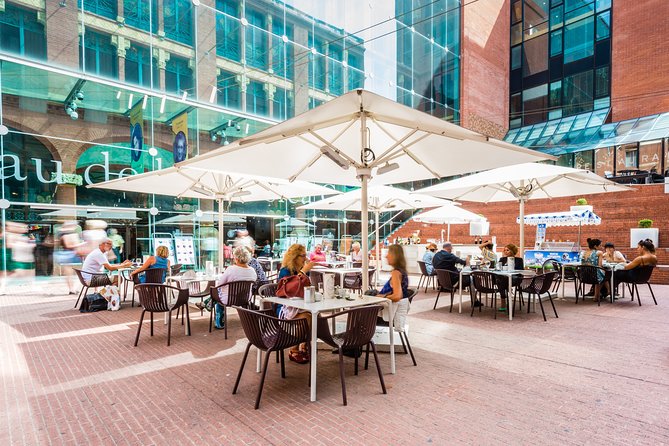
A cafe is available on site, with indoor seating and an outdoor area with tables and umbrellas. You do not need a ticket to enter the cafe or use the restrooms. Food and drinks are not part of the admission, so plan to pay separately if you want a coffee or pastry.
The gift shop is also on site. I would use the cafe as a useful stop before or after the visit rather than planning the whole outing around it.
Getting there and handling the entry
The Palau is in Ciutat Vella, near public transportation. The precise meeting point is the Palau itself at C/ Palau de la Música, 4-6.
Transport conditions can change. Construction near a nearby train station has made the walk longer at times, so check your route on the day rather than relying on an old map or a familiar Barcelona shortcut.
Once there, look for the admission staff and have your mobile ticket ready. The entry process is simple in principle, but instructions can feel unclear when several groups and tour operators are nearby. If you do not see where to begin, ask the Palau staff directly and show the booking on your phone.
The activity ends back at the same meeting point. Service animals are allowed, and most people can take part. The maximum group size is 55, although the self-guided format means you do not follow one large group through the building.
Who will enjoy this visit most
I would recommend this experience to:
- Architecture fans who want to see Catalan Modernisme from the inside.
- Music lovers curious about the setting behind major performances.
- Photographers looking for stained glass, balconies, mosaics, columns, and ornate details.
- Independent visitors who dislike being tied to a guide’s schedule.
- People with about an hour to spare in central Barcelona.
I would think twice if you need a fully personal explanation of every design detail. The audio guide gives structure, but it will not answer follow-up questions or adapt its commentary to your interests.
I would also be cautious if your phone is old, your battery is low, or you do not have headphones. The ticket remains useful without the audio, because the building is impressive on its own, but you would lose much of the tour’s added context.
Booking ahead and cancellation
This experience is often booked around 17 days in advance, so popular entry times may fill. Booking early is sensible if your Barcelona schedule is tight or you want a particular time of day.
Free cancellation is available up to 24 hours before the start time for a full refund. Cancellations or changes made less than 24 hours before the experience are not refunded, and the cut-off follows local Barcelona time.
My verdict on the Palau de la Música Catalana ticket
I would book this if you want to see one of Barcelona’s most remarkable interiors without committing to a concert. The stained-glass hall, ornate balconies, and music-focused design give you plenty to examine in a short visit.
The audio system is the weak link. Bring your own headphones, install the guide carefully, and allow time for setup. If the app fails, ask staff for help rather than abandoning it at once.
The strongest reason to visit is the building itself. The strongest reason to choose this ticket is the freedom to explore it at your own pace. If you can attend an actual performance there, that would offer a different experience. If your schedule does not allow it, this admission still gives you a close look at a remarkable Barcelona concert hall for a reasonable one-hour stop.
FAQ
How long does the Palau de la Música Catalana visit take?
The visit lasts approximately 50 minutes. You may want to allow a little extra time for entry and setting up the audio guide.
What does the admission ticket include?
The ticket includes admission to the Palau de la Música Catalana and access to the audio guide on your own mobile phone.
Are headphones included?
No. Headphones are not included, so bring your own earbuds or headphones.
Can I use my own phone for the audio guide?
Yes. The audio guide is accessed on your own phone and includes explanations, images, music, video, and 360-degree content.
Is the audio guide offered in English?
Yes. The experience is offered in English.
Where does the visit start?
It starts at the Palau de la Música Catalana, C/ Palau de la Música, 4-6, Ciutat Vella, Barcelona, Spain.
Where does the activity end?
The activity ends back at the meeting point.
Is food or drink included?
No. Food and drinks are not included. A cafe is available on site, and the cafe can also be entered without a museum ticket.
Can I cancel for a refund?
Yes. You can cancel at least 24 hours before the experience start time for a full refund. Cancellations or changes made less than 24 hours before the start time are not refunded.
Recently reviewed around Barcelona
- Excursion Aigüestortes – Estany Llebreta (1/2 day)★ 5.0 · 138 reviews
- E-Bike tour in Barcelona with English Guide★ 5.0 · 128 reviews
- Wine Tasting Experience in Barcelona★ 5.0 · 172 reviews
- Barcelona Luxury Yacht Cruise – Day or Sunset, Open Bar & Snacks★ 5.0 · 154 reviews
- Montserrat: Cog-Wheel, Basilica, Black Madonna & Licor Tasting★ 4.5 · 886 reviews
- Barcelona Wax Museum Admission Ticket★ 4.5 · 237 reviews
- Barcelona: Wine Tasting and 5 Course Tapas Pairing Dinner★ 4.5 · 129 reviews
- Andorra Original History and Sightseeing Tour (Private, Pickup)★ 5.0 · 350 reviews
Tickets, compared.
Sagrada Familia Entry Ticket with Audio Guide
Read our review →