
Reviewed · EVENING EXPERIENCES
guided night tour
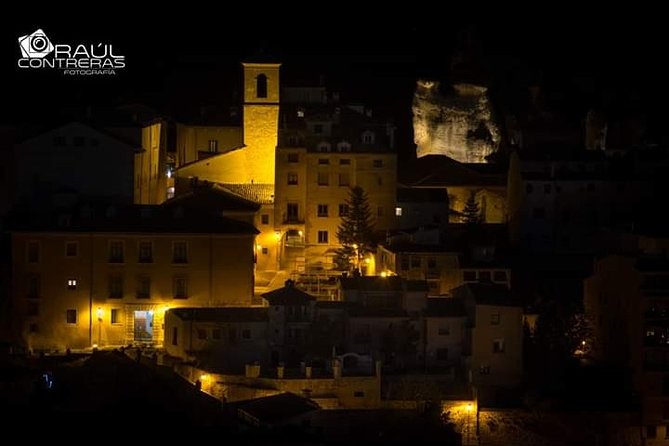
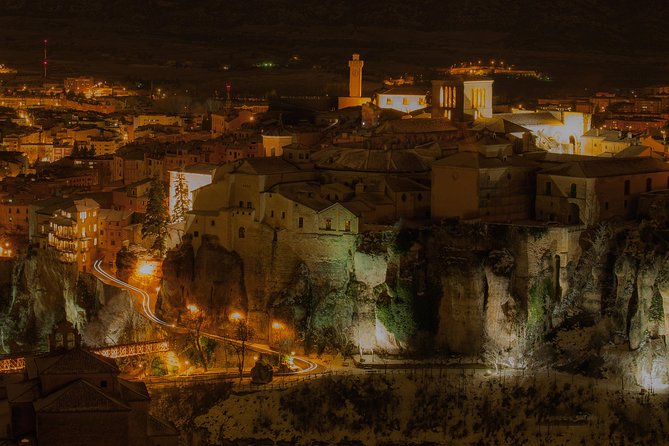
Cuenca changes character after sunset. Its limestone cliffs, narrow medieval lanes, and famous Hanging Houses take on a softer look when the Cathedral, City Hall, churches, and Parador light up. This two-hour evening walk is a smart way to see the old town without the heat and daytime crowds.
I like the way the route mixes major sights with small details, from the story of Cuenca’s old stone bridge to the construction of its cliffside houses. I also like the guides’ personal style. Carlos is praised for humor and unusual stories, while Guillermo and Hugo are noted for clear, friendly explanations. The main consideration is that this is a group tour, with as many as 50 people, and the guide was a few minutes late on one reported occasion.
In This Review
- Quick reasons to consider this Cuenca night walk
- Why Cuenca works so well after sunset
- Plaza Mayor, the Cathedral, and the first city views
- San Pedro Church and Cuenca’s unusual churches
- The former convent and Covarrubias connection
- Castle ruins at the narrowest point of the old center
- The former Inquisition court above the Huécar Gorge
- The Hanging Houses and the famous iron bridge
- The Parador, perched above the gorge
- Guides, storytelling, and group size
- Is $9.88 a fair price?
- Who should book this walk?
- Practical details before you reserve
- Should you book the Cuenca night tour?
- FAQ
- How long does the Cuenca night tour last?
- What time does the tour start?
- Where does the tour begin?
- Where does the tour finish?
- How much does the tour cost?
- Can I cancel for a full refund?
Quick reasons to consider this Cuenca night walk
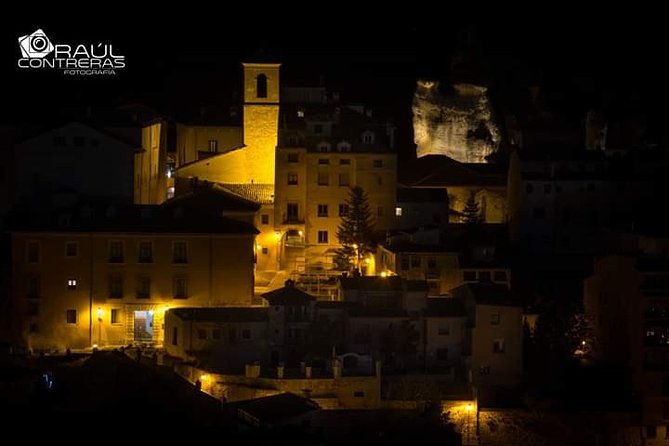
- The Hanging Houses appear at the right moment: The route finishes at the Casas Colgadas, where careful lighting makes Cuenca’s best-known symbol especially striking.
- The route covers the old town’s major landmarks: You pass the Plaza Mayor, Cathedral, City Hall, San Pedro Church, the castle ruins, the Parador, and other historic corners.
- The guides add stories rather than just dates: Carlos, Guillermo, and Hugo are praised for humor, local curiosities, and explanations that help you understand what you are seeing.
- The walk helps you get oriented: Starting in Plaza Mayor and ending near the Spanish Abstract Art Museum gives you a useful route through the historic center.
- The price is unusually low: At $9.88 per person, two hours of guided sightseeing costs less than many single-entry attractions.
- The evening timing has practical value: An 8:00 pm start avoids the hottest part of the day and lets you see Cuenca’s lighting come into play.
Why Cuenca works so well after sunset
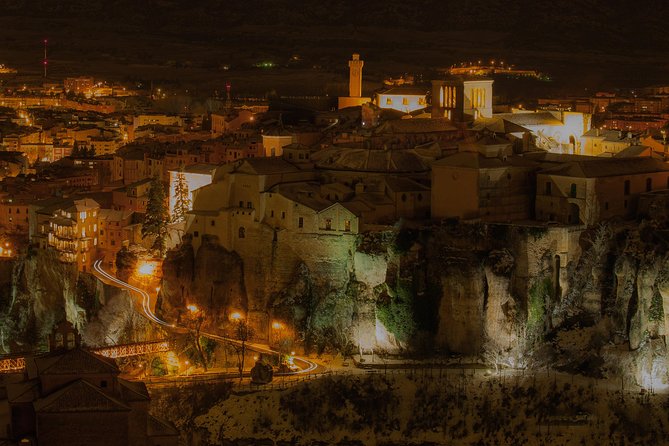
Cuenca is not a city you understand only by ticking off monuments. Its character comes from the way buildings cling to rock above two gorges, with lanes that bend, narrow, and suddenly open to a view. At night, the artificial lighting picks out the stonework and makes the vertical setting easier to appreciate.
The tour begins at Calle Alfonso VIII, 1, close to the Plaza Mayor. The start time is 8:00 pm, so the exact feel of the first part depends on the season. In brighter months, you may begin in daylight and watch the city change during the walk. At other times, the route will already feel nocturnal from the start.
I like this timing because it gives you two versions of Cuenca in one outing. You see the colors and shapes of the old center, then watch the Cathedral, City Hall, churches, and cliffside buildings become more dramatic as the light fades.
The evening also helps with comfort. Cuenca’s historic center includes slopes, steps, and uneven old streets, but the route is described as manageable, with few serious climbs. One guest specifically found it much easier than climbing the Rascacielos stairs elsewhere in the city. Still, wear shoes with a firm sole, since a pleasant stroll on stone streets can become tiring if your footwear is poor.
More Spain trips worth a second look
- Barcelona: Daytime or Sunset Catamaran Cruise with Music
★ 4.3 · 5,923 reviews - Barcelona: La Pedrera Night Experience
★ 4.4 · 4,633 reviews - Valencia: Catamaran Cruise with Sunset Option
★ 4.0 · 3,566 reviews
Plaza Mayor, the Cathedral, and the first city views
The Plaza Mayor is a strong place to begin because it puts several important buildings in one frame. Colorful leaning houses surround the square, while the Cathedral and City Hall provide the main illuminated backdrop.
Your guide uses this opening to explain the old center before leading you into the narrower streets. That orientation matters. If you explore Cuenca alone afterward, you will already have a mental map of the historic core and a better sense of how the main lanes connect.
The Cathedral is one of the most important sights on the route, though the tour information describes an exterior walk rather than an interior visit. That distinction is worth noting if seeing the inside is a priority. The night tour is mainly about the streets, views, façades, and stories told at each stop.
The Plaza Mayor can also be the liveliest section of the walk. A group of up to 50 people may gather here, and the guide’s voice could be harder to hear if the square is busy. Arrive a little early and stay close at the start. That small effort can make a big difference on any group walk.
San Pedro Church and Cuenca’s unusual churches
The route continues to the Church of San Pedro, described as an octagonal church set on a limestone cornice. The setting is as important as the building itself. Cuenca’s religious architecture is often shaped by the rock beneath it, and this stop shows how the city uses narrow ledges and steep edges rather than avoiding them.
At night, the unusual form should be easier to study from outside because the lighting draws attention to the outline. Your guide will also connect the church to the wider story of the old center, where religious buildings, former civic buildings, and private homes sit close together in a small area.
This is one of the points where a guide adds real value. A quick look at an octagonal church may not tell you why it was built that way or how it fits into Cuenca’s setting. The tour’s style, based on the guide descriptions, leans toward explanation and local anecdotes rather than a silent procession from one photo stop to the next.
The former convent and Covarrubias connection
Another stop is a former seventeenth-century convent, also linked to the Palace of D. Sebastián de Covarrubias. The description calls attention to this lesser-known connection, making it a useful counterweight to Cuenca’s most famous sights.
I appreciate stops like this because they keep the walk from becoming a parade of postcard views. The Hanging Houses and Cathedral are essential, but Cuenca’s character also comes from buildings that many people pass without understanding. A guide can point out how a former religious or civic space fits into the old town’s long development.
Do not expect a museum visit or a long indoor presentation here. The experience is a walking tour, and the available information does not promise interior admission. Think of the convent and palace as part of the street-level story, with the guide providing the context.
A different way to spend the day, same corner of Spain:
- Barcelona: Sagrada Familia Entry Ticket with Audio Guide
★ 4.6 · 105,312 reviews - Barcelona: Park Güell Admission Ticket
★ 4.4 · 76,534 reviews - Seville: Royal Alcázar Entry Ticket
★ 4.6 · 28,378 reviews - Barcelona: Casa Batlló Entry with Self-Audioguide Tour
★ 4.7 · 25,359 reviews
Castle ruins at the narrowest point of the old center
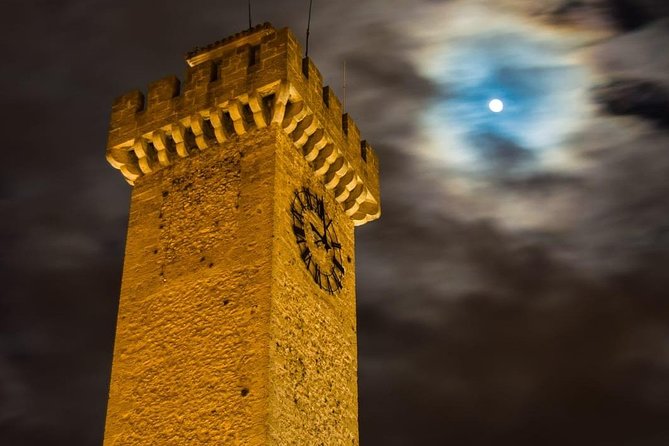
The route reaches the ruins of Cuenca Castle, dating from the thirteenth century. The remains occupy the narrowest part of the historic center, between the two gorges, and the site is described as the location of the city’s first building.
That position gives the stop more weight than a simple pile of old stones. You can grasp why Cuenca developed where it did, how defensive concerns shaped the settlement, and why the old town feels so compressed in places. The gorges are not just scenic edges. They helped define movement, building, and defense.
This is also where the nighttime setting can make the past feel close without requiring theatrical effects. Stone ruins, dark gaps, and high viewpoints naturally create atmosphere. Your guide may add anecdotes and stories, but the interest comes first from the real structure of the place.
The castle section may involve uneven surfaces and some uphill movement. The tour has been described as not especially tiring, but anyone with mobility concerns should remember that Cuenca’s old quarter is built on steep ground. The service allows assistance animals, and the activity is near public transportation, but no detailed accessibility rating is provided.
The former Inquisition court above the Huécar Gorge
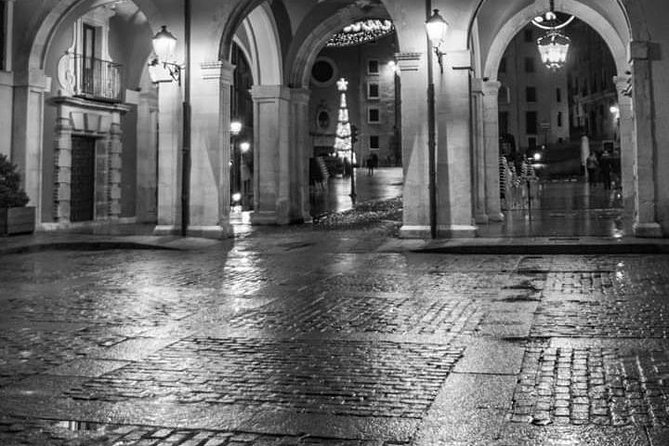
The walk also passes a building that served as a court of the Inquisition and later as a prison. It sits above the Huécar Gorge, dominating part of the old city.
This stop adds a darker layer to the tour. Cuenca is easy to admire for its views and architecture, but its old buildings also carried authority, fear, punishment, and confinement. A good guide can explain those uses without turning the stop into a dry list of dates.
The building’s position helps you read Cuenca as a vertical city. From the gorge edge, the old quarter seems to balance above open space, and the former court’s location shows how power occupied prominent points. Take care near viewpoints after dark, especially when moving with a group. Stay with the guide rather than stepping away for a better photograph.
The Hanging Houses and the famous iron bridge
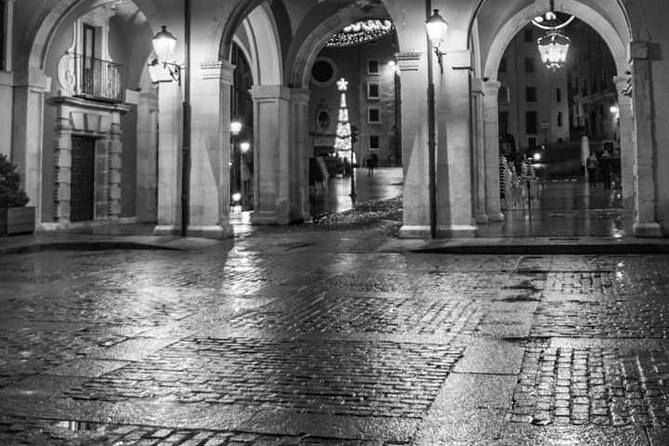
The Casas Colgadas are the emotional high point of the walk. They have been associated with Cuenca for more than 600 years, projecting over the gorge and appearing to defy the drop below. Their special lighting makes them particularly effective at night.
The route is designed to bring you here near the end, when the houses are illuminated. That is a smart choice. You have already learned how Cuenca’s streets and rock formations work, so the Hanging Houses feel like the natural payoff rather than an isolated photo stop.
The endpoint is near the Spanish Abstract Art Museum, Juan March Foundation, at Casas Colgadas, Calle Canónigos, 3. This is useful for planning the rest of your evening. You can finish near one of Cuenca’s signature sights rather than returning to the starting point.
Nearby, the route explains what happened to the earlier stone bridge and why it was replaced by the current iron bridge, built in 1903. This is exactly the kind of practical historical detail I enjoy. The bridge is not just a way across the gorge. It shows how the city adapted its old routes to newer materials and changing needs.
You will want a camera here, but do not judge the whole tour by the final photograph. The real benefit is the explanation of how the bridge, Hanging Houses, ravines, and upper lanes fit together.
The Parador, perched above the gorge
The last major sight is the current Parador, with careful lighting and a dramatic position on rock beside the ravine. The building’s setting gives you another view of Cuenca’s central trick: important structures are placed where ordinary cities might leave empty space.
At night, the Parador is best appreciated from outside and across the gorge. The lighting picks out its shape while the darkness around it emphasizes the drop. This is a quiet, visual end to a route that began in the more enclosed Plaza Mayor.
The walk ends at the Spanish Abstract Art Museum near the Hanging Houses, not at the Parador itself. That distinction matters for your plans. If you want to enter the museum or visit the Parador, you will need to arrange that separately. The tour provides an exterior look and an explanation, not a stated admission visit.
Guides, storytelling, and group size
The strongest part of this experience is the guide. Names connected with the tour include Carlos, Guillermo, and Hugo, so the exact personality may depend on the date and assignment.
Carlos is associated with an amusing, original style and stories about the city’s buildings and hidden details. Guillermo is praised for making architectural information easy to follow, including the construction of the Hanging Houses. Hugo is described as friendly and interesting in his explanations.
That matters because Cuenca can be confusing on your first visit. Its lanes do not always follow an obvious grid, and many buildings look old without announcing why they matter. A guide who explains the structure of the houses, the purpose of former institutions, and the reason for the bridge replacement gives you a more useful visit than a simple list of names.
The group can reach 50 people, which is the main trade-off. A large group keeps the price low, but it may feel less personal than a small walking tour. You should stay near the guide at turns and stops, especially in the winding upper streets. The service is near public transportation, and confirmation is provided when you book.
One small caution: punctuality appears to be good overall, but a minor delay has been reported. I would arrive at the meeting point a few minutes before 8:00 pm rather than cutting it close.
Is $9.88 a fair price?
At $9.88 per person, this is excellent value if you want a guided introduction to Cuenca. Two hours gives you enough time to cover the city’s key sights without paying separately for several attractions. The value comes from the route and the interpretation, not from included admissions.
You should also compare the price with what you would do alone. You can certainly walk through Plaza Mayor, look at the Cathedral, find the castle ruins, and photograph the Hanging Houses without a guide. But you may miss the story of the old bridge, the Covarrubias palace connection, the building that became a prison, and the details of how the cliffside houses were made.
The low cost does mean you should keep expectations sensible. This is not a private tour, not a long museum program, and not a full-day visit to every monument in Cuenca. It is a focused evening walk through the historic center.
Who should book this walk?
I would choose this tour if you are visiting Cuenca for the first time and want a clear introduction before exploring alone. It also suits anyone who prefers cooler evening sightseeing, enjoys architecture, or wants a strong orientation to the old quarter.
It works well for repeat visitors, too. The route’s stories and lesser-known stops can give familiar streets a different meaning. One useful way to plan your time is to pair this night walk with a separate daytime monumental visit, since the two experiences can cover different parts of Cuenca.
Families and mixed-age groups may appreciate the moderate two-hour length, though the old streets still require sensible footwear and care around gorge viewpoints. The tour is open to most participants, and service animals are allowed.
I would look elsewhere if you want a very small group, guaranteed interior access to monuments, or a fully private experience. I would also avoid booking it as your only time in Cuenca if you want to enter several museums and churches. The walk shows you the city from the outside and gives you the stories to make later visits more rewarding.
Practical details before you reserve
The meeting point is C. Alfonso VIII, 1, 16001 Cuenca, with an 8:00 pm start. The walk lasts about two hours and finishes at the Spanish Abstract Art Museum, Juan March Foundation, near the Hanging Houses.
You should plan around the one-way finish. If your hotel or car is near the starting point, check how you will return after the tour. The activity is close to public transportation, but the supplied details do not specify a return transfer.
Booking confirmation arrives at the time of purchase. You can cancel for a full refund if you do so at least 24 hours before the start time. Cancellations or changes made within 24 hours are not refunded or accepted, and the cut-off follows Cuenca local time.
Should you book the Cuenca night tour?
Yes, if you want a low-cost, story-filled first look at Cuenca after dark. The illuminated Cathedral, castle ruins, gorge viewpoints, Parador, and Hanging Houses give the walk plenty of visual appeal, while guides such as Carlos, Guillermo, and Hugo add the architectural and local detail that is hard to pick up alone.
Book it early if your schedule is tight, since it is commonly reserved about 13 days ahead. The best match is a visitor who values clear explanations, authentic old-town details, and a manageable evening walk more than private attention or indoor admissions.
FAQ
How long does the Cuenca night tour last?
The tour lasts approximately two hours.
What time does the tour start?
The start time is 8:00 pm.
Where does the tour begin?
The meeting point is C. Alfonso VIII, 1, 16001 Cuenca, Spain.
Where does the tour finish?
The walk ends at the Spanish Abstract Art Museum, Juan March Foundation, Casas Colgadas, C. Canónigos, 3, 16001 Cuenca, Spain.
How much does the tour cost?
The listed price is $9.88 per person.
Can I cancel for a full refund?
Yes. You must cancel at least 24 hours before the experience start time for a full refund. Cancellations within 24 hours are not refunded.
Recently reviewed around Spain
- Segway Your Way Through Granada’s History: The Ultimate Ride★ 5.0 · 334 reviews
- Firgas, Tejeda, Guayadeque – VIP Tour Gran Canaria★ 4.5 · 173 reviews
- Scuba Diving Experience for Beginners in Gran Canaria★ 5.0 · 561 reviews
- Sioux City Park Entrance Ticket★ 4.5 · 171 reviews
- The Best Horse Riding Experience in Gran Canaria (2 hours)★ 4.5 · 349 reviews
- Supercar Experiences on the Circuit of Maspalomas★ 5.0 · 110 reviews
- Sala Scala Gran Canaria Dinner Show★ 4.5 · 212 reviews
- SUBMARINE ADVENTURE – Submarine Excursion in Puerto de Mogán★ 4.0 · 126 reviews
Evening Experiences, compared.

Daytime or Sunset Catamaran Cruise with Music
Read our review →

Albaicín and Sacromonte Guided Sunset Walking Tour
Read our review →
Sunset or Day Catamaran Cruise with Tapa & Drink
Read our review →
Browse the lists this tour appears in