
Reviewed · MADRID TOURS
From Madrid: Escorial Monastery and the Valley of the Fallen
The most striking part of this outing is the contrast between El Escorial, Felipe II’s vast royal monastery, and the Valley of the Fallen, a monumental basilica carved into a mountainside and linked to the Spanish Civil War. In five hours, you move from royal power and the Spanish Golden Age to one of Spain’s most difficult modern chapters.
I like the easy round-trip transport from central Madrid, and I like having a guide connect the paintings, royal tombs, architecture, and politics into one story. Guides such as Cristina, Beatriz, Sergio, and Rafael have been praised for clear English, good humor, and careful explanations. The main drawback is time: the schedule is efficient, but you may want more time at the Valley of the Fallen, especially for photographs and personal exploration.
In This Review
- Key points to know before you book
- Why these two places belong together
- Leaving Madrid for San Lorenzo de El Escorial
- Entering the Monastery of San Lorenzo
- The 15-minute ride to the Valley of the Fallen
- Inside the granite basilica
- What the guide adds to the experience
- Is $73 a good value from Madrid?
- Who should book this half-day trip?
- My verdict: book it if history matters more than free time
- FAQ
- How long does the tour last?
- Where does the tour begin and end?
- What does the $73 price include?
- Are food and drinks included?
- Is the tour offered in English?
- Can I visit the basilica at El Escorial on a Sunday?
- Is the tour suitable for wheelchair users?
Key points to know before you book
- Two very different monuments in one half-day: El Escorial explains royal Spain, while the Valley of the Fallen confronts the legacy of the Civil War.
- Skip-the-line entry is included: You enter both sites through a separate entrance, saving time on a tightly timed visit.
- The tour runs about five hours: Plan on roughly 45 minutes by bus from Madrid, 105 minutes at El Escorial, one hour at the valley, and the return journey.
- The guide is the main value: The buildings are impressive on their own, but the historical links make far more sense with a live Spanish or English explanation.
- Expect plenty of walking and steps: This is not suitable for wheelchair users or people with mobility impairments.
- The $73 price is fair for a car-free visit: Transport, tickets, guide, headset, and bus Wi-Fi are included, but food and drinks are not.
Why these two places belong together
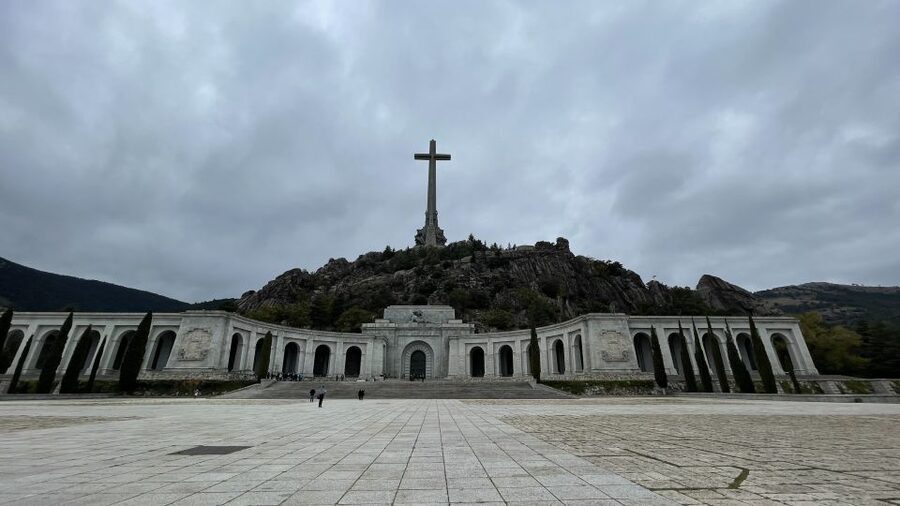
El Escorial and the Valley of the Fallen are not interchangeable sightseeing stops. The first is tied to the Spanish monarchy, Catholic power, art, and Felipe II. The second is tied to the Spanish Civil War, Francisco Franco’s dictatorship, and the burial of 33,847 people who died during the conflict.
That pairing gives you a useful outline of Spanish history across more than 600 years. You begin with a royal complex built to express the political and religious aims of the Spanish Golden Age, then move to a monument shaped by the memory and political argument of the twentieth century.
I find that contrast more valuable than visiting either site as a grand building without context. El Escorial can feel overwhelming because of its scale and many rooms. The Valley of the Fallen can feel stark and politically charged. A good guide helps you understand both without flattening their differences.
This is also a practical combination. Both places are outside Madrid, and reaching them independently is less simple than visiting the capital’s central museums and palaces. The coach removes the need to arrange separate transport, and the five-hour format fits neatly into a morning or afternoon of a Madrid stay.
Other Madrid days travellers weigh against this one:
- Madrid: Tour Bernabéu Entry Ticket
★ 4.5 · 21,573 reviews - Madrid: Prado Museum Entry Ticket
★ 4.6 · 17,509 reviews - Madrid: Royal Palace Fast-Access Admission Ticket
★ 4.6 · 13,856 reviews
Leaving Madrid for San Lorenzo de El Escorial
The meeting point is outside the Commercial Gallery at San Bernardo Street 7. From there, the air-conditioned bus takes about 45 to 50 minutes to reach San Lorenzo de El Escorial.
That journey is short enough to keep the outing comfortable, though it is long enough for your guide to set up the story. Wi-Fi is available on the bus, and a headset is included for the guided visits. The transport has been described as comfortable and well maintained, with drivers such as Javier, Enrique, Juan Antonio, and Eugenio receiving warm praise for safe driving.
On arrival, the schedule allows a bathroom stop before the monastery visit. You should use it, since the tour then moves through a large complex with many rooms and steps. Wear shoes that you can walk in comfortably, and bring clothing suited to the day’s weather. Rain has not stopped people from enjoying the visit, but poor weather can affect outdoor views around the second site.
Entering the Monastery of San Lorenzo
El Escorial is the first major stop, with about 105 minutes devoted to the guided visit. Skip-the-line entry matters here because the schedule is fixed. You do not want to spend a large part of a half-day excursion waiting outside a building you have come so far to see.
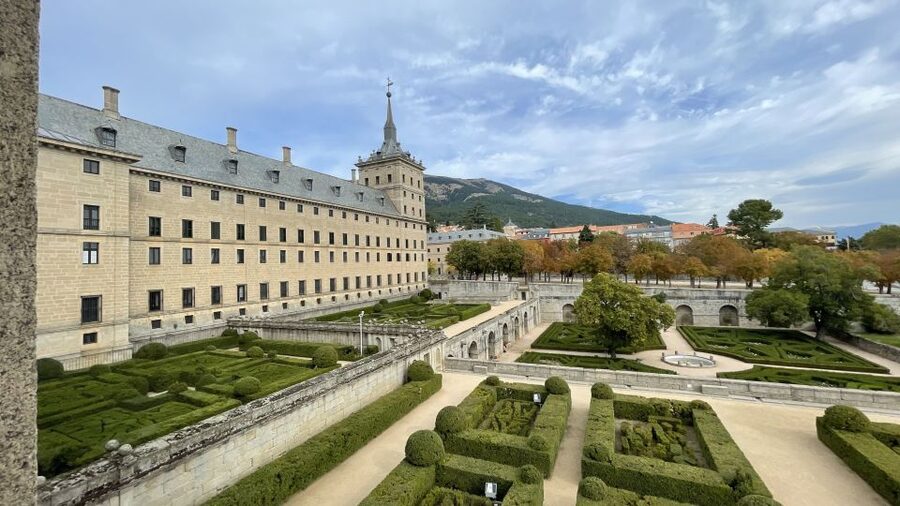
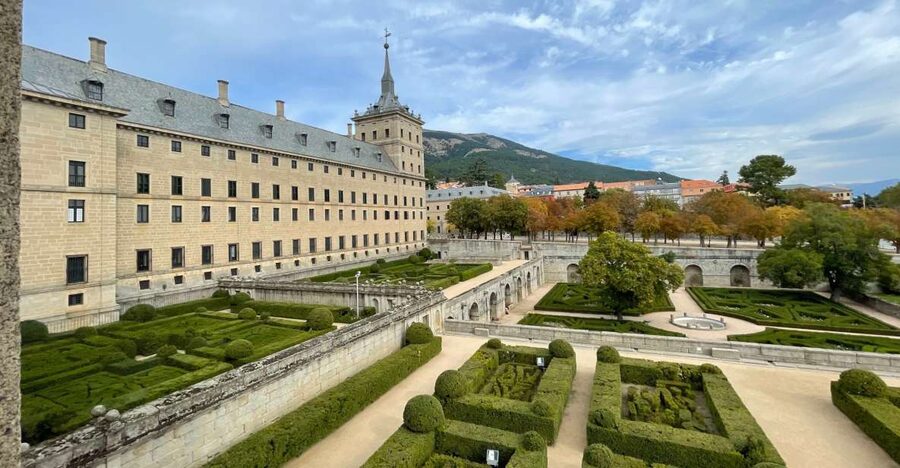
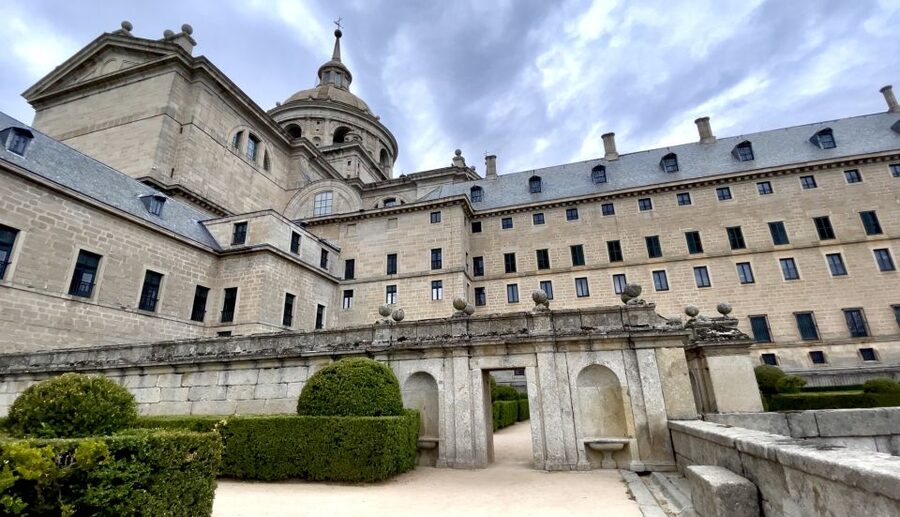
The monastery is also a royal residence, basilica, burial place, library, art collection, and religious foundation in one enormous complex. Its design expresses the ambitions of Felipe II and the culture of sixteenth-century Spain. This is the building that best brings together the era’s monarchy, Catholic faith, learning, and art.
Your route includes the Patio de Reyes, the cloister, the Chapter Rooms, the Pantheon of Kings and Infants, the Royal Rooms, and the basilica, except on Sundays. The exact order can vary, and access to individual areas can depend on the site’s operating conditions.
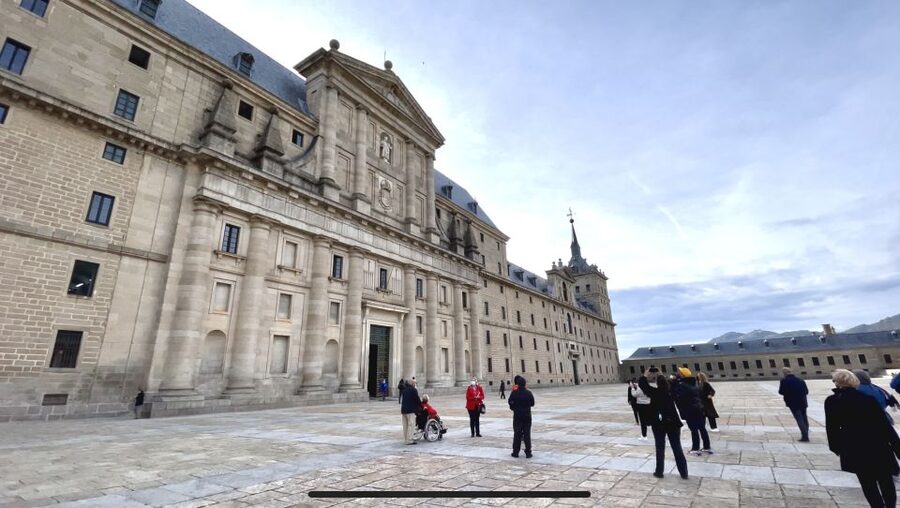
The Patio de Reyes gives you an immediate sense of scale. From there, the complex unfolds through formal courtyards and interior rooms rather than a single palace route. A guide is useful because the architecture can otherwise blur into one grand sequence of stone, columns, religious decoration, and corridors.
The Chapter Rooms and Royal Rooms show different sides of the building. One points toward the monastery’s religious and administrative life, while the other recalls the monarchy that commissioned and used the complex. The Royal Rooms are not simply rooms to admire for their furniture. They help explain how royal residence and religious retreat were combined here.
The Pantheon of Kings and Infants is one of the most important stops. The tombs make the royal connection physical, while the surrounding spaces remind you that El Escorial was not merely a palace designed for comfort. It was built to project an idea of Spain and its place in Europe.
The basilica is another major highlight, though Sunday visitors should be prepared for an exception. Since the tour information specifically notes that the basilica is excluded on Sundays, check the date carefully if that interior is a priority for you.
Art lovers will find plenty to appreciate. The paintings are a major attraction, and the guides regularly receive praise for explaining the artwork as part of the larger story. If you have studied Spanish art history, you may find the pace leaves less time for individual paintings than you would prefer. For most people, though, the advantage is getting a clear framework rather than trying to identify every canvas alone.
The library and gardens are also important parts of the complex. One visitor particularly valued the library, pantheons, and gardens, describing the whole place as more of a spiritual retreat than a conventional royal residence. That is a helpful way to approach El Escorial. It is grand, but not in the same manner as a pleasure palace built only for display.
The 15-minute ride to the Valley of the Fallen
After El Escorial, the coach takes about 15 minutes to the Valley of the Fallen, officially known in Spanish as Valle de los Caídos. The site is in the Peña de Cuelga Muros, amid the Sierra de Guadarrama setting.
The short transfer keeps the day moving. It also means you do not get a long break between the two visits. If you need a drink or snack, plan ahead because food and drinks are not included, and there is no dedicated meal stop in the five-hour schedule.
The valley visit lasts about one hour. That is enough for a guided introduction, the surrounding area, the basilica, and time to take in the monumental cross. It is not generous if you want to wander slowly, study every feature, and take many photographs.
That limitation is the clearest weakness of the outing. One guest wanted more time at this second monument, and another had to hurry back to the bus after trying to see more of the site. Keep an eye on your guide and return time. The coach cannot wait indefinitely, and the site is too large to explore casually during a short stop.
A different way to spend the day, same corner of Spain:
- Madrid: “Emociones” Live Flamenco Performance
★ 4.8 · 12,866 reviews - Madrid: Panoramic Route City Tour
★ 4.1 · 12,259 reviews - Madrid: Live Flamenco Show with Food and Drinks Options
★ 4.5 · 9,901 reviews - Avila & Segovia Tour with Tickets to Monuments from Madrid
★ 5.0 · 9,762 reviews
Inside the granite basilica
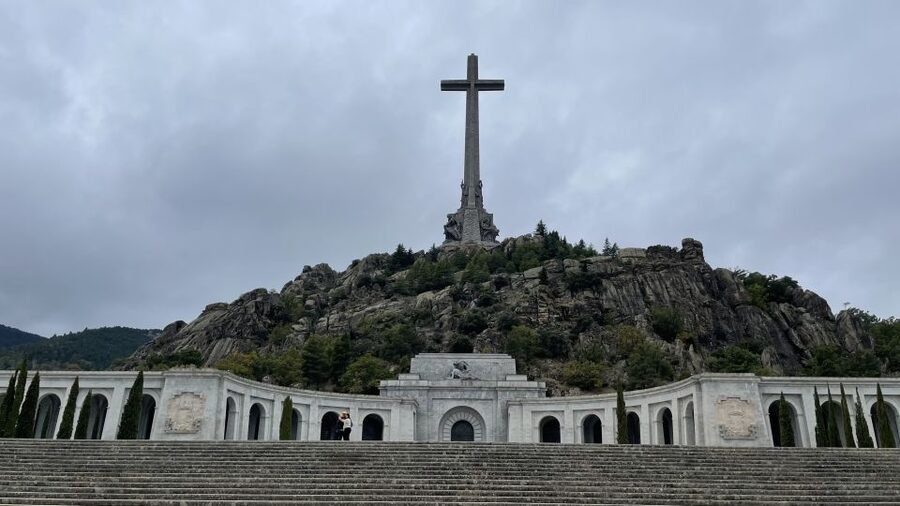
The Valley of the Fallen is visually unlike El Escorial. Instead of a royal complex spread through courtyards and rooms, you encounter a basilica carved into the rock. The scale of the granite interior and the great cross, visible from kilometers away, make this a powerful physical experience.
The site is also politically sensitive. The basilica became a burial place for 33,847 people who died in the Spanish Civil War, and its association with Franco’s dictatorship gives the monument a difficult legacy. The most useful guiding here is neither evasive nor theatrical. It should explain what the monument is, how it was created, and why it remains contested.
The guides are praised for handling this subject respectfully and without pushing a political line. That matters. You are not simply looking at a church in a mountain. You are confronting a monument tied to war, dictatorship, commemoration, and present-day democratic Spain.
Access to the basilica can occasionally be affected by events. One guide was able to get the group inside despite a wedding taking place, but you should understand that the schedule is subject to the practical conditions at the site. The visit still includes the surroundings and the monument’s historical explanation.
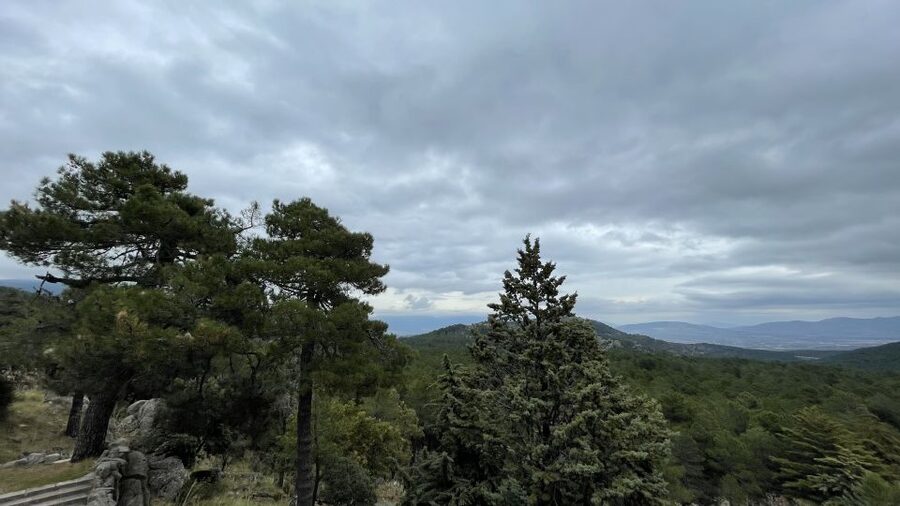
The cross is hard to miss. It is the visual signature of the valley, and its size becomes clearer as you approach. Allow yourself a moment to look back across the setting rather than focusing only on the entrance. The surrounding mountains add to the sense of isolation and scale, especially in clear weather.
What the guide adds to the experience
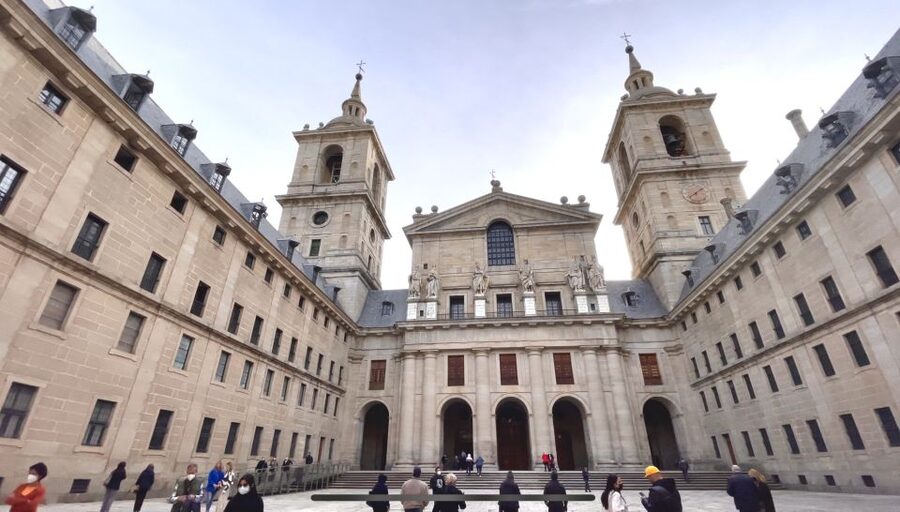
The best reason to choose this organized visit is the commentary. You can look at El Escorial’s stonework, royal tombs, paintings, and rooms on your own, but it is harder to grasp how they fit together without a guide.
The tour operates in Spanish and English, with a live guide and an audio system. Guides named in the feedback include Cristina, Beatriz, Sergio, Rafael, Oscar, Pilar, Maria, Gloria, Arantxa, and Mariasol. Individual guide assignments vary, so you should not book expecting one specific person, but the repeated praise for clear bilingual explanations is encouraging.
Cristina is especially noted for moving smoothly between Spanish and English, answering questions, and keeping the group together. Beatriz is praised for explaining monarchy and the Civil War monument clearly. Sergio is described as friendly and well informed, while Pilar handled a politically sensitive discussion with a calm, impartial approach.
The headset helps you hear while standing in large rooms or moving through a group. It also lets the guide keep speaking without everyone having to crowd around. A minor drawback is that one person encountered background noise in the sound system, so the equipment may not be perfect every time.
The pace appears to be one of the tour’s strongest features. You should expect a structured visit rather than a rushed march. There is time for photographs, a bathroom stop, and a little personal exploration, but not enough freedom to linger at every painting or corner.
Is $73 a good value from Madrid?
At $73 per person, the price is reasonable if you want to see both monuments in one outing. The cost includes round-trip air-conditioned transport, Wi-Fi on the bus, the live guide, headsets, and skip-the-line tickets for both El Escorial and the Valley of the Fallen.
The value improves if you do not have a car. Both sites are outside central Madrid, and arranging transport to each one would take planning. You also gain historical interpretation that is difficult to reproduce with a quick audio recording or a few signs.
The price is less attractive if you want a slow, independent visit. The fixed schedule controls your time, especially at the Valley of the Fallen. You also need to buy your own food and drinks, and the tour does not include a meal.
For a first visit to Madrid, I would see this as a strong half-day option rather than a full-day replacement for the city’s museums and historic neighborhoods. It gives you access to two major sites without consuming an entire day.
Who should book this half-day trip?
I recommend it most to anyone interested in Spanish monarchy, Catholic art, architecture, the Spanish Golden Age, or the Civil War. It also suits you if you want to get beyond central Madrid but do not want to rent a car.
Families with older children and teenagers can benefit from the clear historical narrative. One 17-year-old particularly enjoyed the explanation of Spanish history, which suggests the tour can work well for young people who prefer stories and buildings to a long museum visit.
Art lovers should book with realistic expectations. You will see beautiful paintings and important interiors, but the format does not allow a close study of every artwork. If El Escorial is your main reason for going, consider using your time carefully and listening for the guide’s recommendations on the most important rooms.
This is not a good choice for anyone with significant walking difficulties. Both locations involve steps and substantial movement, and the activity is specifically not suitable for wheelchair users or people with mobility impairments.
Free cancellation up to 24 hours before departure and the option to reserve now and pay later make the booking less rigid. Still, check the available start time and confirm whether your date is a Sunday if the basilica at El Escorial matters to you.
My verdict: book it if history matters more than free time
Book this tour if you want a clear, efficient introduction to two major sites that are difficult to combine independently. The strongest features are the comfortable coach, skip-the-line access, careful historical explanation, and the unusual pairing of Felipe II’s monastery with a Civil War monument.
Skip it if you dislike guided schedules or want hours to wander alone. The Valley of the Fallen, in particular, deserves more time than the one-hour visit can provide.
For most people spending several days in Madrid, I think this is a worthwhile half-day addition. You will see impressive architecture, royal tombs, paintings, a basilica cut from granite, and a huge cross, but the real value is the connection between them. This is a useful outing for understanding Spain beyond its famous city center.
FAQ
How long does the tour last?
The experience lasts about five hours. The schedule includes roughly 45 minutes by coach from Madrid, 105 minutes at El Escorial, 15 minutes to the Valley of the Fallen, one hour at the valley, and about 45 minutes back to Madrid.
Where does the tour begin and end?
The meeting point is outside the Commercial Gallery at San Bernardo Street 7 in Madrid. The coach returns to the same location.
What does the $73 price include?
The price includes round-trip transportation in an air-conditioned bus, bus Wi-Fi, a guide, headsets, and skip-the-line entry tickets for the Monastery of San Lorenzo de El Escorial and the Valley of the Fallen.
Are food and drinks included?
No. Food and drinks are not included, so plan accordingly for the five-hour outing.
Is the tour offered in English?
Yes. The live guide and audio guide are available in English and Spanish.
Can I visit the basilica at El Escorial on a Sunday?
The tour information states that the basilica is excluded on Sundays. If seeing that interior is important to you, choose another day when possible.
Is the tour suitable for wheelchair users?
No. The activity is not suitable for wheelchair users or people with mobility impairments. You should also expect many steps and substantial walking at both locations.
Recently reviewed around Madrid
- Tour Madrid: Secrets in a Electric Tuk Tuk★ 4.6 · 155 reviews
- Madrid: Don Quixote de la Mancha Windmills & Toledo Tour★ 4.9 · 254 reviews
- Tour Guiado En Tuk Tuk Recorre Avila De La Forma Mas Comoda★ 4.4 · 235 reviews
- Madrid: Guided Tour of Toledo with Cathedral Visit★ 4.3 · 399 reviews
- Madrid: Toledo Day Trip with Winery Visit and Wine Tasting★ 4.4 · 177 reviews
- Madrid: 6-Hour Day Trip to Toledo with Guided Walking Tour★ 4.0 · 865 reviews
- Madrid: Tasty Tapas Tour & Visit to a Terrace with Views★ 4.5 · 118 reviews
- Madrid: Flamenco Show&Drink at Tablao 1911 (World’s Oldest)★ 4.7 · 253 reviews
Madrid Tours, compared.


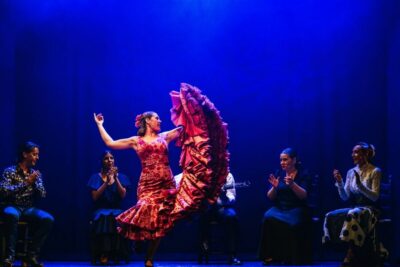
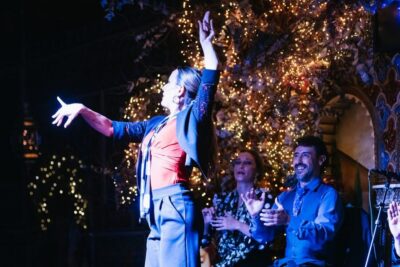
Live Flamenco Show with Food and Drinks Options
Read our review →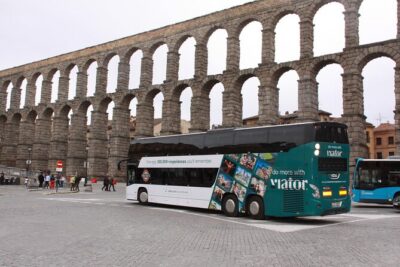
Avila & Segovia Tour with Tickets to Monuments from Madrid
Read our review →
Three Cities in One Day: Segovia, Avila and Toledo from Madrid
Read our review →
Royal Palace Expert Guided Tour with Skip-the-Line
Read our review →Browse the lists this tour appears in