

Reviewed · MUSEUMS
Figueres: Dalí Theatre-Museum Entry Ticket
Dalí’s Theatre-Museum is not simply a building filled with paintings. The building itself is part of the artwork, covered in giant eggs, golden figures, and theatrical details that prepare you for the strange, playful experience inside. You move through optical illusions, sculptures, installations, and rooms that feel more like a dream than a standard museum.
I like the sheer range of work here, from Dalí’s famous surrealist pieces to his lesser-known jewelry designs. I also like that you can visit Dalí’s final resting place beneath the museum’s geodesic dome. The main drawback is crowding, especially when new timed groups enter every 15 minutes, and the lack of an included audio guide means you need to bring your own context.
In This Review
- Key points to know before you go
- Why the Figueres museum feels like a Dalí artwork
- Inside the largest collection of Dalí’s work
- Optical illusions and 3D installations
- Dalí’s final resting place beneath the dome
- The jewelry collection many visitors miss
- Rotating exhibitions and changing perspectives
- How long you need for the visit
- Price, access, and what the ticket covers
- Bags, timing, and small details that matter
- Who will enjoy this museum most
- Should you book the Dalí Theatre-Museum?
- FAQ
- Where is the Dalí Theatre-Museum located?
- How long is the ticket valid?
- Is the museum visit guided?
- Does the ticket include transportation?
- Can I bring food or drinks inside?
- Are large bags and umbrellas allowed?
- Is the museum wheelchair accessible?
Key points to know before you go
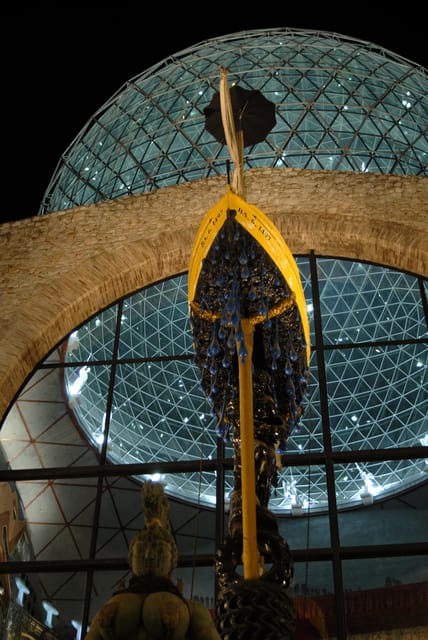
- Dalí designed the full experience: The eggs, golden statues, dome, rooms, and displays all form part of the museum visit.
- Expect more than paintings: Sculptures, optical tricks, 3D installations, jewelry, and rotating displays keep the visit varied.
- Plan at least two hours: The collection is large, and a quick pass will miss much of the museum’s oddball charm.
- Book your time carefully: Entry is valid only on the stated date and time, and late arrival can mean losing your reservation.
- Leave large items behind: Bags, umbrellas, luggage, pushchairs, and objects larger than 35 x 35 x 25 centimeters may not be allowed inside.
- This is a self-guided visit: A guide is not included, so you set your own pace and make your own way to the museum.
Why the Figueres museum feels like a Dalí artwork
Salvador Dalí’s hometown museum works best when you stop expecting a normal art gallery. You are not walking into a quiet sequence of white rooms with labels and framed canvases. You are entering a theatrical setting that Dalí helped shape around his own work.
The exterior gives you the first clue. Giant eggs and gold-colored statues turn the museum into a surreal landmark before you have even reached the entrance. The building has a playful, slightly eccentric look, and that matters because Dalí wanted the visit to feel like an event, not just a lesson in art history.
Inside, the layout encourages exploration rather than a strict march from one room to the next. You might move from a painting to a sculptural display, then into an optical illusion or a 3D installation. The effect is deliberately unpredictable. I like this approach because it makes the museum accessible even if you do not know much about surrealism.
It can also be confusing. The labyrinthine layout does not always make it obvious which room comes next. If you like a clear, numbered route, you may find the flow frustrating when the museum is crowded. Go with the idea that you are exploring Dalí’s imagination, not following a perfectly ordered textbook.
More Girona & Costa Brava museums and collections:
- Girona: Cathedral of Girona + Art Museum + St. Felix Church
★ 4.6 · 158 reviews - Girona: Jewish Heritage Guided City Tour and Museum Visit
★ 4.8 · 124 reviews - Madrid: Prado Museum Entry Ticket
★ 4.6 · 17,509 reviews
Inside the largest collection of Dalí’s work
The museum is known for holding the largest collection of Dalí’s works, and the variety is one of its strongest points. You will find paintings, sculptures, installations, and other forms of visual experimentation rather than a single narrow period of his career.
That variety helps you see Dalí as more than the painter of melting clocks. The displays show his interest in illusion, unusual materials, theatrical presentation, and visual jokes. Some pieces invite careful study, while others work through surprise. You may find yourself looking twice at an object because the first impression does not tell the whole story.
The collection also gives you a sense of Dalí’s versatility. His work can be precise and technically polished one moment, then strange and comic the next. The museum is at its best when you let those contrasts sit side by side.
Do not rush past the installations. A painting may reward a few minutes of close attention, but a three-dimensional work often needs to be viewed from different angles. Optical illusions are especially easy to miss if you follow the crowd and move on too quickly.
Because the visit is self-guided, you control the pace. That is useful if one room catches your attention. It is less useful if you want a clear explanation of every work. An audio guide is not included, and adding one would make the museum easier to understand for visitors who want background on Dalí’s life, ideas, and techniques.
Optical illusions and 3D installations
Dalí liked to make viewers question what they were seeing, and this museum gives that interest plenty of room. Optical illusions and 3D installations make the collection active rather than purely observational.
You may need to stand in a particular place, change your angle, or look beyond the obvious image. Some pieces ask you to notice how separate objects combine into a larger picture. Others rely on scale, perspective, or a playful visual trick.
I like these works because they give you something to do. You are not only standing in front of art and reading a label. You are testing your own eyesight and trying to work out how the piece operates.
The tradeoff is that these displays can slow the visit. When the museum is busy, people gather around the same visual effect, making it harder to see comfortably. An early time slot is the sensible choice if you want more breathing room.
Dalí’s final resting place beneath the dome
One of the museum’s most unusual details is also one of its most personal. Dalí’s final resting place is beneath the iconic geodesic dome, linking the artist directly with the building he helped create.
The dome is one of the museum’s defining features, visible from outside and important to the interior experience. Its geometric structure contrasts with the playful and irregular details elsewhere in the building. That contrast captures much of Dalí’s appeal: careful design paired with bizarre ideas.
This part of the visit is quieter in mood than the more theatrical displays. It gives you a moment to think about the museum as Dalí’s chosen final setting, rather than simply a collection of objects connected to his career.
I would not plan the entire visit around this one point, but it adds meaning to the building. You are seeing not only where Dalí’s works are displayed, but also the place where he wanted to remain.
More Girona & Costa Brava trips worth a second look
- Barcelona: Sagrada Familia Entry Ticket with Audio Guide
★ 4.6 · 105,312 reviews - Barcelona: Park Güell Admission Ticket
★ 4.4 · 76,534 reviews - Seville: Royal Alcázar Entry Ticket
★ 4.6 · 28,378 reviews - Seville: Cathedral and La Giralda Entry Ticket
★ 4.5 · 24,592 reviews
The jewelry collection many visitors miss
The dedicated jewelry section is a worthwhile reason to slow down. Dalí’s jewelry is less familiar to many people than his paintings and sculptures, yet it shows the same interest in imagination, symbols, and careful craftsmanship.
These pieces offer a useful change of scale. Large installations and bold sculptures can dominate your attention, while jewelry asks you to look closely. Details that might be lost in a huge room become the main event.
I like this section because it broadens your view of Dalí’s talents. You see how his visual ideas could move from canvas and sculpture into objects designed to be worn and examined up close.
If you are visiting with children, the jewelry may hold their attention for a different reason than the paintings. The unusual forms are easy to notice, and the smaller displays create a pause after the larger, more theatrical rooms.
Rotating exhibitions and changing perspectives
The museum also includes rotating exhibitions featuring Dalí and other artists. This means the exact experience can change over time, even for someone returning to Figueres.
A rotating section can add useful context by placing Dalí’s work beside different themes or artists. It may also offer a fresh look at a familiar part of his career. I would treat this area as a bonus rather than a reason to expect a fixed program, since the content can change.
The changing displays are another reason not to rush through the museum. Even if you mainly want to see the permanent collection, the temporary material may help you connect Dalí’s work to a wider artistic setting.
How long you need for the visit
The ticket is valid for one day, but that does not mean you should treat the museum as a quick stop. A visit of two hours or more gives you time to take in the building, major works, optical displays, jewelry, and the dome.
You could move through faster, but the museum’s details reward patience. A short visit may cover the headline pieces while missing the playful objects and smaller rooms that give the museum its character.
I would allow extra time if Dalí has been on your must-see list for years. The range of work can easily hold your attention longer than expected. At the same time, you should not feel obligated to inspect every piece equally. Choose a comfortable pace and pause when something catches your eye.
Crowding can affect the timing. New ticket groups are admitted at quarter-hour intervals, so the museum may feel more packed after several groups arrive. An earlier entry time is a practical choice, especially if you want to spend time with the optical illusions without standing shoulder to shoulder.
Price, access, and what the ticket covers
At $27 per person, this is not a throwaway museum ticket, but the price includes access to a large collection rather than a single exhibition room. You also get the unusual building, interactive displays, jewelry section, rotating exhibitions, and the final resting place beneath the dome.
For a Dalí enthusiast, the value is strong because the museum brings so many parts of his career together in one place. You are not paying only to see a few famous paintings. You are paying for a full artistic environment.
The value is less clear if you prefer traditional museums with detailed interpretation and a quiet, orderly route. This ticket does not include a guided tour, transportation, food, or drinks. You will need to arrange your own way to the Dalí Theatre-Museum and make your own discoveries inside.
The museum is wheelchair accessible. Children under 12 must be accompanied by an adult. Food and drinks, smoking, pets other than assistance dogs, and flash photography are not allowed.
Bags, timing, and small details that matter
Take the timed entry seriously. You may visit only on the date and time printed on your reservation. If you miss that slot, the booking can be canceled, and entry may depend on availability at the moment.
Security staff search handbags and backpacks at the entrance. Knives, penknives, and other objects considered potentially dangerous may be held until the end of your visit.
Large items are another concern. Objects larger than 35 x 35 x 25 centimeters, along with rucksacks, bags, umbrellas, luggage, pushchairs, or anything staff consider a security risk, may not enter the museum. The consignment office is intended for bags, umbrellas, luggage, and other large items, but do not use it for valuables, money, jewelry, dangerous objects, or living beings.
The simplest plan is to arrive with only what you need. A small day bag is more convenient than a full sightseeing pack, and you will spend less time sorting out belongings at the entrance.
Who will enjoy this museum most
This experience suits you best if you like art that plays with perception. You do not need to be an expert on Dalí, but you should enjoy odd shapes, visual jokes, unexpected combinations, and rooms that do not behave like standard gallery spaces.
It is also a good choice for:
- First-time Dalí visitors who want a broad introduction
- Art fans interested in paintings, sculpture, installations, and jewelry
- Families with older children who enjoy optical illusions
- Visitors already in Figueres who want a major cultural stop
- People who prefer setting their own pace instead of joining a fixed tour
You may want to think twice if you need a quiet museum, a detailed guide in the ticket price, or a perfectly clear sequence of rooms. The building is part of the attraction, but its theatrical design and crowded layout can make the visit feel busy.
Should you book the Dalí Theatre-Museum?
You should book if Dalí is a major reason for visiting Figueres or if you want an art museum that feels unlike a standard gallery. The combination of the building, large collection, optical illusions, jewelry, rotating exhibitions, and dome makes this more than a routine museum admission.
Choose the earliest practical time if you dislike crowds. Give yourself at least two hours, keep your bags small, and remember that there is no guide or transport included. If you want every work explained, you may miss that extra layer of context, but the freedom to explore at your own pace is part of the appeal.
For most art lovers, the ticket earns its place in a Catalonia itinerary. For casual visitors, the decision comes down to your taste: if Dalí’s strange, theatrical imagination sounds fun, book it. If you prefer calm galleries and conventional displays, this may feel like too much spectacle.
FAQ
Where is the Dalí Theatre-Museum located?
The museum is in Figueres, Catalonia, Spain. Go directly to the Dalí Theatre and Museum for entry.
How long is the ticket valid?
The ticket is valid for one day, but entry is tied to the stated date and time on your reservation.
Is the museum visit guided?
No. A guided tour is not included, so you explore the museum independently.
Does the ticket include transportation?
No. Transportation is not included. You must make your own way to the Dalí Theatre and Museum.
Can I bring food or drinks inside?
No. Food and drinks are not allowed inside the museum.
Are large bags and umbrellas allowed?
Large bags, rucksacks, luggage, umbrellas, pushchairs, and objects larger than 35 x 35 x 25 centimeters may not be allowed inside. These items may need to be left at the consignment office, subject to the museum’s security rules.
Is the museum wheelchair accessible?
Yes. The Dalí Theatre-Museum is wheelchair accessible.
Recently reviewed around Girona & Costa Brava
- Catamaran ride -Costa Brava with barbecue and drinks. Familiar.★ 4.5 · 278 reviews
- Game Of Thrones Walking Tour in Girona★ 5.0 · 406 reviews
- Medieval Three Villages Small Group Day Trip from Barcelona★ 5.0 · 994 reviews
- Girona History and Legends Tour Small Group from Girona★ 5.0 · 299 reviews
- Catalonia Hot Air Balloon Ride and Breakfast over the Volcanoes of la Garrotxa★ 5.0 · 132 reviews
- Tossa de Mar Scuba Diving PADI★ 5.0 · 175 reviews
- Explore Cap Norfeu and the Secret Cave: An Underwater World★ 4.5 · 118 reviews
- Girona History, Legends, and Food Walking Tour with food tasting★ 5.0 · 195 reviews
Museums, compared.

FC Barcelona Museum “Barça Immersive Tour” Ticket
Read our review →
Park Güell and Gaudí House Museum Entry Ticket
Read our review →
Puro Flamenco Show with Optional Museum Ticket
Read our review →

Girona & Dali Museum Small Group Tour with Pick-up from Barcelona
Read our review →
Oceanogràfic, Hemisfèric & Science Museum Combo
Read our review →Browse the lists this tour appears in