
Reviewed · CITY TOURS
City Sightseeing Barcelona Hop-On Hop-Off Bus Tour: 24 or 48-Hour
Barcelona’s Bus Turistic gives you a quick read on a city that spreads from the Gothic Quarter to the hills of Montjuïc and Tibidabo. From the open upper deck, you can spot Gaudí’s fanciful façades, the Sagrada Familia, Olympic sites, beaches, and broad avenues without wrestling with the subway map.
I especially like the freedom to hop off at any stop and the chance to ride both routes on one pass. The 360-degree views are excellent for photos and for deciding which sights deserve more of your time. The catch is traffic. A loop advertised at about two hours can take much longer, especially on the Red Route.
In This Review
- Key points to know
- What the Barcelona Bus Turistic actually feels like
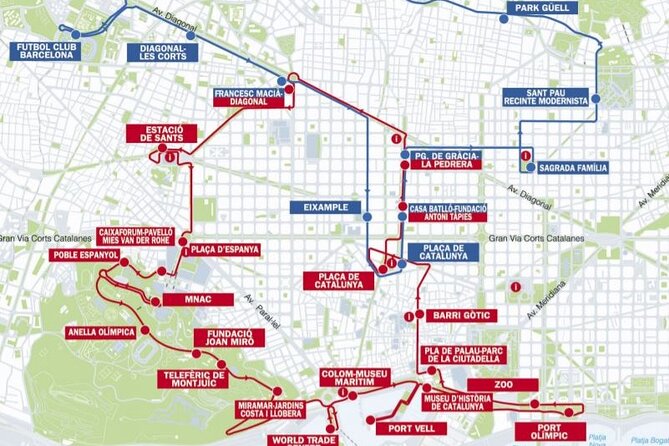
- Red Route: Montjuïc, the waterfront, and the Sagrada Familia
- Plaça de Catalunya and Passeig de Gràcia
- Eixample and Sants
- CaixaForum, Poble Espanyol, and the National Art Museum
- The Olympic Ring and Joan Miró Foundation
- Miramar, the port, and La Rambla
- Port Olímpic, the beaches, and the Forum
- Poblenou, Glòries, and Sagrada Familia
- Blue Route: Park Güell, Tibidabo, and Pedralbes
- Casa Batlló and La Pedrera
- Sant Pau Recinte Modernista
- Park Güell
- Tibidabo, Sarrià, and Pedralbes
- Camp Nou and Diagonal
- How to use 24 or 48 hours wisely
- Weather, comfort, and small practical snags
- Price and who gets good value
- Booking, cancellation, and accessibility notes
- Should you book the Barcelona Bus Turistic?
- FAQ
- How long is the Barcelona hop-on hop-off tour?
- Does the ticket include both Barcelona bus routes?
- How often do the buses run?
- What time does the first bus leave?
- What time is the last bus?
- Are attraction admission tickets included?
- Can I cancel for a full refund?
Key points to know
- Two routes cover different sides of Barcelona: The Red Route handles Montjuïc, the waterfront, beaches, Sagrada Familia, and Glòries, while the Blue Route reaches Park Güell, Tibidabo, Pedralbes, and Camp Nou.
- The open upper deck is best for seeing the city: It gives you clear views for photos, but wind, rain, and cold can make the ride uncomfortable.
- A full loop takes patience: The stated tour duration is about 120 minutes, but traffic has stretched the Red Route to roughly two and a half hours.
- You get audio commentary, not a live city guide: Commentary is available in 16 languages, with headphones supplied, plus onboard Wi-Fi.
- The pass works best with a plan: Use the first ride to get your bearings, then spend the rest of your 24 or 48 hours hopping off at two or three places that interest you most.
What the Barcelona Bus Turistic actually feels like

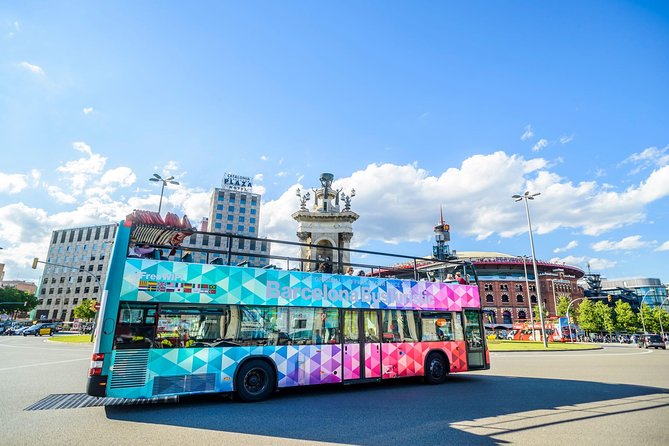
This is a transport-and-sightseeing service rather than a traditional guided tour. You board a pink-and-blue Bus Turistic, take an open-air seat if the weather is kind, plug in your headphones, and watch Barcelona roll past.
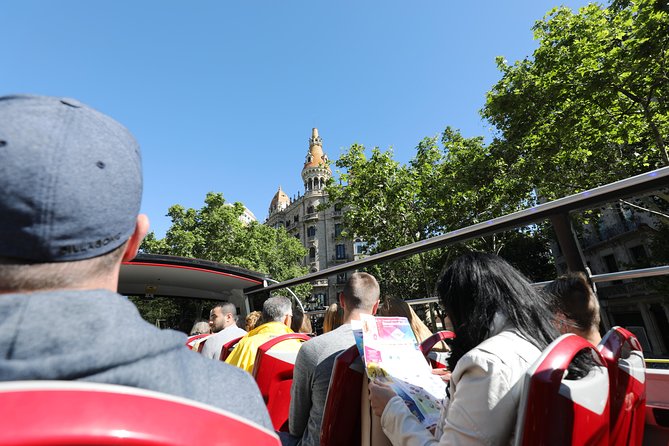
The upper deck is the main reason to choose this over the subway. You can look up at ornate balconies, see the outline of Montjuïc, photograph church towers, and follow the changing character of the city. The lower deck offers shelter, but dirty windows have sometimes made photography difficult.
The recorded commentary gives you basic context as you pass each landmark. It is available in 16 languages, including English, and the headphone system lets you select your language. Some passengers find the narration useful and well organized, while others find it thinner than they expected. You will not have a live guide pointing out every upcoming stop.
That matters when you are trying to decide where to get off. Keep the route map handy and check the stop names before boarding. Plaça de Catalunya can be confusing at first because more than one sightseeing operator uses the square, and buses for different routes may wait on different sides.
More City Tours in Barcelona
- Barcelona: City Sightseeing Hop-On Hop-Off Bus Tour
★ 4.4 · 10,061 reviews - Barcelona City Tour Hop-On Hop-Off with Optional Boat
★ 4.0 · 3,012 reviews - Barcelona: Private City Tour by Eco Tuk Tuk
★ 4.9 · 1,339 reviews
Red Route: Montjuïc, the waterfront, and the Sagrada Familia
The Red Route is the broad city circuit, with 24 stops. It is the better first ride if you want a general introduction to Barcelona and its major zones.
Plaça de Catalunya and Passeig de Gràcia
Start at Plaça de Catalunya, Barcelona’s central meeting point. From here, the bus heads along Passeig de Gràcia, one of the city’s grandest avenues.
Get off at Casa Batlló and the Fundació Antoni Tàpies if you want Gaudí architecture and modern art close together. Casa Batlló’s roof and bone-like façade are easy to appreciate from the bus, but the interior requires a separate ticket.
The nearby Passeig de Gràcia stop also puts you close to La Pedrera, officially Casa Milà. This is one of the most useful stops for comparing Gaudí’s work, though you should allow extra time if you plan to enter either building.
Eixample and Sants
The Eixample stops show Barcelona’s carefully planned grid, with broad streets and clipped corners. From the bus, you get a good sense of how different this district is from the tight medieval lanes downtown.
A stop near Avinguda de Roma leads toward Estació de Sants, Barcelona’s main railway station. This is not a major sightseeing stop by itself, but it can be useful if you are connecting with trains or staying near the station.
The circuit then reaches Plaça d’Espanya, one of the city’s most impressive traffic circles. It is a practical base for Montjuïc, the Fira Barcelona exhibition grounds, and the museums higher on the hill.
More Barcelona trips worth a second look
- Flamenco Show Ticket at Theatre Barcelona City Hall
★ 4.5 · 1,264 reviews - Barcelona: City Walking Tour with Local Guide
★ 4.9 · 980 reviews - Barcelona: Sagrada Familia or Coastal City Sights by eBike
★ 4.8 · 812 reviews - Barcelona: City Highlights Guided Segway Tour
★ 4.9 · 624 reviews
CaixaForum, Poble Espanyol, and the National Art Museum
At CaixaForum and the Mies van der Rohe Pavilion, you can see two very different kinds of 20th-century design. CaixaForum occupies a former textile factory, while the pavilion is a spare modernist landmark known for its clean lines and open plan.
Poble Espanyol is a purpose-built village showing regional Spanish architecture, crafts, shops, and restaurants. It is touristy by design, but it can work well if you want a compact cultural stop without crossing the whole country.
Higher on Montjuïc, the Museu Nacional d’Art de Catalunya occupies the Palau Nacional. The building itself is a reason to stop, and the steps in front offer sweeping views back toward Plaça d’Espanya and the city.
The Olympic Ring and Joan Miró Foundation
The Anella Olímpica, or Olympic Ring, recalls the 1992 Summer Olympics. The bus gives you an easy look at the stadium area and Montjuïc’s broad civic spaces.
The Fundació Joan Miró is one of the route’s strongest museum stops. It presents the work of Joan Miró in a building designed with the art in mind, and it is a good choice if you want something beyond Gaudí.
The cable car stop is useful if you want to ride the Telefèric de Montjuïc. The cable car is not included in the bus pass, and admission to attractions generally is not included, so check your budget before hopping off.
Miramar, the port, and La Rambla
Miramar and the Jardins de Costa i Llobera offer a quieter side of Montjuïc, with gardens and views toward the port. The World Trade Center stop then brings you down toward the waterfront.
At Colom, the bus reaches the lower end of La Rambla. This is a good place to continue on foot toward the Gothic Quarter, markets, and central streets. La Rambla can be crowded, so keep your belongings close and do not expect the bus to be faster than walking for every short journey.
The nearby Museu d’Història de Catalunya sits by the old harbor. It provides historical context for Catalonia and works well with a stroll through the port area.
Port Olímpic, the beaches, and the Forum
The Port Olímpic and beach stops show Barcelona’s modern waterfront. The city’s Olympic redevelopment reshaped this area, and from the bus you can see the change from working harbor to public waterfront.
Port Olímpic is a natural place to hop off for a walk. Bogatell Beach and Nova Mar Bella Beach offer a less central shoreline experience than the area near Barceloneta, though your enjoyment will depend on weather and time of year.
The route continues to the Forum and Parc Diagonal Mar. These stops are farther from the historic center and are less essential on a short visit, but they help you see how Barcelona extends eastward beyond the classic sights.
Poblenou, Glòries, and Sagrada Familia
Poblenou mixes older industrial traces with newer development. It is worth choosing if you have a second day and want to see a district that feels less focused on the standard sightseeing circuit.
At Plaça de les Glòries, you can see Torre Glòries, the bullet-shaped tower designed by Jean Nouvel. The area also offers access to newer cultural and design spaces, though the stop is mainly useful as a link between the waterfront and Sagrada Familia.
The Sagrada Familia stop is one of the busiest and most useful on the entire network. Antoni Gaudí’s unfinished basilica is extraordinary from the outside, but you need a separate entry ticket to see the interior. If you have a timed admission, allow plenty of margin because traffic can delay the bus.
The Red Route finishes near Arc de Triomf and the North Bus Station before returning to Plaça de Catalunya. Arc de Triomf is convenient for the old city, Ciutadella Park, and the El Born district.
Blue Route: Park Güell, Tibidabo, and Pedralbes

The Blue Route has 14 stops and covers a different slice of Barcelona. It is less useful as a single sightseeing loop for a first-time orientation, but it reaches several attractions that the Red Route does not.
Casa Batlló and La Pedrera
The Blue Route begins at Plaça de Catalunya and repeats the Casa Batlló area. It then heads toward La Pedrera on Passeig de Gràcia.
If you are using a 48-hour pass, this repeated central section makes it easy to connect the two routes. You can ride one route in the morning and switch to the other without buying another ticket.
Sant Pau Recinte Modernista
The Sant Pau stop serves the former Hospital de Sant Pau, a major modernist complex designed by Lluís Domènech i Montaner. Its tiled halls, gardens, and elaborate façades make it a fine partner to Gaudí’s work.
This is one of the best stops for architecture without the intense crowds around Sagrada Familia. You still need a separate admission ticket to enter the complex.
Park Güell
The Park Güell stop is a major reason to take the Blue Route. Gaudí’s park combines colorful ceramic work, curved forms, gardens, and city views.
The bus gets you near the attraction, but it does not include admission. If you have a reserved entry time, check the walking distance from the stop and build in time for the uphill approach. Park Güell is not a casual five-minute stop if you plan to explore properly.
Tibidabo, Sarrià, and Pedralbes
The Tibidabo stop connects with the Tramvia Blau and the route toward Tibidabo. The tram and mountain attractions are separate experiences, so treat this as a transport connection rather than an included part of the bus tour.
Sarrià gives you a look at a more residential district, while the Monestir de Pedralbes offers a peaceful medieval monastery setting. These stops suit a slower second day more than a rushed one-day itinerary.
At Palau Reial and the Pavellons Güell, you can explore another Gaudí-related area. The pavellons are known for their ornamental details and distinctive gate, and the stop also serves the broad grounds around the Royal Palace area.
Camp Nou and Diagonal
The Futbol Club Barcelona stop is the one to choose if you want to visit Camp Nou or focus on the club’s football heritage. Entry arrangements and access can change, and admission is not part of the bus ticket.
The Diagonal and Les Corts stops show Barcelona’s modern commercial side. Francesc Macià and the final Eixample stops are useful for connecting with the city’s main grid, but they are less compelling if your time is limited.
Sant Antoni, near the end of the Blue Route, is handy for reaching a market district and the surrounding streets. From there, you can make your own way back toward the center or reconnect with another stop.
How to use 24 or 48 hours wisely
The 24-hour pass is enough if you want an overview plus a few carefully chosen stops. I would ride one complete route early, then get off at two attractions that match your interests. Trying to enter every landmark along the way will leave you waiting for buses and watching the clock.
The 48-hour pass makes more sense if you want both routes and several longer visits. You can use the first day to ride the Red and Blue circuits, then use the second day for Sagrada Familia, Park Güell, Montjuïc museums, the beach, or Camp Nou.
Buses are scheduled to run about every 20 minutes, and service begins at Stop 1 at 9 a.m. The stated final departure from Stop 1 is 7 p.m. However, service reports have not always matched that simple timetable, so do not plan your final connection around the last possible bus.
A second practical point: the 120-minute duration is an estimate, not a guarantee. Barcelona’s traffic lights, tour buses, pedestrians, and narrow streets all slow the service. One full Red Route ride has taken about two and a half hours, and a short trip can sometimes be quicker on foot.
Weather, comfort, and small practical snags

The upper deck is open at the sides, even when part of it is covered. In rain and wind, you can get cold and wet quickly. Bring a jacket, and do not assume the roof will protect you from bad weather.
On sunny days, the upper deck is the clear winner. You get better photographs and a much stronger sense of the city’s size. On chilly evenings, wear warm layers because the wind chill is real.
The buses are generally clean, though window cleanliness can vary. If photography matters to you, sit in an open section rather than behind a window whenever possible.
Keep your ticket safe. A lost ticket may require you to buy another one. Mobile and printed paper vouchers are accepted, and the voucher can be redeemed at any stop along the routes.
The included coupon booklet offers more than 200 euros in stated discounts at Barcelona attractions. That sounds generous, but the real value depends on which attractions you plan to visit and whether the discounts apply to your chosen admission. Treat it as a bonus rather than the main reason to buy.
Price and who gets good value
At about $39.54 per person, the 24-hour option is reasonable if you use it for sightseeing rather than simple transport. Barcelona has a strong public transport system, so the bus is not the cheapest way to move from one neighborhood to another.
You are paying for open views, direct access to major sights, recorded commentary, Wi-Fi, and the freedom to ride both routes. If you complete a loop and visit two or three attractions, the price can feel fair. If you board once, sit in traffic, and get off after an hour, the value drops sharply.
The pass suits first-time visitors, families who want an easy overview, and anyone with only one full day. It also helps if walking long distances or changing subway lines is difficult.
I would skip it if you already know Barcelona well, prefer walking, or need fast point-to-point transport. The bus is designed for orientation and sightseeing, not speed.
Booking, cancellation, and accessibility notes
Confirmation arrives at booking, and the tour operates all year except January 1 and December 25. The service is offered in English through the audio system, with commentary available in 16 languages.
The supplied earphones may not work for every hearing aid style. If you use CIC or ITE hearing aids, contact the operator before booking to confirm whether suitable headphones are available on your route. The information supplied for this tour does not promise alternate headphone styles, so do not assume they will be provided.
Free cancellation is available when you cancel at least 24 hours before the local start time. Within 24 hours, changes and refunds are not accepted.
Should you book the Barcelona Bus Turistic?

Book it if you want a broad first look at Barcelona, good photo angles, and the freedom to choose your stops. I would choose the 48-hour pass if your schedule allows it, since the city’s attractions are spread widely and traffic makes a single day feel tight.
For a one-day visit, ride the Red Route first, then choose Sagrada Familia, Montjuïc, La Rambla, or the waterfront. Add the Blue Route only if Park Güell, Sant Pau, Pedralbes, Tibidabo, or Camp Nou is high on your list.
Go early, confirm the exact stop location, keep a jacket nearby, and allow extra time for traffic. Used that way, the bus is a useful sightseeing tool. Used as a fast shuttle, it can test your patience.
FAQ
How long is the Barcelona hop-on hop-off tour?
The stated tour duration is about 120 minutes. A full route can take longer in traffic, and the Red Route has taken roughly two and a half hours.
Does the ticket include both Barcelona bus routes?
Yes. Your 24 or 48-hour pass includes access to both the Red and Blue Routes.
How often do the buses run?
The stated frequency is about every 20 minutes. High-season information also says buses may run as often as every five minutes, so actual intervals can vary.
What time does the first bus leave?
The first bus departs from Stop 1 at Plaça de Catalunya at 9 a.m.
What time is the last bus?
The stated last departure from Stop 1 is 7 p.m. Because service times can vary, avoid relying on the final departure for an important connection.
Are attraction admission tickets included?
No. Entry to attractions, food, and drinks are not included. The pass does include a coupon booklet with stated discounts at selected Barcelona attractions.
Can I cancel for a full refund?
Yes, if you cancel at least 24 hours before the experience start time. Cancellations or changes made within 24 hours are not refunded.
Recently reviewed around Barcelona
- Excursion Aigüestortes – Estany Llebreta (1/2 day)★ 5.0 · 138 reviews
- E-Bike tour in Barcelona with English Guide★ 5.0 · 128 reviews
- Wine Tasting Experience in Barcelona★ 5.0 · 172 reviews
- Barcelona Luxury Yacht Cruise – Day or Sunset, Open Bar & Snacks★ 5.0 · 154 reviews
- Montserrat: Cog-Wheel, Basilica, Black Madonna & Licor Tasting★ 4.5 · 886 reviews
- Barcelona Wax Museum Admission Ticket★ 4.5 · 237 reviews
- Barcelona: Wine Tasting and 5 Course Tapas Pairing Dinner★ 4.5 · 129 reviews
- Andorra Original History and Sightseeing Tour (Private, Pickup)★ 5.0 · 350 reviews
City Tours, compared.

Granada City Train 1 or 2-Day Hop-On Hop-Off Ticket
Read our review →
Barcelona City Tour Hop-On Hop-Off with Optional Boat
Read our review →

Browse the lists this tour appears in